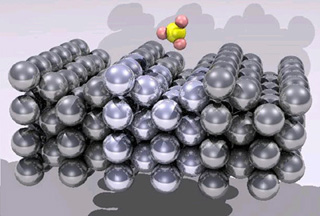
Course3.32019 lectures
Atomistic Computer Modeling of Materials (SMA 5107)
Prof. Gerbrand Ceder and Prof. Nicola Marzari · Massachusetts Institute of Technology
About
This course uses the theory and application of atomistic computer simulations to model, understand, and predict the properties of real materials. Specific topics include: energy models from classical potentials to first-principles approaches; density functional theory and the total-energy pseudopotential method; errors and accuracy of quantitative predictions: thermodynamic ensembles, Monte Carlo sampling and molecular dynamics simulations; free energy and phase transitions; fluctuations and transport properties; and coarse-graining approaches and mesoscale models. The course employs case studies from industrial applications of advanced materials to nanotechnology. Several laboratories will give students direct experience with simulations of classical force fields, electronic-structure approaches, molecular dynamics, and Monte Carlo.
This course was also taught as part of the Singapore-MIT Alliance (SMA) programme as course number SMA 5107 (Atomistic Computer Modeling of Materials).
Acknowledgements
Support for this course has come from the National Science Foundation’s Division of Materials Research (grant DMR-0304019) and from the Singapore-MIT Alliance.
Lectures
Video Lectures
- Lecture 1: Introduction and Case Studies
- Lecture 2: Potentials, Supercells, Relaxation, Methodology
- Lecture 3: Potentials 2
- Lecture 5: First Principles Energy Methods
- Lecture 6: First Principles Energy Methods
- Lecture 7: Technical Aspects of Density Functional Theory
- Lecture 8: Case Studies of DFT
- Lecture 9: Advanced DFT - Success and Failure
- Lecture 11: Finite Temperature
- Lecture 13: Molecular Dynamics I
- Lecture 14: Molecular Dynamics II
- Lecture 15: Molecular Dynamics III: First Principles
- Lecture 17: Monte Carlo Simulations
- Lecture 18: Monte Carlo Simulation II
- Lecture 19: Free Energies and Physical Coarse-Graining
- Lecture 20: Model Hamiltonions
- Lecture 22: Ab-Initio Thermodynamics and Structure Prediction
- Lecture 23: Accelerated Molecular Dynamics
- Lecture 25: Case Studies - High Pressure
Syllabus and materials
At MIT OpenCourseWare, as the course publishes them.
Credits and licence
- Institution
- Massachusetts Institute of Technology
- Department
- Materials Science and Engineering
- Taught by
- Prof. Gerbrand Ceder, Prof. Nicola Marzari
- Term
- Spring 2005
- Level
- Graduate
- Language
- English
- Subjects
- Physics, Biology, Engineering
- Source
- MIT OpenCourseWare
- Licence
- CC BY-NC-SA 4.0, as MIT OpenCourseWare states it. Non-commercial use only. MIT OpenCourseWare's terms
- Attribution
- Prof. Gerbrand Ceder, Prof. Nicola Marzari. Atomistic Computer Modeling of Materials (SMA 5107). Spring 2005. Massachusetts Institute of Technology: MIT OpenCourseWare, https://ocw.mit.edu/. License: Creative Commons BY-NC-SA.
- Who can watch
- MIT OpenCourseWare gives no rating. Invisible Network shows it to Tweens profiles and older, judged from what the source says about it. How courses are placed
More like this
 Course
Matrix Methods in Data Analysis, Signal Processing, and Machine Learning
34 lectures · Video
 Course
Computational Science and Engineering I
50 lectures · Video
 Course
Engineering Dynamics
223 lectures · Video
 Course
Becoming the Next Bill Nye: Writing and Hosting the Educational Show
132 lectures · Video
 Course
Introduction to Nuclear Engineering and Ionizing Radiation
34 lectures · Video
 Course
Thermodynamics of Materials
38 lectures · Video
 Course
Introduction to Solid-State Chemistry
38 lectures · Video
 Course
Introduction to Solid State Chemistry
62 lectures · Video
 Course
Symmetry, Structure, and Tensor Properties of Materials
43 lectures · Video
 Course
Biological Chemistry I
75 lectures · Video
 Course
Biological Chemistry II
49 lectures · Video
 Course
Thermodynamics & Kinetics
36 lectures · Video