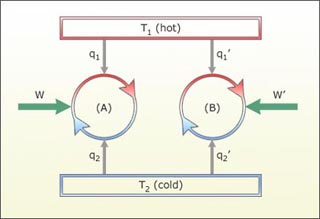
Course5.6036 lectures29 h 53 min
Thermodynamics & Kinetics
Prof. Keith A. Nelson and Prof. Moungi Bawendi · Massachusetts Institute of Technology
About
This subject deals primarily with equilibrium properties of macroscopic systems, basic thermodynamics, chemical equilibrium of reactions in gas and solution phase, and rates of chemical reactions.
Acknowledgements
The material for 5.60 has evolved over a period of many years, and therefore several faculty members have contributed to the development of the course contents. The following are known to have assisted in preparing the lecture notes available on OpenCourseWare: Emeritus Professors of Chemistry: Robert A. Alberty, Carl W. Garland, Irwin Oppenheim, John S. Waugh. Professors of Chemistry: Moungi Bawendi, John M. Deutch, Robert W. Field, Robert G. Griffin, Keith A. Nelson, Robert J. Silbey, Jeffrey I. Steinfeld. Professor of Bioengineering and Computer Science: Bruce Tidor. Professor of Chemistry, Rice University: James L. Kinsey. Professor of Physics, University of Illinois: Philip W. Phillips.
Lectures
Video Lectures
- Lecture 1: State of a system, 0th law, equation of state
- Lecture 2: Work, heat, first law
- Lecture 3: Internal energy, expansion work
- Lecture 4: Enthalpy
- Lecture 5: Adiabatic changes
- Lecture 6: Thermochemistry
- Lecture 7: Calorimetry
- Lecture 8: Second law
- Lecture 9: Entropy and the Clausius inequality
- Lecture 10: Entropy and irreversibility
- Lecture 11: Fundamental equation, absolute S, third law
- Lecture 12: Criteria for spontaneous change
- Lecture 13: Gibbs free energy
- Lecture 14: Multicomponent systems, chemical potential
- Lecture 15: Chemical equilibrium
- Lecture 16: Temperature, pressure and Kp
- Lecture 17: Equilibrium: application to drug design
- Lecture 18: Phase equilibria — one component
- Lecture 19: Clausius-Clapeyron equation
- Lecture 20: Phase equilibria — two components
- Lecture 21: Ideal solutions
- Lecture 22: Non-ideal solutions
- Lecture 23: Colligative properties
- Lecture 24: Introduction to statistical mechanics
- Lecture 25: Partition function (q) — large N limit
- Lecture 26: Partition function (Q) — many particles
- Lecture 27: Statistical mechanics and discrete energy levels
- Lecture 28: Model systems
- Lecture 29: Applications: chemical and phase equilibria
- Lecture 30: Introduction to reaction kinetics
- Lecture 31: Complex reactions and mechanisms
- Lecture 32: Steady-state and equilibrium approximations
- Lecture 33: Chain reactions
- Lecture 34: Temperature dependence, Ea, catalysis
- Lecture 35: Enzyme catalysis
- Lecture 36: Autocatalysis and oscillators
Syllabus and materials
At MIT OpenCourseWare, as the course publishes them.
Credits and licence
- Institution
- Massachusetts Institute of Technology
- Department
- Chemistry
- Taught by
- Prof. Keith A. Nelson, Prof. Moungi Bawendi
- Term
- Spring 2008
- Level
- Undergraduate
- Language
- English
- Subjects
- Physics, Chemistry
- Source
- MIT OpenCourseWare
- Licence
- CC BY-NC-SA 4.0, as MIT OpenCourseWare states it. Non-commercial use only. MIT OpenCourseWare's terms
- Attribution
- Prof. Keith A. Nelson, Prof. Moungi Bawendi. Thermodynamics & Kinetics. Spring 2008. Massachusetts Institute of Technology: MIT OpenCourseWare, https://ocw.mit.edu/. License: Creative Commons BY-NC-SA.
- Who can watch
- MIT OpenCourseWare gives no rating. Invisible Network shows it to Teens profiles and older, judged from what the source says about it. How courses are placed
More like this
 Course
Engineering Dynamics
223 lectures · Video
 Course
Introduction to Nuclear Engineering and Ionizing Radiation
34 lectures · Video
 Course
Thermodynamics of Materials
38 lectures · Video
 Course
Introduction to Solid-State Chemistry
38 lectures · Video
 Course
Introduction to Solid State Chemistry
62 lectures · Video
 Course
Symmetry, Structure, and Tensor Properties of Materials
43 lectures · Video
 Course
Biological Chemistry I
75 lectures · Video
 Course
Biological Chemistry II
49 lectures · Video
 Course
Principles of Chemical Science
36 lectures · Video
 Course
Principles of Chemical Science
46 lectures · Video
 Course
Principles of Chemical Science
35 lectures · Video
 Course
Physical Chemistry
36 lectures · Video