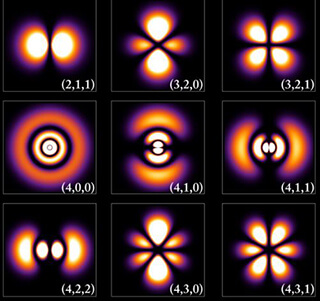
Course5.6136 lectures30 h 59 min
Physical Chemistry
Prof. Robert Field · Massachusetts Institute of Technology
About
This course is an introduction to quantum mechanics for use by chemists. Topics include particles and waves, wave mechanics, semi-classical quantum mechanics, matrix mechanics, perturbation theory, molecular orbital theory, molecular structure, molecular spectroscopy, and photochemistry. Emphasis is on creating and building confidence in the use of intuitive pictures.
Lectures
Lecture Videos
- Lecture 1: Quantum Mechanics—Historical Background, Photoelectric Effect, Compton Scattering
- Lecture 2: Wave Nature of the Electron and the Internal Structure of an Atom
- Lecture 3: Two-Slit Experiment, Quantum Weirdness
- Lecture 4: Classical Wave Equation and Separation of Variables
- Lecture 5: Quantum Mechanics: Free Particle and Particle in 1D box
- Lecture 6: 3-D Box and QM Separation of Variables
- Lecture 7: Classical Mechanical Harmonic Oscillator
- Lecture 8: Quantum Mechanical Harmonic Oscillator
- Lecture 9: The Harmonic Oscillator: Creation and Annihilation Operators
- Lecture 10: The Time-Dependent Schrödinger Equation
- Lecture 11: Wavepacket Dynamics for Harmonic Oscillator and PIB
- Lecture 12: Catch Up and Review, Postulates
- Lecture 13: From Hij Integrals to H Matrices I
- Lecture 14: From Hij Integrals to H Matrices II
- Lecture 15: Non-Degenerate Perturbation Theory I
- Lecture 16: Non-Degenerate Perturbation Theory II: HO using a,a†
- Lecture 17: Rigid Rotor I. Orbital Angular Momentum
- Lecture 18: Rigid Rotor II. Derivation by Commutation Rules
- Lecture 19: Spectroscopy: Probing Molecules with Light
- Lecture 20: Hydrogen Atom I
- Lecture 21: Hydrogen Atom II. Rydberg States
- Lecture 22: Helium Atom
- Lecture 23: Many-Electron Atoms
- Lecture 24: Molecular Orbital Theory I. Variational Principle and Matrix Mechanics
- Lecture 25: Molecular Orbital Theory II. H2+, A2, AB Diatomics
- Lecture 26: Qualitative MO Theory: Hückel
- Lecture 27: Non-Degenerate Perturbation Theory III
- Lecture 28: Modern Electronic Structure Theory: Basis Sets
- Lecture 29: Modern Electronic Structure Theory: Electronic Correlation
- Lecture 30: Time-Dependent Perturbation Theory I. H is Time-Independent, Zewail Wavepacket
- Lecture 31: Time-Dependent Perturbation Theory II. H is Time-Dependent: Two-Level Problem
- Lecture 32: Intermolecular Interactions by Non-Degenerate Perturbation Theory
- Lecture 33: Electronic Spectroscopy: Franck-Condon
- Lecture 34: Electronic Spectroscopy and Photochemistry
- Lecture 35: δ-Functions, Eigenfunctions of X, Discrete Variable Representation
- Lecture 36: Time Dependence of Two-Level Systems: Density Matrix, Rotating Wave Approximation
Syllabus and materials
At MIT OpenCourseWare, as the course publishes them.
Credits and licence
- Institution
- Massachusetts Institute of Technology
- Department
- Chemistry
- Teacher
- Prof. Robert Field
- Term
- Fall 2017
- Level
- Undergraduate
- Language
- English
- Subjects
- Chemistry
- Source
- MIT OpenCourseWare
- Licence
- CC BY-NC-SA 4.0, as MIT OpenCourseWare states it. Non-commercial use only. MIT OpenCourseWare's terms
- Attribution
- Prof. Robert Field. Physical Chemistry. Fall 2017. Massachusetts Institute of Technology: MIT OpenCourseWare, https://ocw.mit.edu/. License: Creative Commons BY-NC-SA.
- Who can watch
- MIT OpenCourseWare gives no rating. Invisible Network shows it to Tweens profiles and older, judged from what the source says about it. How courses are placed
More like this
 Course
Introduction to Solid-State Chemistry
38 lectures · Video
 Course
Introduction to Solid State Chemistry
62 lectures · Video
 Course
Biological Chemistry I
75 lectures · Video
 Course
Biological Chemistry II
49 lectures · Video
 Course
Principles of Chemical Science
36 lectures · Video
 Course
Principles of Chemical Science
46 lectures · Video
 Course
Principles of Chemical Science
35 lectures · Video
 Course
Thermodynamics & Kinetics
36 lectures · Video
 Course
Introductory Biology
35 lectures · Video
 Course
Making Science and Engineering Pictures: A Practical Guide to Presenting Your Work
39 lectures · Video
 Course
Fundamentals of Photovoltaics
26 lectures · Video
 Course
Advanced Thermodynamics
25 lectures · Video