
Course5.08J / 7.08J,7.8049 lectures
Biological Chemistry II
Prof. Joanne Stubbe and Prof. Elizabeth Nolan · Massachusetts Institute of Technology
About
This course is an advanced treatment of biochemical mechanisms that underlie biological processes. Topics include macromolecular machines such as the ribosome, the proteasome, fatty acid synthases as a paradigm for polyketide synthases and non-ribosomal polypeptide synthases, and polymerases. Emphasis will be given to the experimental methods used to unravel how these processes fit into the cellular context as well as the coordinated regulation of these processes.
Lectures
Lecture & Recitation Videos
- Lecture 1: Introduction
- Lecture 2: Protein Synthesis 1
- Recitation 1: Determining, Analyzing, and Understanding Protein Structures
- Lecture 3: Protein Synthesis 2
- Lecture 4: Protein Synthesis 3
- Lecture 5: Protein Synthesis 4
- Recitation 2: Pre-Steady State and Steady-State Kinetic Methods Applied to Translation
- Lecture 6: Protein Synthesis 5
- Lecture 7: Protein Synthesis 6
- Lecture 8: Protein Folding 1
- Recitation 3: Pre-Steady State and Steady-State Kinetic Methods Applied to Translation
- Lecture 9: Protein Folding 2
- Lecture 10: Protein Folding 3
- Lecture 11: Protein Folding 4
- Recitation 4: Purification of Native and Mutant Ribosomes, Protein Purification
- Lecture 12: Protein Degradation 1
- Lecture 13: Protein Degradation 2
- Lecture 14: Protein Degradation 3
- Recitation 5: Overview of Cross-Linking, Including Photo-Reactive Cross-Linking Methods
- Lecture 15: PK and NRP Synthases 1
- Lecture 16: PK and NRP Synthases 2
- Recitation 6: Macromolecular Electron Microscopy Applied to Fatty Acid Synthase
- Lecture 17: PK and NRP Synthases 3
- Lecture 18: PK and NRP Synthases 4
- Recitation 7: Application of Single Molecule Methods to Understand Macromolecular Machines And Protein Degradation
- 19. Cholesterol Biosynthesis 1
- Lecture 20: Cholesterol Biosynthesis 2
- Lecture 21: Cholesterol Biosynthesis 3 & Cholesterol Homeostasis 1
- Recitation 8: Application of CRISPR to Study Cholesterol Regulation
- Lecture 22: Cholesterol Homeostasis 2
- Lecture 23: Cholesterol Homeostasis 3
- Lecture 24: Cholesterol Homeostasis 4
- Recitation 9: Cholesterol Homeostasis and Sensing
- Lecture 25: Cholesterol Homeostasis 5 & Metal Ion Homeostasis 1
- Lecture 26: Metal Ion Homeostasis 2
- Lecture 27: Metal Ion Homeostasis 3
- Recitation 10: Metal-Binding Studies and Dissociation Constant Determination
- Lecture 28: Metal Ion Homeostasis 4
- Lecture 29: Metal Ion Homeostasis 5
- Recitation 11: Mass Spectrometry
- Lecture 30: Metal Ion Homeostasis 6
- Lecture 31: Metal Ion Homeostasis 7 & Reactive Oxygen Species 1
- Recitation 12: Mass Spectrometry of the Cysteine Proteome
- Lecture 32: Reactive Oxygen Species 2
- Lecture 33: Reactive Oxygen Species 3
- Lecture 34: Reactive Oxygen Species 4 & Nucleotide Metabolism 1
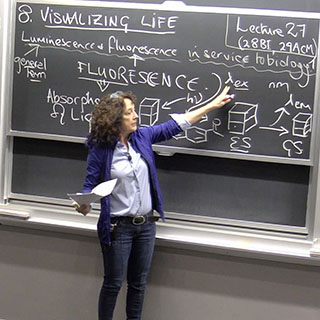
- Recitation 13: Fluorescence Methods
- Lecture 35: Nucleotide Metabolism 2
- Lecture 36: Nucleotide Metabolism 3
Syllabus and materials
At MIT OpenCourseWare, as the course publishes them.
Credits and licence
- Institution
- Massachusetts Institute of Technology
- Department
- Chemistry; Biology
- Taught by
- Prof. Joanne Stubbe, Prof. Elizabeth Nolan
- Term
- Spring 2016
- Level
- Undergraduate
- Language
- English
- Subjects
- Chemistry, Biology
- Source
- MIT OpenCourseWare
- Licence
- CC BY-NC-SA 4.0, as MIT OpenCourseWare states it. Non-commercial use only. MIT OpenCourseWare's terms
- Attribution
- Prof. Joanne Stubbe, Prof. Elizabeth Nolan. Biological Chemistry II. Spring 2016. Massachusetts Institute of Technology: MIT OpenCourseWare, https://ocw.mit.edu/. License: Creative Commons BY-NC-SA.
- Who can watch
- MIT OpenCourseWare gives no rating. Invisible Network shows it to Tweens profiles and older, judged from what the source says about it. How courses are placed
More like this
 Course
Becoming the Next Bill Nye: Writing and Hosting the Educational Show
132 lectures · Video
 Course
Introduction to Solid-State Chemistry
38 lectures · Video
 Course
Introduction to Solid State Chemistry
62 lectures · Video
 Course
Biological Chemistry I
75 lectures · Video
 Course
Principles of Chemical Science
36 lectures · Video
 Course
Principles of Chemical Science
46 lectures · Video
 Course
Principles of Chemical Science
35 lectures · Video
 Course
Thermodynamics & Kinetics
36 lectures · Video
 Course
Physical Chemistry
36 lectures · Video
 Course
Introduction to Biology
35 lectures · Video
 Course
Introductory Biology
34 lectures · Video
 Course
Introductory Biology
35 lectures · Video