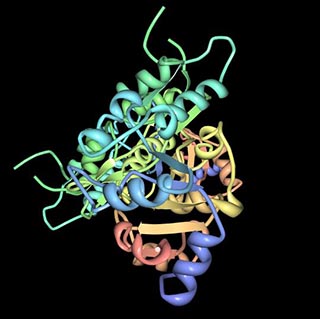
Course5.07SC75 lectures
Biological Chemistry I
Prof. John Essigmann, Prof. Joanne Stubbe and Dr. Bogdan Fedeles · Massachusetts Institute of Technology
About
This course examines the chemical and physical properties of the cell and its building blocks, with special emphasis on the structures of proteins and principles of catalysis, as well as the chemistry of organic / inorganic cofactors required for chemical transformations within the cell. Topics encompass the basic principles of metabolism and regulation in pathways, including glycolysis, gluconeogenesis, fatty acid synthesis / degradation, pentose phosphate pathway, Krebs cycle and oxidative phosphorylation.
Course Format
This OCW Scholar course, designed for independent study, is closely modeled on the course taught on the MIT campus. The on-campus course has two types of class sessions: Lectures and recitations. The lectures meet three times each week and recitations meet once a week. In recitations, an instructor or Teaching Assistant elaborates on concepts presented in lecture, working through new examples with student participation, and answers questions.
MIT students who take the corresponding residential class typically report an average of 10–15 hours spent each week, including lectures, recitations, readings, homework, and exams. All students are encouraged to supplement the textbooks and readings with their own research.
The Scholar course has three major learning units, called Modules. Each module has been divided into a sequence of lecture sessions that include:
Textbook Readings
Lecture Notes or Storyboards
A video by Professor JoAnne Stubbe or Professor John Essigmann
Problem Sets and solutions
To help guide your learning, each of these problem sets are accompanied by Problem Solving Videos where Dr. Bogdan Fedeles solves one of the problems from the set.
Lectures
Instructor Insights
- How Can You Not Think Enzymes Are Cool?
- Research Focus: Ribonucleotide Reductases (RNRs)
- Becoming a Toxicologist
- Research Focus: Genetic Change
- Focusing on the Morphological Unit of Life
- Using a Vitamin Bottle as a Teaching Tool
- Teaching Central Pathways to Help Students Understand Metabolism
- Why Students Should Memorize Amino Acid Side Chains
- Motivating Students to Study Metabolic Biochemistry with Oncology Applications
- Advice for Next Teaching Generation: Focus Curricula on the Microbial World
Lexicon
- Lexicon of Biochemical Reactions: Introduction
- Lexicon of Biochemical Reactions: Redox Cofactors
- Lexicon of Biochemical Reactions: Vitamin B6 / PLP
- Lexicon of Biochemical Reactions: Cofactors Formed from Vitamin B12
Session 1: What is Biochemistry?
Session 3: Enzymes and Catalysis
Session 4: Enzyme Kinetics and Enzyme Inhibition
Session 5: Biochemical Transformations I
Session 7: Biochemical Transformations III
Session 8: Introduction to Sugar Chemistry and Carbohydrate Catabolism
- Session 8: Intro to Sugar Chemistry and Carbohydrate Catabolism
- Session 8: Problem Set 6, Problem 2: Mechanism of Phosphoglycerate Mutase
Session 9: Glycolysis and Early Stages of Respiration
Session 10: Respiration: TCA Cycle
- Session 10: Respiration: TCA Cycle
- Session 10: Problem Set 7, Problem 1: Tracing Labels through Pathways
Session 11: Maintenance of Redox Neutrality
Session 12: Respiration: Electron Transport and Oxidative Phosphorylation
- Session 12: PLP (Pyridoxal Phosphate) Chemistry
- Session 12: Respiration: ETOP
- Session 12: Problem Set 8, Question 2: Bioenergetics of the Electron Transport Chain
Session 13: Respiration: Proton Pumps and ATP Synthesis
Session 14: Lipid Catabolism: Fatty Acid Beta-Oxidation
Session 15: Special Cases in Fatty Acid Metabolism
- Session 15: Special Cases in Fatty Acid Metabolism
- Session 15: Problem Set 9, Problem 1: Catabolism of Triacylglycerols
Session 16: Ketogenesis, Diabetes and Starvation
- Session 16: Ketogenesis, Diabetes and Starvation
- Session 16: The Science Behind Type II Diabetes
- Session 16: Blood Sugar Fluctuations and Gluconeogenesis
- Session 16: When Your Breath Smells Like Nail Polish Remover
Session 17: Fatty Acid and Lipid Biosynthesis
Session 18: Carbohydrate Biosynthesis I: Glycogen Synthesis
Session 19: Carbohydrate Biosynthesis II: Gluconeogenesis
- Session 19: Carbohydrate Biosynthesis II: Gluconeogenesis
- Session 19: Problem Set 10, Problem 3: Gluconeogenesis
Session 20: Carbohydrate Biosynthesis III: Pentose Phosphate Pathway
Session 21: Regulation of Metabolism
Resource Index
- Lexicon of Biochemical Reactions: Introduction
- Lexicon of Biochemical Reactions: Cofactors Formed from Vitamin B12
- Lexicon of Biochemical Reactions: Vitamin B6 / PLP
- Lexicon of Biochemical Reactions: Redox Cofactors
- Problem Set 1, Problem 1: Sizes and Equilibria
- Lecture 5: Enzymes and Catalysis
- Problem Set 2, Problem 1: Primary Structure
- Problem Set 3, Question 2: Proteases: Mechanisms of Inhibition
- Session 5: Carbonyl Chemistry
- Problem Set 4, Problem 2: The Mechanism of HMG-CoA Synthase
- Problem Set 5, Problem 5: How Mannose, an Isomer of Glucose, Enters Glycolysis
- ses 8: Intro to Sugar Chemistry and Carbohydrate Catabolism
- Problem Set 6, Problem 2: Mechanism of Phosphoglycerate Mutase
- ses 9: Glycolysis and Early Stages of Respiration
- ses 10: Respiration: TCA Cycle
- Problem Set 7, Problem 1: Tracing Labels through Pathways
- Ses 11: Maintenance of Redox Neutrality
- PLP (Pyridoxal Phosphate) Chemistry
- Ses 12: Respiration: ETOP
- Problem Set 8, Question 2: Bioenergetics of the Electron Transport Chain
- Ses 13: Respiration: Proton Pumps and ATP Synthesis
- Ses 14: Lipid Catabolism: Fatty Acid Beta-Oxidation
- Ses 15: Special Cases in Fatty Acid Metabolism
- Problem Set 9, Problem 1: Catabolism of Triacylglycerols
- Session 16: Ketogenesis, Diabetes and Starvation
- Ses 17: Fatty Acid and Lipid Biosynthesis
- Session 18: Carbohydrate Biosynthesis I: Glycogen Synthesis
- ses19: Carbohydrate Biosynthesis II: Gluconeogenesis
- Problem Set 10, Problem 3: Gluconeogenesis
- ses20: Carbohydrate Biosynthesis III: Pentose Phosphate Pathway
- ses21: Regulation of Metabolism
Syllabus and materials
At MIT OpenCourseWare, as the course publishes them.
Credits and licence
- Institution
- Massachusetts Institute of Technology
- Department
- Chemistry
- Taught by
- Prof. John Essigmann, Prof. Joanne Stubbe, Dr. Bogdan Fedeles
- Term
- Fall 2013
- Level
- Undergraduate
- Language
- English
- Subjects
- Chemistry, Biology
- Source
- MIT OpenCourseWare
- Licence
- CC BY-NC-SA 4.0, as MIT OpenCourseWare states it. Non-commercial use only. MIT OpenCourseWare's terms
- Attribution
- Prof. John Essigmann, Prof. Joanne Stubbe, Dr. Bogdan Fedeles. Biological Chemistry I. Fall 2013. Massachusetts Institute of Technology: MIT OpenCourseWare, https://ocw.mit.edu/. License: Creative Commons BY-NC-SA.
- Who can watch
- MIT OpenCourseWare gives no rating. Invisible Network shows it to Tweens profiles and older, judged from what the source says about it. How courses are placed
More like this
 Course
Becoming the Next Bill Nye: Writing and Hosting the Educational Show
132 lectures · Video
 Course
Introduction to Solid-State Chemistry
38 lectures · Video
 Course
Introduction to Solid State Chemistry
62 lectures · Video
 Course
Biological Chemistry II
49 lectures · Video
 Course
Principles of Chemical Science
36 lectures · Video
 Course
Principles of Chemical Science
46 lectures · Video
 Course
Principles of Chemical Science
35 lectures · Video
 Course
Thermodynamics & Kinetics
36 lectures · Video
 Course
Physical Chemistry
36 lectures · Video
 Course
Introduction to Biology
35 lectures · Video
 Course
Introductory Biology
34 lectures · Video
 Course
Introductory Biology
35 lectures · Video