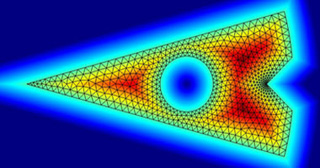
Course18.08550 lectures42 h 30 min
Computational Science and Engineering I
Prof. Gilbert Strang · Massachusetts Institute of Technology
About
This course provides a review of linear algebra, including applications to networks, structures, and estimation, Lagrange multipliers. Also covered are: differential equations of equilibrium; Laplace’s equation and potential flow; boundary-value problems; minimum principles and calculus of variations; Fourier series; discrete Fourier transform; convolution; and applications.
Note: This course was previously called “Mathematical Methods for Engineers I.”
Lectures
Video Lectures
- Course Introduction
- Lecture 1: Four Special Matrices
- Recitation 1: Key Ideas of Linear Algebra
- Lecture 2: Differential Eqns and Difference Eqns
- Lecture 3: Solving a Linear System
- Lecture 4: Delta Function Day
- Recitation 2
- Lecture 5: Eigenvalues (Part 1)
- Lecture 6: Eigen Values (part 2) and Positive Definite (part 1)
- Lecture 7: Positive Definite Day
- Lecture 8: Springs and Masses
- Recitation 3
- Lecture 9: Oscillation
- Recitation 4
- Lecture 10: Finite Differences in Time
- Lecture 11: Least Squares (part 2)
- Lecture 12: Graphs and Networks
- Recitation 5
- Lecture 14: Exam Review
- Lecture 13: Kirchhoff's Current Law
- Recitation 6
- Lecture 15: Trusses and A^(T)CA
- Lecture 16: Trusses (part 2)
- Lecture 17: Finite Elements in 1D (part 1)
- Recitation 7
- Lecture 18: Finite Elements in 1D (part 2)
- Lecture 19: Quadratic/Cubic Elements
- Lecture 20: Element Matrices; 4th Order Bending Equations
- Recitation 8
- Lecture 21: Boundary Conditions, Splines, Gradient, Divergence
- Recitation 9
- Lecture 22: Gradient and Divergence
- Lecture 23: Laplace's Equation
- Lecture 25: Fast Poisson Solver (part 1)
- Lecture 24: Laplace's Equation (part 2)
- Lecture 27: Finite Elements in 2D (part 2)
- Lecture 26: Fast Poisson Solver (part 2); Finite Elements in 2D
- Recitation 10
- Lecture 28: Fourier Series (part 1)
- Lecture 29: Fourier Series (part 2)
- Recitation 11
- Lecture 30: Discrete Fourier Series
- Lecture 31: Fast Fourier Transform, Convolution
- Recitation 12
- Lecture 32: Convolution (part 2), Filtering
- Lecture 33: Filters, Fourier Integral Transform
- Lecture 34: Fourier Integral Transform (part 2)
- Recitation 13
- Lecture 35: Convolution Equations: Deconvolution
- Lecture 36: Sampling Theorem
Syllabus and materials
At MIT OpenCourseWare, as the course publishes them.
Credits and licence
- Institution
- Massachusetts Institute of Technology
- Department
- Mathematics
- Teacher
- Prof. Gilbert Strang
- Term
- Fall 2008
- Level
- Graduate
- Language
- English
- Subjects
- Mathematics, Engineering
- Source
- MIT OpenCourseWare
- Licence
- CC BY-NC-SA 4.0, as MIT OpenCourseWare states it. Non-commercial use only. MIT OpenCourseWare's terms
- Attribution
- Prof. Gilbert Strang. Computational Science and Engineering I. Fall 2008. Massachusetts Institute of Technology: MIT OpenCourseWare, https://ocw.mit.edu/. License: Creative Commons BY-NC-SA.
- Who can watch
- MIT OpenCourseWare gives no rating. Invisible Network shows it to Tweens profiles and older, judged from what the source says about it. How courses are placed
More like this
 Course
The Analytics Edge
35 lectures · Video
 Course
Single Variable Calculus
35 lectures · Video
 Course
Multivariable Calculus
35 lectures · Video
 Course
Matrix Methods in Data Analysis, Signal Processing, and Machine Learning
34 lectures · Video
 Course
Linear Algebra
35 lectures · Video
 Course
Linear Algebra
158 lectures · Video
 Course
Engineering Dynamics
223 lectures · Video
 Course
Becoming the Next Bill Nye: Writing and Hosting the Educational Show
132 lectures · Video
 Course
Introduction to Nuclear Engineering and Ionizing Radiation
34 lectures · Video
 Course
Thermodynamics of Materials
38 lectures · Video
 Course
Introduction to Solid-State Chemistry
38 lectures · Video
 Course
Introduction to Solid State Chemistry
62 lectures · Video