
Antikristus: Arvostelukoe kristinopista
by Friedrich Wilhelm Nietzsche
Translated by Aarni Kouta
Human-made only is on in this browser, so Project Gutenberg's machine summaries are left out. Settings.
"Antikristus: Arvostelukoe kristinopista" by Friedrich Wilhelm Nietzsche is a philosophical work written in 1888 and published in 1895. Nietzsche launches a fierce critique of Christianity, arguing it promotes weakness and decay rather than strength and vitality. He challenges Christian morality, denounces the concept of pity as harmful to life, and claims religious values are based on imaginary fictions. Contrasting Christianity with Buddhism and examining its Jewish origins, Nietzsche presents his controversial vision of a transvaluation of all values.
AI-generated Summary written by Project Gutenberg, by machine.
- Language
- Finnish (Suomi)
- On Project Gutenberg since
- 1 September 2016
- Read in the last 30 days
- 443 times at Project Gutenberg
More by Friedrich Wilhelm Nietzsche
See all: More by Friedrich Wilhelm Nietzsche
Index of the Project Gutenberg Works of Friedrich Nietzsche

We Philologists
The Case of Wagner, Nietzsche Contra Wagner, and Selected Aphorisms.
Beyond Good and Evil
Thus Spake Zarathustra: A Book for All and None
The Genealogy of Morals
The Twilight of the Idols; or, How to Philosophize with the Hammer. The Antichrist
Ecce Homo
The Birth of Tragedy; or, Hellenism and Pessimism
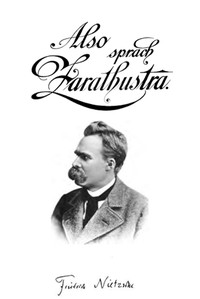
Also sprach Zarathustra: Ein Buch für Alle und Keinen
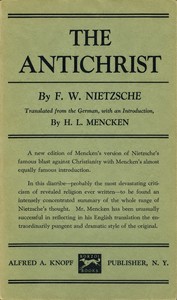
The Antichrist
The Joyful Wisdom ("La Gaya Scienza")

Human, All Too Human: A Book for Free Spirits
The Will to Power: An Attempted Transvaluation of All Values. Book III and IV

The Dawn of Day

Jenseits von Gut und Böse
The Will to Power: An Attempted Transvaluation of All Values. Book I and II
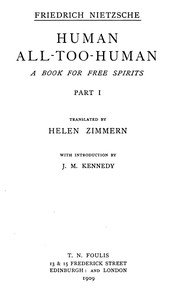
Human, All-Too-Human: A Book for Free Spirits, Part 1
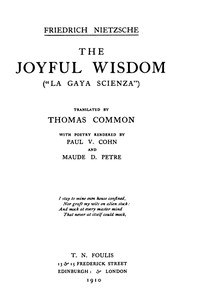
The Joyful Wisdom ("La Gaya Scienza")