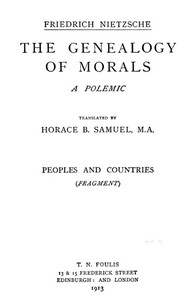
The Genealogy of Morals
The Complete Works, Volume Thirteen, edited by Dr. Oscar Levy.
by Friedrich Wilhelm Nietzsche
Edited by Oscar Levy · Translated by J. M. Kennedy · Translated by Horace Barnett Samuel
"The Genealogy of Morals" by Friedrich Wilhelm Nietzsche is a philosophical work published in 1887. Consisting of three interrelated treatises, it traces the evolution of moral concepts to challenge what Nietzsche views as moral prejudices, particularly those of Christianity and Judaism. Through historical analysis, Nietzsche examines how opposing value systems—"good and evil" versus "good and bad"—emerged from different social classes. He explores the aristocratic morality of the powerful and the "slave morality" born from resentment, revealing how values became inverted throughout history.
Summary written by Project Gutenberg, by machine.
- Language
- English
- On Project Gutenberg since
- 13 June 2016
- Read in the last 30 days
- 13,960 times at Project Gutenberg
More by Friedrich Wilhelm Nietzsche
See all: More by Friedrich Wilhelm Nietzsche
Index of the Project Gutenberg Works of Friedrich Nietzsche

We Philologists

The Case of Wagner, Nietzsche Contra Wagner, and Selected Aphorisms.

Thus Spake Zarathustra: A Book for All and None

Beyond Good and Evil
The Twilight of the Idols; or, How to Philosophize with the Hammer. The Antichrist
Ecce Homo
The Birth of Tragedy; or, Hellenism and Pessimism
The Antichrist

The Joyful Wisdom ("La Gaya Scienza")

Human, All Too Human: A Book for Free Spirits
Also sprach Zarathustra: Ein Buch für Alle und Keinen
The Will to Power: An Attempted Transvaluation of All Values. Book III and IV

The Dawn of Day
The Will to Power: An Attempted Transvaluation of All Values. Book I and II
Human, All-Too-Human: A Book for Free Spirits, Part 1
The Joyful Wisdom ("La Gaya Scienza")

Human, All-Too-Human: A Book for Free Spirits, Part 2
Thoughts Out of Season, Part II