
Human, All Too Human: A Book for Free Spirits
by Friedrich Wilhelm Nietzsche
Translated by Alexander Harvey
"Human, All Too Human: A Book for Free Spirits" by Friedrich Wilhelm Nietzsche is a philosophical work published in 1878. Breaking from his earlier essay style, Nietzsche employs short aphorisms to examine metaphysics, morality, religion, and human nature. Written during his break with composer Richard Wagner and originally dedicated to Voltaire, this collection marks Nietzsche's turn toward French Enlightenment thinking and the aphoristic style that would define his later philosophy. The work challenges conventional Christian morality while exploring the origins of moral feelings and metaphysical thought.
Summary written by Project Gutenberg, by machine.
- Language
- English
- On Project Gutenberg since
- 26 November 2011
- Read in the last 30 days
- 5,624 times at Project Gutenberg
More by Friedrich Wilhelm Nietzsche
See all: More by Friedrich Wilhelm Nietzsche
Index of the Project Gutenberg Works of Friedrich Nietzsche

We Philologists

The Case of Wagner, Nietzsche Contra Wagner, and Selected Aphorisms.
Thus Spake Zarathustra: A Book for All and None
Beyond Good and Evil
The Genealogy of Morals
The Twilight of the Idols; or, How to Philosophize with the Hammer. The Antichrist
Ecce Homo
The Birth of Tragedy; or, Hellenism and Pessimism
The Antichrist
The Joyful Wisdom ("La Gaya Scienza")
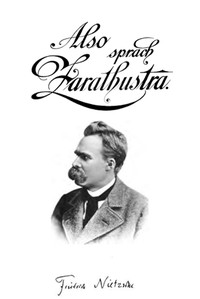
Also sprach Zarathustra: Ein Buch für Alle und Keinen
The Will to Power: An Attempted Transvaluation of All Values. Book III and IV

The Dawn of Day
The Will to Power: An Attempted Transvaluation of All Values. Book I and II
Human, All-Too-Human: A Book for Free Spirits, Part 1
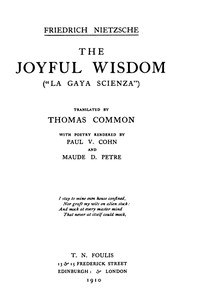
The Joyful Wisdom ("La Gaya Scienza")

Human, All-Too-Human: A Book for Free Spirits, Part 2
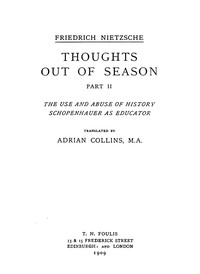
Thoughts Out of Season, Part II