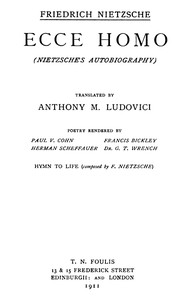
Ecce Homo
Complete Works, Volume Seventeen
by Friedrich Wilhelm Nietzsche
Edited by Oscar Levy · Translated by Paul V. Cohn · Translated by Anthony M. Ludovici
"Ecce Homo" by Friedrich Wilhelm Nietzsche is a philosophical autobiography written in 1888. In this provocative final work, Nietzsche offers his own interpretation of his life, philosophy, and significance through boldly titled chapters like "Why I Am So Wise" and "Why I Write Such Good Books." He reviews his major works, presents a new image of the Dionysian philosopher, and challenges Christianity's morality. Written with characteristic hyperbole and self-conscious irony, the book puts Nietzsche himself on trial while declaring his vision for humanity's future.
Summary written by Project Gutenberg, by machine.
- Language
- English
- On Project Gutenberg since
- 30 May 2016
- Read in the last 30 days
- 11,222 times at Project Gutenberg
More by Friedrich Wilhelm Nietzsche
See all: More by Friedrich Wilhelm Nietzsche
Index of the Project Gutenberg Works of Friedrich Nietzsche

We Philologists
The Case of Wagner, Nietzsche Contra Wagner, and Selected Aphorisms.
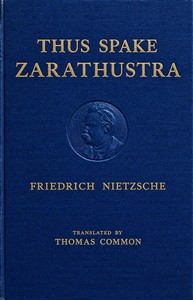
Thus Spake Zarathustra: A Book for All and None
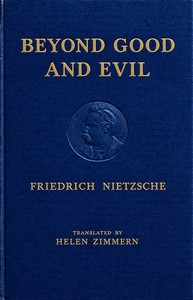
Beyond Good and Evil
The Genealogy of Morals
The Twilight of the Idols; or, How to Philosophize with the Hammer. The Antichrist
The Birth of Tragedy; or, Hellenism and Pessimism
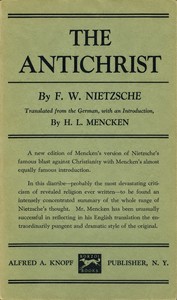
The Antichrist
The Joyful Wisdom ("La Gaya Scienza")

Human, All Too Human: A Book for Free Spirits
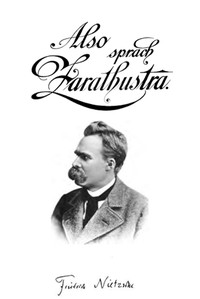
Also sprach Zarathustra: Ein Buch für Alle und Keinen
The Will to Power: An Attempted Transvaluation of All Values. Book III and IV

The Dawn of Day
The Will to Power: An Attempted Transvaluation of All Values. Book I and II
Human, All-Too-Human: A Book for Free Spirits, Part 1
The Joyful Wisdom ("La Gaya Scienza")

Human, All-Too-Human: A Book for Free Spirits, Part 2
Thoughts Out of Season, Part II