Podcasts · Education · Society & Culture
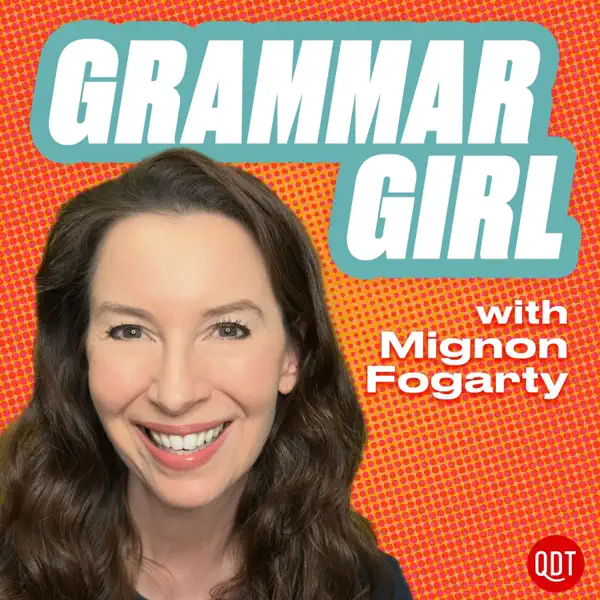
Grammar Girl
QuickAndDirtyTips.com
300 episodes
Five-time winner of Best Education Podcast in the Podcast Awards. Grammar Girl provides short, friendly tips to improve your writing and feed your love of the English language. Whether English is your first language or your second language, these grammar, punctuation, style, and business tips will make you a better and more successful writer. Grammar Girl is a Quick and Dirty Tips podcast.
More about the show
Hosted on Acast. See acast.com/privacy for more information.
Episodes page 2 of 6
-
How to get started as a freelance writer
1192. How do you get your first writing jobs when you don’t have much experience? Grammar Girl shares stories from her own early career and offers advice on finding a niche, spotting opportunities, making industry…
-
The case for language clarity, with Iva Cheung
1191. This week, we talk to Iva Cheung, a plain language expert and editor who has helped shape Canada's accessibility standards. We look at what plain language actually means (it's more than just short words and…
-
Does Yoda speak 'real' English? Is it 'a real trouper' or 'a real trooper'?
1190. This week, we look at what makes Yoda's English special, and we look at the difference between “trooper” and “trouper,” including whether singular “troop” may be short for “trooper” and why “a real trouper” is…
-
Everyone has a story to tell, and why your memoir matters, with Grant Faulkner
1189. This week, we talk to Grant Faulkner, co-founder of Memoir Nation and former executive director of NaNoWriMo, about what makes writing a memoir different from writing fiction. We look at why memory is more story…
-
How ‘bee’s knees’ became high praise, and why do recipes sound so bossy?
1188. This week, we look at how “the bee's knees” went from meaning something tiny to the cheeriest slang of the 1920s — and why it outlasted the cat's pajamas and the clam's overshoes. Then, we look at why recipes…
-
Why your topic isn't a point (and how to fix it), with Joel Schwartzberg
1187. Today, we talk to workplace communications coach and author Joel Schwartzberg about how to clearly and effectively get to the point, and he outlines how his clients use AI as a communication tool without losing…
-
How many people is a 'troop'? Why spelling bees are called 'bees.'
1186. This week, we look at why the word "troops" is surprisingly ambiguous and what style guides say about using it to refer to individual service members. Then, we look at why spelling bees are called "bees" and…
-
The hidden logic of English spelling, with Colin Gorrie
1185. Today, we look at why English spelling is secretly optimized for readers. Colin Gorrie, linguist and creator of the Dead Language Society newsletter, shared the real history of silent letters, why medieval…
-
How the Crusades gave us 'lingua franca.' 'That' or 'who' for animals? Doot doot doot
1184. This week, we look at the history of lingua francas, from the original mix of Italian, French, Spanish, Arabic, and Turkish used during the Crusades to today's global English. Plus, we look at whether it's wrong…
-
Meeting the new editor, with AP Stylebook's Anna Jo Bratton
1183. This week, we talk to Anna Jo Bratton about leading the committee that decides the rules for the "journalism bible." We look at how the team "pressure-tests" new rules and why the process isn't a democracy. Then…
-
Decoding the colon: AP vs. MLA style. Plus, words with no known origin.
1182. This week, we solve the mystery of the colon: when do you actually need to capitalize the next word? We compare AP, Chicago, and MLA styles to give you a clear answer. Then, we look at common words with…
-
The hidden superpower of verbs, with Sarah L. Kaufman
1181. This week, we talk to Sarah L. Kaufman about verbs. We look at why English is a "manner verb" superpower and why babies often learn prepositions before actions. Then, we look at how choosing strong, dynamic verbs…
-
Why English creates so many words spelled the same. Why we say 'ye olde' instead of 'the old.'
1180. Why does "Ye Olde Shoppe" look old-fashioned? This week, we look at the vanished letters of English — thorn, eth, and yogh — and at why English has so many words that are spelled the same but have different…
-
'Why We Talk Funny.' The reasons behind our accents, with Valerie Fridland
1179. This week, we talk to Valerie Fridland, a linguist and professor who grew up in Memphis surrounded by Southern accents and now researches the history and social power of speech. We look at her new book, "Why We…
-
Should you start a sentence with 'hopefully'? Why we might not recognize alien language.
1178. Do you cringe when someone says "Hopefully, he'll pass the test"? This week, we look at why "hopefully" as a sentence adverb has been controversial for decades, even though the Associated Press accepted it in…
-
Inside the life of a curator (and the myth of white gloves), with John Overholt.
1177. This week, we look at behind-the-scenes of being a curator at Harvard's Houghton Library with John Overholt. We look at why 18th-century paper is surprisingly tough, how John managed the high-stakes transport of…
-
Why 'stressed' spelled backwards reveals a delicious truth. 'Me' versus 'myself'
1176. This week, we look at mind-bending words, including "semordnilap" (which spells "palindromes" backwards), "pentasyllabic" (which has five syllables), and "hyphenated" (which is not hyphenated). Then, we tackle…
-
Losing clients to AI, and how to gain them back, with Suzanne Bowness
1175. In this bonus segment, which originally aired last October for Grammarpaloozians, we look at how AI is disrupting the freelance writing industry with author Suzanne Bowness. She shares her strategy for…
-
What the way we pronounce Iran says about us. Odorous or malodorous? When smell words stink.
1174. This week, we look at why we pronounce "Iran" and "Iraq" differently and what those pronunciations reveal about our political beliefs. Then, we look at the "smelly" words that confuse people, including "odorous,"…
-
The 3,000 hidden colors of the dictionary, with Kory Stamper
1173. This week, we talk to former Merriam-Webster editor Kory Stamper to discuss her new book, "True Color." We look at the obsessive, "dictionary-ese" world of color definitions, looking at why the dictionary…
-
Denim: Secret place names hiding in plain sight. Why the principal is more than your pal.
1172. This week, we look at "toponyms" — words named after places — and you'll discover the hidden place names in denim, jeans, sherry, cantaloupe, and more. Then, we break down "principal" versus "principle," with…
-
The crossword puzzle's role in World War II and the fight against Nazism.
1171. In the bonus segment that aired for Grammarpaloozians in November, we look at the early history of crossword puzzles and their surprising political uses. Natan Last explains how the “New York Times” crossword,…
-
Feghoots: Groan-worthy story puns. How your brain stores words.
1170. This week, we look at "feghoots," the pun-based stories popularized by writers like Isaac Asimov, and why they are designed to make you roll your eyes. Then, we look at how your brain stores words and the…
-
The ‘Tale of Two Dictionaries,’ with Peter Sokolowski
1169. In this bonus segment, originally released in November, we look at Peter Sokolowski's "Tale of Two Dictionaries," tracing the word "dictionary" back to a 16th-century Latin work by a monk named Calepino. We look…
-
Why leprechauns are shoemakers. The March equinox versus the vernal equinox.
1168. This week, we look at the word "leprechaun" and its surprisingly wild origin story involving shoemaking, ancient Rome, and wolf-men. Then we look at the word "equinox": its Chaucer connection, the newer word…
-
'Mini' and 'factoid' don't mean what you think, with Jess Zafarris
1167. In this bonus segment that originally ran for Grammarpaloozians last October, we look at the surprising true origins of words that often fool people. We explore why "miniature" originally referred to a red color…
-
Is the Academy Awards singular or plural? Writing about time.
1166. This week, we look the grammar of the Academy Awards and how to avoid an "illogical plot twist" in your sentences. Then, we look at common time-related redundancies like "period of time," the proper way to use…
-
Mapping the American Tongue: The Dictionary of American Regional English (DARE), with Joan Houston Hall
1165. Today, we talk with Joan Houston Hall to look at the monumental task of documenting how Americans speak. We look at the Dictionary of American Regional English (DARE), exploring the unique folk words that survive…
-
The history of the octothorpe. Sir Fragalot and sentence fragments. Dribzle.
1164. This week, we look at the origin of the octothorpe — also known as the pound sign or hashtag — and why it has so many different names. Then, we look at sentence fragments and the secret of "Sir Fragalot" to help…
-
How 'be like' took over the world, with Sali Tagliamonte
1163. This week, we look at what it’s like to be a "language detective" with Sali Tagliamonte and how she used her own teenagers as a research lab. We look at a 25-year study on how the phrase "be like" became a…
-
Why 'Tonka' sounds big and 'bitty' sounds small. Why you CAN start a sentence with 'because.'
1162. This week, we look at why some names just "feel right" while others don't and how vowels like "ee" create associations with smallness and sweetness while back vowels like "ah" sound bigger and more serious. Then,…
-
WHY WE USE ALL CAPS TO SHOUT, with Glenn Fleishman
1161. Today, we look at the history of writing in all-uppercase letters. Tech historian Glenn Fleishman explains how capitals transitioned from a sign of importance to a convention for shouting. Plus, we discuss his…
-
Battle of the moguls. 'Awhile' versus 'a while.' Crittador.
1160. This week, we look at why "mogul" means both a ski bump and a powerful person. Then, we tackle when to use "awhile" versus "a while," with a trick to help you remember. 🔗 Join the Grammar Girl Patreon. 🔗 Share…
-
Writing for ‘civic clarity’ (plus, the power of short sentences), with Roy Peter Clark
1159. This week, we look at "civic clarity" with writing instructor Roy Peter Clark in a newly edited version of our 2020 conversation. We look at the ethical code of clear communication and why "civic clarity" is more…
-
How bored tourists invented an Olympic sport. Centigrade or Celsius? Piqua
1158. This week, we go full Winter Olympics, tracing the origin of "ski," "luge," "toboggan," and more. Then, we look at why we say "Celsius" instead of "centigrade." 🔗 Join the Grammar Girl Patreon. 🔗 Share your…
-
Why AI loves em dashes, with Sean Goedecke
1157. This week, we look at AI em dashes with Sean Goedecke, software engineer for GitHub. We talk about why artificial intelligence models frequently use em dashes and words like "delve," and how training on public…
-
Why 'forte' has three pronunciations. What is 'playing the dozens'? Ornish
1156. This week, we look at the pronunciation chaos surrounding "forte" and "pianoforte," from the French fencing term meaning "strong point" to the Italian musical direction meaning "loud." Then, we look at "playing…
-
How can there be hundreds of words for snow? with Dr. Charles Kemp
1155. This week, we look at whether it’s actually true that Inuit languages have hundreds of words for snow with Dr. Charles Kemp. We look at how researchers used a database of 18 million volumes to find out how our…
-
Scarecrows and other 'cutthroat' compounds. Reading versus listening. Squirrel Hill Tunnel.
1154. This week, we look at "headless" nouns like "scarecrow," "pickpocket," and "breakfast." We look at why these "cutthroat compounds" break the normal rules of English grammar. Then, we look at the science of…
-
Scrabble strategy and tournament culture, with John Chew
1153. This week, we look at the high-stakes world of Scrabble tournaments with John Chew, head of the North American Scrabble Players Association. We look at the strict etiquette of the tile bag, why professional…
-
What is a baker’s dozen? Making O-words plural. Wrong pew.
1152. This week, we look at what a baker's dozen is and why it's actually 13. We also look at other "dozen" phrases, like "devil's dozen" and "banker's dozen." Finally, we tackle the inconsistency of making words that…
-
Building the Online Etymology Dictionary, with Doug Harper
1151. This week, we look at the deep history of words with Doug Harper, creator of Etymonline. We look at the "gravitational" link between digging a grave and having a grave problem, the surprising 1839 origin of "OK,"…
-
Using ‘impact’ as a verb. ‘Sympathy’ versus ‘empathy.’ Big help, Irving.
1150. This week, we look at "impact" as a verb and why it's a pet peeve for so many editors and readers. Then, we look at the linguistic shift between sympathy and empathy, exploring how "sympathy" began to sound…
-
Rare books, burned letters, and Johnson’s dictionary, with John Overholt
1149. This week, we look at the life and legacy of Samuel Johnson, the man behind the 1755 Dictionary of the English Language. We talk with John Overholt, curator at Harvard’s Houghton Library, about Johnson's eclectic…
-
Penny idioms that are still legal tender. The linguistic history of procrastination. Tanner tour.
1148. This week, we look at penny idioms that are still "legal tender" in our language even as the U.S. penny is retired. We look at the history of phrases like "a bad penny" and "penny wise and pound foolish." Then,…
-
The Goth letters: why the alphabet goes off the rails after T, with Danny Bate
1147. In this bonus segment that originally ran in October, we look at the fascinating history of the "new letters" of the alphabet — V, W, X, Y, and Z. Danny Bate explains why T was the original end of the alphabet…
-
War of the dots. Why we say 'pitch black.' Pitch hot.
1146. This week, we look at the history of Braille, from the tragic accident that inspired Louis Braille's six-dot system to the "War of the Dots"—a decades-long conflict over competing reading standards in the U.S.…
-
How a long-lost yearbook revealed the origin of 'hella,' with Ben Zimmer
1145. In this bonus segment from October, I talk with Ben Zimmer about "hella" and how even yearbook messages can be digitized to help preserve the language record. Ben shares the full story of this slang term, and we…
-
The origin of X in algebra. Why we say ‘how come’ for ‘why.’ Water handles.
1144. This week, we look at the origin of the letter X as the variable for the unknown in algebra. Then, we look at the phrase "how come," explaining why it's more informal than "why" and how its grammar subtly differs…
-
2025 Words of the Year, with Jess Zafarris and Danny Hieber
1143. This week, we look at the 2025 words of the year with Jess Zafarris and Danny Hieber. We look at viral slang like "six seven" and cultural terms like "rage bait" and "fatigued." We also look at the dramatic rise…
More in Education
The Mel Robbins Podcast
Mel Robbins

The Jordan B. Peterson Podcast
Dr. Jordan B. Peterson
IMO with Michelle Obama and Craig Robinson
Higher Ground
The Rich Roll Podcast
Rich Roll
The Lazy Genius Podcast
Kendra, The Lazy Genius
Life Kit
NPR
The Bossticks
Lauryn Bosstick and Michael Bosstick / Dear Media
Motivation Daily by Motiversity
Motiversity

جافکری | Jafekri
Amirali Gh
EconTalk
Russ Roberts
The Jefferson Fisher Podcast
Civility Media
Good Life Project
Jonathan Fields / Acast
Shows are listed from Apple Podcasts' charts and directory, and Podcast Index where it is used. Every show and episode belongs to its publisher and plays from the publisher's own feed; this site hosts none of them. Explicit shows are for adult profiles only, and children’s profiles hear only children’s shows. More about this list.