Podcasts · Education · Society & Culture
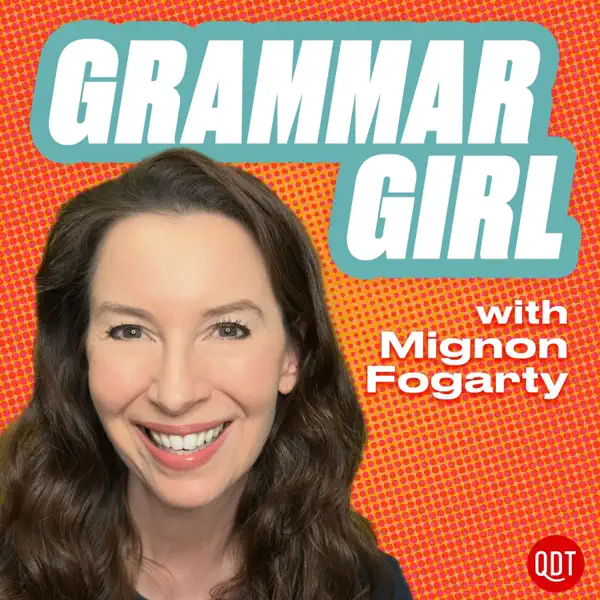
Grammar Girl
QuickAndDirtyTips.com
300 episodes
Five-time winner of Best Education Podcast in the Podcast Awards. Grammar Girl provides short, friendly tips to improve your writing and feed your love of the English language. Whether English is your first language or your second language, these grammar, punctuation, style, and business tips will make you a better and more successful writer. Grammar Girl is a Quick and Dirty Tips podcast.
More about the show
Hosted on Acast. See acast.com/privacy for more information.
Episodes page 3 of 6
-
2025 Words of the Year, with Jess Zafarris and Danny Hieber
1143. This week, we look at the 2025 words of the year with Jess Zafarris and Danny Hieber. We look at viral slang like "six seven" and cultural terms like "rage bait" and "fatigued." We also look at the dramatic rise…
-
'Pride and prejudice' before Jane Austen. Was Parson Brown a real person? Happy Panda.
1142. This week, we look at the history of the phrase "pride and prejudice," which was used frequently before Jane Austen’s 1813 novel. Then, we look at whether Parson Brown from “Winter Wonderland” was a real person,…
-
The 'sheeple' incident, with Stefan Fatsis
1141. We look at the controversy that caught Stefan Fatsis by surprise when he defined the word "sheeple" for Merriam-Webster, leading to public complaints. We also look at the origin and purpose of the obscure…
-
The rise of the 'hamster wheel.' The many names of Santa Claus. Unattractive turtles.
1140. This week, we look at the difference between the modern phrase "hamster wheel" and the older "rat race," and why the former gained popularity. We also look at the similar concept of the hedonic treadmill. Then,…
-
An inspiring tutor, 'New York System' hot dogs, and 'queen spotting.'
1139. In this bonus discussion with Martha Barnette back in March, we look at Martha's pivotal twelve-year journey with a polyglot tutor who transformed her understanding of ancient Greek, starting with the etymology…
-
Why Brits eat biscuits and Americans eat cookies. Why brands keep nouning everything. Hamster alert.
This week, in honor of National Cookie Day, we look at the vocabulary split between British and American English, including the differences between a cookie and a biscuit, and the two meanings of "pudding." Then, we…
-
Rob Drummond on languaging and our fluid speaking identities
In this bonus conversation with Rob Drummond from back in June, he and I get into the fascinating concept of "languaging" — the idea that speaking is an active process we use to constantly shape and project our…
-
The sinful fork (and other dinner-table surprises)
1136. This week, we go full Thanksgiving, talking about the origin of butter knives, forks, and more. You'll love all the tidbits you can share with your family or friends during dinner. 🔗 Share your familect…
-
Why print dictionaries still matter, with Peter Sokolowski
1135. This week, we talk with Peter Sokolowski, editor at large at Merriam-Webster, about the new print 12th Collegiate Dictionary. We look at why print still matters, how the dictionary used lookup data to decide…
-
Personification in language and AI. Dictums, maxims, and proverbs. Expensitive.
1134. This week, we look at the poetic power of personification (the language quirk that gives human traits to nonhuman things) and why style guides advise against using it for AI. Then, we look at the different names…
-
The secret rules of crossword puzzles, with Natan Last
1133. This week, crossword pro Natan Last talks about his book "Across the Universe." We look at the technical and cultural differences between American and British puzzle styles and the secrets that will surprise you…
-
How '23 skidoo' & 'at sixes and sevens' are related to '6-7.'
1132. This week, in honor of Dictionary.com choosing "6-7" as its Word of the Year, we look at the origin of other number phrases: "23 skidoo" and "at sixes and sevens." 🔗 Share your familect recording in a WhatsApp…
-
What a ‘Science' magazine experiment says about the future of AI in journalism, with Abigail Eisenstadt
1131. This week, we talk with ‘Science' magazine senior writer Abigail Eisenstadt about her team's year-long experiment testing ChatGPT's ability to summarize research papers. We look at their methodology, the…
-
What Roman togas have to do with today's elections. 'Home in' versus 'hone in.'
1130. This week, we look at words related to elections, and then I help you remember the difference between "home in" and "hone in" with a tip that includes a shocking historical tidbit about spiders. 🔗 Share your…
-
Finding the true history of words, with Ben Zimmer
1129. This week, we talk with Ben Zimmer about the linguistic detective work of antedating words — finding earlier usages than those published in dictionaries. We look at the surprising origins of "Ms.," "scallywag,"…
-
‘Ghost words’ and their history. Rules for ‘between’ and ‘among.’ Wilsoning.
1128. This week, in honor of Halloween, we look at “ghost words” and phrases, from “ghost runners” in baseball to “ghost forests” made by earthquakes. We also look at the difference between “between” and “among” for…
-
How to be a ‘feisty freelancer,’ with Suzanne Bowness
1127. This week, we talk with Suzanne Bowness about creating a successful life as a writer. We look at high-value industries that are good targets for freelance work and the best job titles to pitch. Suzanne provides…
-
Shakespeare's ‘wherefore’ and other false friends. The language of fear. A Tom.
1126. This week, we look at words for fear and why "wherefore" doesn't mean what many people think it means. The false friends segment was written by Karen Lunde, a career writer and editor. These days, she designs…
-
Why Q needs U and how hieroglyphics created our alphabet, with Danny Bate
1125. This week, we talk with linguist and author Danny Bate about his book, "Why Q Needs U." We look at the ancient origins of our alphabet, tracing its conceptual leap from Egyptian hieroglyphs to symbols that…
-
The political, royal and obscene meanings of blue. The differences in ‘plumb’ and plum.’
1124. This week, we look at blue idioms, including the political history of "blue states," the medical reason for being "blue in the face," and the astronomical reason for a "blue moon." Then, we look at the difference…
-
The fight for the modern dictionary, with Stefan Fatsis
1123. This week, we talk with author and self-described “word freak” Stefan Fatsis about his book "Unabridged." He shares his experience embedding at Merriam-Webster to become a lexicographer, sharing the contrast…
-
‘Math’ versus ‘maths’ and other British differences. ‘Spendthrift’ means what?
1122. This week, we look at two subtle but persistent differences between American and British English: why Americans say "math" and Brits say "maths," and why Americans are "in the hospital" while Brits are "in…
-
Why ‘Useless Etymology’ gives you super powers, with Jess Zafarris
1121. This week, we talk with Jess Zafarris about her book “Useless Etymology.” We look at three ways she says etymology gives you superpowers. We also look at the origins of simple words and learn why “girl” didn't…
-
Can you use ‘epicenter’ for positive things? The etymology of ‘bro.’ Mukwonago, Oconomowoc.
1120. This week, we look at tricky uses of the word "epicenter" and how people feel about using it metaphorically. We also look at where the word “brother” came from and how it branched into “bro,” “boy,” and even…
-
Adapting a classic: from words to watercolors, with K. Woodman-Maynard
1119. This week, we talk with illustrator and cartoonist K. Woodman-Maynard about her new graphic novel adaptation of "Tuck Everlasting." We look at the creative process of adapting a beloved book, including how she…
-
Dime idioms. ‘HoCo’ and syllable acronyms. Pulling a Trevor
1118. This week, we look at the origins of idioms related to the word "dime," like "turn on a dime" and "get off the dime." We also look at a special kind of acronym that uses syllables, and how words like "Nabisco,"…
-
How algorithms are changing the meaning of words, with Adam Aleksic
1117. This week, we talk with Adam Aleksic, also known as the Etymology Nerd, about the ways algorithms are changing the meaning of words. We look at how words like "preppy" have evolved and how social media is…
-
The pirate history of ‘scallywag.’ ‘Used to’ versus ‘use to.’ Cheese grits.
1116. This week, we clarify the origins of the word "Schnauzer" and why it may mean "snout," "growler," or "mustache." Then, in honor of Talk Like a Pirate Day, we look at the true origins of the word "scallywag,"…
-
From clay tablets to the Gutenberg press, with Keith Houston
1115. This week, we talk with Keith Houston about his book, "The Book." We look at how writing technology evolved from clay tablets and bamboo slips to papyrus and paper. He shares some surprising facts, including why…
-
Why we have indents. More on Formica. Running on Edgar.
1114. This week, we look at the history and purpose of indents, from medieval manuscripts to modern word processors, and the difference between a first-line indent and a hanging indent. Then, we look at the…
-
The surprising ways we gesture about time and space, with Lauren Gawne
1113. This week, we talk with linguist Lauren Gawne about her book "Gesture: A Slim Guide." We look at how different cultures gesture about abstract concepts like time and space, and how we unknowingly gesture from our…
-
Vonnegut’s semicolon rule. What age has to do with language. Chocolate donut.
1112. This week, we look at why you can safely ignore Kurt Vonnegut’s famous advice about ignoring semicolons. We also look at why taking punctuation advice from fiction writers may not be a good idea for business…
-
Why we say 'near miss.' How dogs got their names. Stupid dog Jackie.
1111. This week, we look at the phrase "near miss" and why this seemingly illogical term actually makes sense. Then, in honor of National Dog Day, we look at how 16 different dog breeds got their names, including why a…
-
How to build a successful writers’ newsletter, with Jane Friedman
1110. This week, we talk with Jane Friedman, an expert on the business of being a writer. We look at how to build a strong email newsletter and why it's a critical tool for authors in today's publishing world. Jane…
-
What is 'versing'? ‘Whatchamacallit' and other placeholder words. Chicken.
1109. This week, we look at why kids and video gamers talk about "versing" someone. Then, we look at the linguistics of placeholder words like "whatchamacallit" and "thingamajig," including some fun international…
-
AI's impact on translators, untranslatable Dutch words, and more, with Heddwen Newton
1108. This week, we talk to Heddwen Newton about some of the unique and untranslatable words she's discovered while translating. She shares her thoughts on why the translation profession is being hit hard by AI and the…
-
Double possessives. Words that do double duty. The monkeys aren't working.
1107. This week, we look at double possessives, such as "a friend of Mignon's" and whether they are grammatically correct. Then, we look at words that do double duty, from the nautical origins of "scuttlebutt" to…
-
New words: 'beer muscles' & 'waka jumpers,' with Fiona McPherson.
1106. We talk with Fiona McPherson, a senior editor at the Oxford English Dictionary, about the playful words that get added to the OED. We look at the dictionary's ongoing work to expand its coverage of World…
-
How pronouns reveal our psychology. How'd we get our alphabet? Tabagogox.
1105. This week, we look at how the pronouns you use can reveal your psychological state — for example, how using "I" versus "we" can signal how you are coping with a breakup or a tragic event. Then, we look at where…
-
‘Spark words’ and the hidden history of ‘panic’ and ‘Ritalin,’ with Martha Barnette
1104. This week with Martha Barnette, co-host of "A Way with Words" and author of "Friends with Words: Adventures in Languageland," we look at the concept of a "spark word" — the word that ignites a love of language.…
-
'Heat wave' vs. 'cold snap.' Why reading stories makes you smarter. Rogering.
1103. Why do we talk about "heat waves" but "cold snaps"? This week, we look at the history behind these common weather phrases and other quirky idioms like "raining cats and dogs" and "under the weather." Then, we…
-
Why plain English matters in science (and everywhere else), with Anne Greene
1102. This week, Anne Greene joins us to talk about the importance of writing in plain English, especially in scientific fields. We look at why short words are easier for our eyes to read and how a well-structured…
-
'Y' plurals. Bill Labov's linguistic legacy. Choo-choo
1101. Do you know when to change a "y" to an "ies" for a plural, and when to just add an "s"? Today, we look at the rules. Then, we look at linguist Bill Labov's famous department store study, which shows how social…
-
How 'algospeak' is changing language, with Adam Aleksic
1100. This week, we talk with popular online linguist Adam Aleksic, also known as Etymology Nerd. We discuss "algospeak" and how social media algorithms are changing language. We discuss euphemisms like "unalive," the…
-
Pop, soda, or coke? When Q stands alone. Pizza bones.
1099. Do you call it "pop," "soda," or "coke"? We look at the interesting history behind these regional names for carbonated beverages. Then, we look at words where you can use a Q without a U, which might help your…
-
Metaphors and your brain. How figurative language works, with Dr. Vicky Lai
1098. We talk with cognitive scientist Dr. Vicky Lai about how frequently we use metaphors and what happens in our brains when we hear them. We also look at her research on irony and its effect on emotion, and how…
-
Can you have a million bacons? Martha's Vineyard's unique sound.
1097. Do you wonder whether "bacon" can be plural? We look at the difference between countable and uncountable nouns. Then, we look at how the Martha's Vineyard accent developed and what it tells us about language and…
-
The surprising history (and politics) of emoji, with Keith Houston
1096. This week, we look at the world of emoji with Keith Houston, author of "Face with Tears of Joy." He discusses the long history of emoji, from ancient origins to early computer character sets, and the formal…
-
Is ‘sick’...good? What we think of posh language and class. Misunderseed
1095. Is “sick” really “good”? This week, we explore how words flip their meanings and why language changes over time. Then, we look at the 1950s idea of "U and Non-U English" and what it tells us about social…
-
The language of children’s storytelling, with Doug Fraser
1094. Have you ever wondered about the linguistic techniques behind popular children's podcasts? This week, we talk with Doug Fraser, also known as Dougie Pickles from the "Cozy Critters" podcast, who explains his…
More in Education
The Mel Robbins Podcast
Mel Robbins
IMO with Michelle Obama and Craig Robinson
Higher Ground

The Rich Roll Podcast
Rich Roll
Life Kit
NPR
The Jordan Harbinger Show
Jordan Harbinger

The Jordan B. Peterson Podcast
Dr. Jordan B. Peterson
BPLUS بیپلاس پادکست فارسی خلاصه کتاب
Ali Bandari
Motivation Daily by Motiversity
Motiversity
The Bossticks
Lauryn Bosstick and Michael Bosstick / Dear Media
THE ED MYLETT SHOW
Ed Mylett

All Ears English Podcast
Lindsay McMahon and Michelle Kaplan

Conversations with Tyler
Mercatus Center at George Mason University
Shows are listed from Apple Podcasts' charts and directory, and Podcast Index where it is used. Every show and episode belongs to its publisher and plays from the publisher's own feed; this site hosts none of them. Explicit shows are for adult profiles only, and children’s profiles hear only children’s shows. More about this list.