Podcasts · Education · Society & Culture
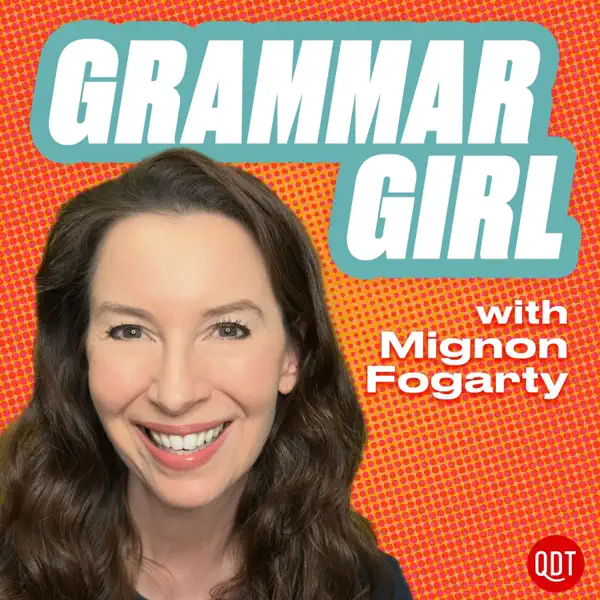
Grammar Girl
QuickAndDirtyTips.com
300 episodes
Five-time winner of Best Education Podcast in the Podcast Awards. Grammar Girl provides short, friendly tips to improve your writing and feed your love of the English language. Whether English is your first language or your second language, these grammar, punctuation, style, and business tips will make you a better and more successful writer. Grammar Girl is a Quick and Dirty Tips podcast.
More about the show
Hosted on Acast. See acast.com/privacy for more information.
Episodes page 4 of 6
-
Why we drop sounds. ChatGPT is changing how people talk. Kombi
1093. Why do we say “prob’ly” instead of “probably”? This week, we look at elision in everyday speech. Then, we look at a wild study showing that the way people talk is being influenced by AI. The elision segment was…
-
What your accent says about you (and your identity), with Rob Drummond
1092. Your accent may be saying more than your words. Sociolinguist Rob Drummond explains how accents shape our identities, how they differ across social classes, and why changing your accent can affect how you’re…
-
Are em dashes really a sign of AI writing? 'Caretaker' vs. 'caregiver'
1091. Is the em dash a sign of AI writing? I looked at where the idea comes from, and we have the final answer! Then, we look at the difference between "caregiver" and "caretaker." The "'caregiver" and "caretaker'"…
-
What your hands are saying (even when you’re not thinking about it), with Lauren Gawne
1090. Your hands may be saying more than your words. Lauren Gawne explains how gestures shape communication, how they differ across cultures, and why removing gestures can make your speech less fluent. Lauren Gawne →…
-
‘Further’ vs. ‘farther.’ Why designers use fake Latin. Blondie hot
1089. Do you wonder when you should use "further" or "farther"? We have the answer (where there is one). Then, you’ve seen lorem ipsum everywhere, but what does it mean? And where did it come from? The "lorem ipsum"…
-
What AI means for writers and editors, with Daniel Heuman
1088. He says he hates AI writing, but he's also the CEO of the company behind Draftsmith, an AI editing tool. Today, I talk with Daniel Heuman about editing, AI, energy use, and how tools like DraftSmith try to help…
-
'The' rules you never learned. Why did Latin die?
1087. You use the word "the" hundreds of times a day, but are you pronouncing it wrong? Today I have the rules I never learned about whether to say “thuh” or “thee.” Then, we look at why Latin died (and why "died"…
-
The publishing world is changing. Jane Friedman tells us how.
1086. What does it really take to earn a living as a writer? Jane Friedman explains the multiple paths writers take — from speaking and consulting to newsletters and hybrid publishing—and offers grounded, practical…
-
Why 'plz' might be pushing people away. How to write better thank-you notes. Studaloo
1085. Do abbreviations like “plz” and “ty” actually make your texts feel less sincere? New research suggests they might. We explore how shortened words affect how your messages are received — even in romantic…
-
Why simplified spelling nearly took over America (and why it didn't), with Gabe Henry
1084. This week, Gabe Henry talks about his new book, "Enough Is Enuf," and the long, strange quest to simplify English spelling. Learn why the "Chicago Tribune" made simplified spelling its house style for decades and…
-
Why 'wake' is so confusing. The playful language of vacations.
1083. Is it "woke," "woken," or "waked"? We break down why the verb "wake" is one of the trickiest in English, with four competing forms and centuries of change. Then, we lighten things up with a look at vacation…
-
Ambrose Bierce, from ‘The Devil’s Dictionary’ to disappearing in Mexico, with Jim Norrena
1082. Copy editor Jim Norrena joins us this week for a conversation about Ambrose Bierce, his famous "Devil's Dictionary," and his darkly funny take on the world. We look at Bierce’s fascinating (and tragic) life, his…
-
Why 'epitome' is confusing. Quirky stories behind baby animal names. Alice doors
1081. Is an epitome a summary or a shining example? We look at why this word trips people up and how its meaning has changed over time. Then, we take a linguistic safari through the world of baby animal names—and what…
-
How YouTubers' voices evolve, with Andrew Cheng
1080. Linguist Andrew Cheng explains why people’s accents shift over time, especially when they move—and how YouTubers make perfect data subjects. If you've ever cringed at your old voice recordings, this one’s for…
-
What dictionary labels tell us about words. Why we say 'mama'. DU, STU, and LO.
1079. Ever wonder what labels like "informal," "archaic," or "offensive" mean in a dictionary entry? We explain how different dictionaries use labels to describe when, where, and how to use words. Then, we explore why…
-
The secret to writing ‘the same but different,’ with Mary Robinette Kowal
1078. Mary Robinette Kowal talks about going from writing magic-filled Regency romances to Hugo-nominated science fiction, what it's like to work with an agent, and how she keeps her career moving forward. Plus, she…
-
'Lit' vs. 'lighted.' The mysteries of the dollar sign. Redd up.
1077. Is it “lit” or “lighted”? Both are correct, but we look at how their popularity has switched over time. Then we investigate four of the competing theories about the origin of the dollar sign and end with tips…
-
Ghostwriters, book deals, and AI: What you didn’t know about publishing, with Dan Gerstein
1076. Dan Gerstein, founder of Gotham Ghostwriters, looks at how ghostwriting fiction really works, who’s hiring ghostwriters, and why AI can’t replace human storytelling. We also talked about how ghostwriters…
-
'I.e.' versus 'e.g.' What Shakespeare actually added to English. Four schnitzels.
1075. People often confuse "i.e." and "e.g." We'll help you get them right — no Latin required. Then, in honor of Shakespeare’s birthday, we look at five common myths about his contributions to the English language,…
-
AI and the future of dictionaries, with Erin McKean
1074. Is AI good enough to replace lexicographers? Wordnik founder Erin McKean shares what works, what doesn’t, and why the future of dictionaries is far from settled. Find Erin McKean at wordnik.com, dressaday.com,…
-
Better paragraph breaks. The story behind 'mad money' and 'pin money.' Bruce bad.
1073. Today, we have practical tips for writing better paragraphs (and it's not the formulaic topic-sentence structure). Then, we look at the surprising history of phrases like “mad money” and “pin money” and what they…
-
The future of editing jobs in the age of AI, with Samantha Enslen
1072. Is AI coming for our jobs—or just the boring parts? This week, Samantha Enslen of Dragonfly Editorial talks about how she sees AI changing the work of writers and editors. We talked about real clients, real…
-
How to write photo captions. The real difference between ‘immigrate’ and ‘emigrate.’ Ko Pha-ngan'd
1071. Is it "Taylor and I" or "Taylor and me"? We explain why photo captions follow their own grammar rules. Then, we explore the subtle difference between "immigrate" and "emigrate," how the terms are used…
-
The hidden techniques behind well-paced fiction, with Joshua Essoe
1070. Fiction editor Joshua Essoe explains the hidden techniques behind pacing in storytelling. Learn how good pacing shapes reader engagement, why well-placed story beats and emotional shifts matter, and how popular…
-
Why don't we say the L in 'walk'? Never use 'always.' PABST
1069. Have you ever wondered why we have silent L's in words like "walk" and "half"? Those questions lead us to L-vocalization, spelling pronunciation, and why American and British speakers differ. Plus, we look at…
-
Exploring slang, AI ghost words, and language change, with Heddwen Newton
1068. Did Yosemite Sam ever actually say "tarnation"? What’s "fridgescaping," and why is it trending? And why is AI filling the internet with nonsense words like “lrtsjerk”? Linguist and translator Heddwen Newton…
-
What’s wrong with "'til"? Why tiny words control conversations. How many cookies?
1067. Think "'til" is a valid alternative to "until"? Think again! We learn about the difference between "till" and "until" and why many style guides frown on "'til." Then, we uncover the hidden power of…
-
The best punctuation book, period, with June Casagrande
1066. Do you really need that comma? Should your dashes have spaces? Is there ever just one "right" way to punctuate? June Casagrande, author of "The Best Punctuation Book, Period," busts punctuation myths, compares…
-
Why we say ‘OK.’ How tea shaped English slang. Poetry winner
1065. Is it "OK" or "okay"? We look at the surprising history of one of the world’s most recognized English words and how a 19th-century election campaign helped it stick. Then, we have some fun with Victorian tea…
-
Behind the scenes of Wikipedia: editing, accuracy, and notability, with Jonathan Rick
1064. Is Wikipedia the last refuge on online truth? With AI-generated content and misinformation spreading online, Wikipedia is growing in esteem, but who decides what gets published? How does Wikipedia determine…
-
How did our holidays become so 'corny'? Why do some words have accent marks in English? Cubby hole
1063. Why is it called "corned beef" when there’s no corn involved? We look at how the word "corn" evolved to mean different things over time. Then, we look at the role of accent marks in English — why some words keep…
-
Why kids can't read (and what we can do about it), with Kate Crist
1062. Did you know that 21% of U.S. adults struggle with basic literacy? In this eye-opening episode, literacy specialist Kate Crist talks about the literacy crisis in America, how reading is taught incorrectly in…
-
The mystery of ‘it’ in English. The most dramatic moments in grammar history. Ghost Town Mad, the song
1061. Ever wonder why we say "It's raining" even though "it" doesn't refer to anything? We explain the logic behind this quirky English rule. Then, we look at some of the most dramatic moments in grammar history,…
-
From 'Parasite' to 'Emilia Pérez': How movies shape language, with Andrew Cheng
1060. Why do villains always have British accents? Why was "Parasite" a game-changer for non-English films? And how is AI secretly shaping the voices you hear on screen? With the Oscars coming up, Dr. Andrew Cheng…
-
Why Americans write 'canceled' but still write 'cancellation.' How printing history gave us 'fine print.' Fluff.
1059. Ever wonder why Americans use "canceled" with one L but still write "cancellation" with two? We explore how spelling rules, stress patterns, and historical quirks explain this inconsistency. Plus, we look at the…
-
Writing Motivation Hacks, with Mary Robinette Kowal
1058. If you struggle to sit down and write, you’ll love this conversation with award-winning author and podcaster Mary Robinette Kowal. Learn how to conquer writing obstacles with tips on managing distractions,…
-
Why we misuse ‘literally.’ How ham radio got its name. District
1057. Why do people use "literally" when they mean "figuratively"? This week, we look at how the meaning of "literally" changed over time. Plus, we look at how amateur radio operators came to be known as "hams" and why…
-
How to be a ghostwriter, with Dan Gerstein
1056. Ghostwriting is more than just anonymous book writing — it’s a thriving industry. Dan Gerstein, founder of Gotham Ghostwriters, shares how writers can break into ghostwriting, what types of projects are…
-
Why some holidays have apostrophes. Why Californians say ‘the 405.’ MIGD
1055. Ever wonder why some holidays have apostrophes while others don’t? We look at Mother’s Day, Veterans Day, and Presidents’ Day. Then, we look at why Southern Californians say "the 405" while the rest of the…
-
Word games and the joy of playing every day, with Lex Friedman
1054. Ever wonder what goes into designing daily word games? Lex Friedman, creator of Lex.games, shares his journey from puzzle lover to puzzle maker, how he keeps his games fresh, and why some puzzles stump even the…
-
'Toeing' the line. Metonymy versus synecdoche. Ghost town mad
1053. If you’ve ever hesitated between ‘toe the line’ and ‘tow the line,’ this episode is for you. We look at the phrase's history to clear up the confusion. Then, we look at metonymy and synecdoche — powerful literary…
-
Wordplay and cartoons: Inside the making of 'AB@C,' with Rob Meyerson and Dan Misdea
1052. What do “CDB” and “U11 2” have in common? They’re both examples of gramograms! This week, I chat with writer Rob Meyerson and New Yorker cartoonist Dan Misdea about their book "AB@C," a fun collection of…
-
Does 'book-book' make sense? Fun words for jigsaw lovers. Chilly chickens.
1051. This week, we look at doubled words, like "salad-salad" or "job-job," and what the repetition is actually telling us. Then, in honor of National Puzzle Day, we look at the history of jigsaw puzzles and some fun…
-
The secret to writing a good memoir, with Wendy Dale
1050. This week, I talk with Wendy Dale, author of "The Memoir Engineering System," about how to write a compelling memoir. We look at the differences between memoir and autobiography, the importance of plot, and why…
-
Quotation marks in 1906. Starting stories in the middle. Road trip words.
1049. I came across a hilarious entry about quotation marks in an old usage guide and had to share it. Then, we look at a technique that can work for both fiction and nonfiction writing — starting a story in the…
-
'Rebel with a Clause,' the movie, with Ellen Jovin and Brandt Johnson
1048. Ellen Jovin set up a folding table on the street in all 50 U.S. states to talk with people about grammar, which led to the book "Rebel with a Clause." Now, her story, and the story of people who talked with her,…
-
From "august" to "August." Why the union is always "strong." Nee nee
1047. This week, we look at word pairs like "august/August" that change their meaning when capitalized and how you can make your meaning clear. Then, we look at how we got to the point where U.S. presidents always seem…
-
The psychology of fandom, with Jennifer Lynn Barnes
1046. Jennifer Lynn Barnes, author of the "Inheritance Games" books, discusses how writing from different points of view can help readers connect with characters in different ways. We also talked about her book…
-
Does 'Wicked' have a grammar error? What is the 'neck of the woods'? To be Frances
1045. A listener asked if the song "The Wizard and I" should actually be "The Wizard and Me," so we look at how you can tell. And then we look at interesting idioms about familiar places: "neck of the woods," "stomping…
-
The case of the mystery dialect, with Natalie Schilling
1044. Today, I'm talking about a strange disappearance that forensic linguist Natalie Schilling worked on that she calls "the case of the mystery dialect." This is the original bonus segment from our conversation back…
More in Education
The Mel Robbins Podcast
Mel Robbins
IMO with Michelle Obama and Craig Robinson
Higher Ground
The Rich Roll Podcast
Rich Roll
Life Kit
NPR
The Jordan Harbinger Show
Jordan Harbinger

The Jordan B. Peterson Podcast
Dr. Jordan B. Peterson
BPLUS بیپلاس پادکست فارسی خلاصه کتاب
Ali Bandari
Motivation Daily by Motiversity
Motiversity
The Bossticks
Lauryn Bosstick and Michael Bosstick / Dear Media
THE ED MYLETT SHOW
Ed Mylett

All Ears English Podcast
Lindsay McMahon and Michelle Kaplan

Conversations with Tyler
Mercatus Center at George Mason University
Shows are listed from Apple Podcasts' charts and directory, and Podcast Index where it is used. Every show and episode belongs to its publisher and plays from the publisher's own feed; this site hosts none of them. Explicit shows are for adult profiles only, and children’s profiles hear only children’s shows. More about this list.