Course9.4020 lectures24 h 34 min
Introduction to Neural Computation
Prof. Michale Fee and Daniel Zysman · Massachusetts Institute of Technology
About
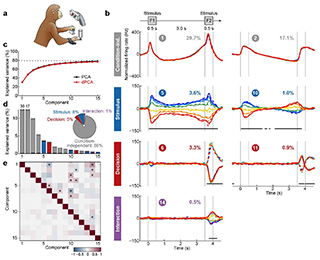
This course introduces quantitative approaches to understanding brain and cognitive functions. Topics include mathematical description of neurons, the response of neurons to sensory stimuli, simple neuronal networks, statistical inference and decision making. It also covers foundational quantitative tools of data analysis in neuroscience: correlation, convolution, spectral analysis, principal components analysis, and mathematical concepts including simple differential equations and linear algebra.
Lectures
Lecture Videos
- 1. Overview and Ionic Currents
- 2. RC Circuit and Nernst Potential
- 3. Nernst Potential and Integrate and Fire Models
- 4. Hodgkin-Huxley Model Part 1
- 5. Hodgkin-Huxley Model Part 2
- 6. Dendrites
- 7. Synapses
- 8. Spike Trains
- 9. Receptive Fields
- 10. Time Series
- 11. Spectral Analysis Part 1
- 12. Spectral Analysis Part 2
- 13. Spectral Analysis Part 3
- 14. Rate Models and Perceptrons
- 15. Matrix Operations
- 16. Basis Sets
- 17. Principal Components Analysis
- 18. Recurrent Networks
- 19. Neural Integrators
- 20. Hopfield Networks
Syllabus and materials
At MIT OpenCourseWare, as the course publishes them.
Credits and licence
- Institution
- Massachusetts Institute of Technology
- Department
- Brain and Cognitive Sciences
- Taught by
- Prof. Michale Fee, Daniel Zysman
- Term
- Spring 2018
- Level
- Undergraduate
- Language
- English
- Subjects
- Biology, Medicine and health, Engineering, Psychology and the brain
- Source
- MIT OpenCourseWare
- Licence
- CC BY-NC-SA 4.0, as MIT OpenCourseWare states it. Non-commercial use only. MIT OpenCourseWare's terms
- Attribution
- Prof. Michale Fee, Daniel Zysman. Introduction to Neural Computation. Spring 2018. Massachusetts Institute of Technology: MIT OpenCourseWare, https://ocw.mit.edu/. License: Creative Commons BY-NC-SA.
- Who can watch
- MIT OpenCourseWare gives no rating. Invisible Network shows it to Teens profiles and older, judged from what the source says about it. How courses are placed
More like this
 Course
Matrix Methods in Data Analysis, Signal Processing, and Machine Learning
34 lectures · Video
 Course
Computational Science and Engineering I
50 lectures · Video
 Course
Engineering Dynamics
223 lectures · Video
 Course
Becoming the Next Bill Nye: Writing and Hosting the Educational Show
132 lectures · Video
 Course
Introduction to Nuclear Engineering and Ionizing Radiation
34 lectures · Video
 Course
Thermodynamics of Materials
38 lectures · Video
 Course
Introduction to Solid-State Chemistry
38 lectures · Video
 Course
Introduction to Solid State Chemistry
62 lectures · Video
 Course
Symmetry, Structure, and Tensor Properties of Materials
43 lectures · Video
 Course
Biological Chemistry I
75 lectures · Video
 Course
Biological Chemistry II
49 lectures · Video
 Course
Computation Structures
35 lectures · Video