Course21M.38347 lectures
Computational Music Theory and Analysis
Prof. Michael Scott Asato Cuthbert · Massachusetts Institute of Technology
About
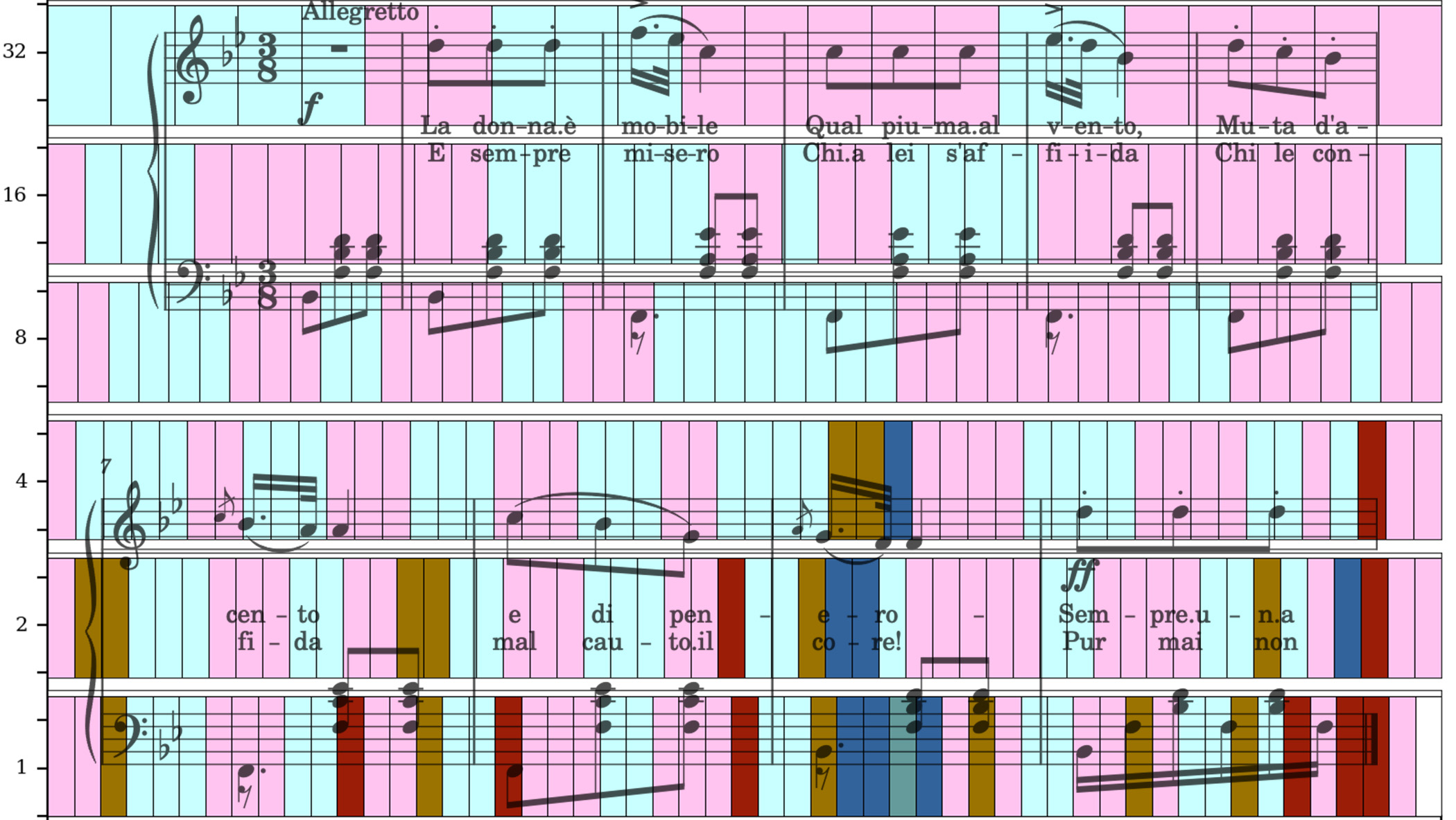
This course presents major approaches to computational music theory and musicology in the symbolic (score-based) domain. It covers algorithms for music theory, encoding, corpus studies, musical search and similarity, feature extraction and machine learning, music generation, and computational music perception. Other topics include repertory access and computational bias. Programming assignments are in Python using the MIT-created music21 toolkit.
Lectures
Videos
- Video 0: Overview of 21M.383 Computational Music Theory for OCW Learners
- Class 1 Video: How Do Computers "Hear" Music?
- Video 1a: music21 Coding Tutorial for OCW Learners
- Class 2 Video: Representation of Notes, Pitches, and Durations
- Video 3a: Introduction to Pitch Representation
- Video 3b: Pitch Representation: Pros, Cons, and Stakeholders
- Video 3c: How to Approach the Problem Sets
- Class 4 Video: Intro to Scores and Music Representation
- Video 4a: How to Read an Academic Article
- Video 4b: Music Representation in General
- Class 5 Video: Music Representation (II)
- Video 6a: Music Representation (III): Unlocking Pitch in music21
- Video 6b: Representations of Ontologies: Craig Sapp’s Rosetta Stone
- Class 7 Video: Music Representation (IV) & Hierarchies (I)
- Video 7a: Unlocking Duration and Note Objects in music21
- Video 7b: Streams as Hierarchies: Types of Containers in music21
- Video 7c: music21 Streams, Corpus, and Meter Features
- Video 7d: Partwise vs. Timewise Polyphonic Representations
- Class 8 Video: Hierarchies (II): Streams and Recursions
- Video 9a: Music Information Retrieval (MIR): Sound to Score and Music Theory
- Video 9b: Introduction to MusicXML
- Video 9c: Interview with Michael Good on MusicXML
- Class 10 Video: Equivalence and Intervals (I); Hierarchies (IV)
- Video 10a: Review: Equivalence Classes and OPTIC
- Class 11 Video: Equivalence and Intervals (II) and Filters in music21
- Video 12a: Painting Emotions in Music and Text
- Video 12b: Chorales as a Corpus
- Video 12c: Graphing and Plotting in music21
- Video 12d: How to Work with Ties in music21
- Class 13 Video: Corpus Studies and Statistics
- Class 14 Video: Corpus Studies and Statistics (II)
- Class 15 Video: Encoding Corpora and Voice Leading
- Class 17 Video: Introduction to Music Cognition
- Classes 18-21 Video: Brief Synopsis of Guest Sessions on Music Cognition
- Video 22a: Chord Review and 13 Chords: Some Problems with Roots
- Video 22b: Problem Sets 7-8: Working and Composing with Scales, Chords, and Roman Numerals
- Video 22c: Algorithmic Improvisation: Intro to George Lewis
- Class 23 Video: Algorithmic Composition
- Class 24 Video: Algorithmic Composition (II)
- Class 25 Video: Algorithmic Composition (III)
- Video 26a: Vocabulary Reduction
- Class 27 Video: Feature Extraction and Machine Learning
- Class 28 Video: Feature Extraction and Machine Learning (II)
- Video 29a: Feature Extraction and Machine Learning (III): Artificial Intelligence
- Class 30 Video: Mathematical and Statistical Musicology
- Class 31 Video: Music Visualization and Optical Music Recognition
- Video 32a: Tipping the Iceberg
Syllabus and materials
At MIT OpenCourseWare, as the course publishes them.
- Syllabus
- About the Course and music21
- About This Class and Your Instructor
- Setting Up Your Own Dev Environment
- About Asynchronous Materials
- Class 1: Welcome / Introduction
- Class 2: Representation of Notes, Pitches, and Durations
- Class 3: Asynchronous Material on Pitch Representation and Their Stakeholders
- Some Simple Pitch Representations
- How Problem Sets Will Work
- Problem Set 1: Pitch Representation and Manipulation
- Class 4: Introduction to Scores and Music Representation
- Class 5: Music Representation (II)
- Class 6: Asynchronous Material Asynchronous Material on Representation of…
- Problem Set 2: Computational Ontology + Representation System
- Class 7: Music Representation and Hierarchies
- Class 8: Hierarchies (II): Streams and Recursions
- Class 9: Asynchronous Material on Music Representation, Streams, Music…
- Problem Set 3: Stream Encoding and Bach Chorales
- Class 10: Equivalence and Intervals (I); Hierarchies (IV)
- Problem Set 4: Equivalence, Representation, and Intervals
- Class 11: Equivalence and Intervals (II) and Filters in music21
- Class 12: Asynchronous Material on Corpus Studies and Statistics
- Problem Set 5: Corpus Research
- Class 13: Corpus Studies and Statistics
Credits and licence
- Institution
- Massachusetts Institute of Technology
- Department
- Music
- Teacher
- Prof. Michael Scott Asato Cuthbert
- Term
- Spring 2023
- Level
- Undergraduate
- Language
- English
- Subjects
- Mathematics, Computer science, History, Art, architecture and design, Music
- Source
- MIT OpenCourseWare
- Licence
- CC BY-NC-SA 4.0, as MIT OpenCourseWare states it. Non-commercial use only. MIT OpenCourseWare's terms
- Attribution
- Prof. Michael Scott Asato Cuthbert. Computational Music Theory and Analysis. Spring 2023. Massachusetts Institute of Technology: MIT OpenCourseWare, https://ocw.mit.edu/. License: Creative Commons BY-NC-SA.
- Who can watch
- MIT OpenCourseWare gives no rating. Invisible Network shows it to Teens profiles and older, judged from what the source says about it. How courses are placed
More like this
 Course
The Analytics Edge
35 lectures · Video
 Course
Single Variable Calculus
35 lectures · Video
 Course
Multivariable Calculus
35 lectures · Video
 Course
Matrix Methods in Data Analysis, Signal Processing, and Machine Learning
34 lectures · Video
 Course
Linear Algebra
35 lectures · Video
 Course
Linear Algebra
158 lectures · Video
 Course
Computational Science and Engineering I
50 lectures · Video
 Course
Becoming the Next Bill Nye: Writing and Hosting the Educational Show
132 lectures · Video
 Course
Computation Structures
35 lectures · Video
 Course
Introduction to Algorithms
47 lectures · Video
 Course
Introduction to Electrical Engineering and Computer Science I
54 lectures · Video
 Course
Probabilistic Systems Analysis and Applied Probability
149 lectures · Video