Course6.01SC54 lectures34 h 58 min
Introduction to Electrical Engineering and Computer Science I
Prof. Leslie Kaelbling and others · Massachusetts Institute of Technology
About
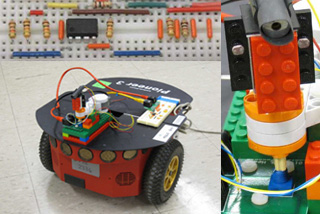
This course provides an integrated introduction to electrical engineering and computer science, taught using substantial laboratory experiments with mobile robots. Our primary goal is for you to learn to appreciate and use the fundamental design principles of modularity and abstraction in a variety of contexts from electrical engineering and computer science.
Our second goal is to show you that making mathematical models of real systems can help in the design and analysis of those systems. Finally, we have the more typical goals of teaching exciting and important basic material from electrical engineering and computer science, including modern software engineering, linear systems analysis, electronic circuits, and decision-making.
Course Format
This course has been designed for independent study. It includes all of the materials you will need to understand the concepts covered in this subject. The materials in this course include:
Lecture videos from Spring 2011, taught by Prof. Dennis Freeman
Recitation videos, developed for OCW Scholar by teaching assistant Kendra Pugh
Course notes
Software and design labs
Homework assignments and additional exercises
Nano-quizzes and exams with solutions
Content Development
Leslie Kaelbling
Lectures
Object-Oriented Programming
- Lecture 1: Object-Oriented Programming
- Recitation 1: Object-Oriented Programming
- Recitation 2: Inheritance
State Machines
- Lecture 2: Primitives, Combination, Abstraction, and Patterns
- Recitation 3: Python Notables
- Recitation 4: State Machines
Signals and Systems
Linear Time-Invariant Signals and Systems
Characterizing System Performance
- Lecture 5: Characterizing System Performance
- Recitation 7: Poles, Part I
- Recitation 8: Poles, Part II
Designing Control Systems
Circuits
- Lecture 7: Circuits
- Recitation 9: Circuits: Representation, KVL, KCL
- Recitation 10: Circuits: NVCC, Sample Problem
Op-Amps
Circuit Abstractions
Discrete Probability
State Estimation
Search Algorithms
Optimizing a Search
Resource Index
- Lecture 1: Object-Oriented Programming
- Recitation 1: Object-Oriented Programming
- Recitation 2: Inheritance
- Lecture 2: Primitives, Combination, Abstraction, and Patterns
- Recitation 3: Python Notables
- Recitation 4: State Machines
- Lecture 3: Signals and Systems
- Recitation 5: LTI Motivations and Representations
- Recitation 6: System Equivalences
- Lecture 5: Characterizing System Performance
- Recitation 7: Poles, Part I
- Recitation 8: Poles, Part II
- Lecture 6: Designing Control Systems
- Lecture 7: Circuits
- Recitation 9: Circuits: Representation, KVL, KCL
- Recitation 10: Circuits: NVCC, Sample Problem
- Lecture 8: Op-Amps
- Recitation 11: Op-Amps
- Lecture 9: Circuit Abstractions
- Recitation 12: Thevenin/Norton Equivalence and Superposition
- Lecture 10: Discrete Probability and State Estimation
- Recitation 13: Probability: Basics
- Recitation 14: Probability: State Estimation
- Lecture 12: Search Algorithms
- Recitation 15: Search: Basics
- Lecture 13: Optimizing a Search
- Recitation 16: Search: Dynamic Programming, Costs and Heuristics
Syllabus and materials
At MIT OpenCourseWare, as the course publishes them.
Credits and licence
- Institution
- Massachusetts Institute of Technology
- Department
- Electrical Engineering and Computer Science
- Taught by
- Prof. Leslie Kaelbling, Prof. Jacob White, Prof. Harold Abelson, Prof. Dennis Freeman, Prof. Tomás Lozano-Pérez, Prof. Isaac Chuang
- Term
- Spring 2011
- Level
- Undergraduate
- Language
- English
- Subjects
- Computer science, Engineering, Art, architecture and design
- Source
- MIT OpenCourseWare
- Licence
- CC BY-NC-SA 4.0, as MIT OpenCourseWare states it. Non-commercial use only. MIT OpenCourseWare's terms
- Attribution
- Prof. Leslie Kaelbling, Prof. Jacob White, Prof. Harold Abelson, Prof. Dennis Freeman, Prof. Tomás Lozano-Pérez, Prof. Isaac Chuang. Introduction to Electrical Engineering and Computer Science I. Spring 2011. Massachusetts Institute of Technology: MIT OpenCourseWare, https://ocw.mit.edu/. License: Creative Commons BY-NC-SA.
- Who can watch
- MIT OpenCourseWare gives no rating. Invisible Network shows it to Tweens profiles and older, judged from what the source says about it. How courses are placed
More like this
 Course
Matrix Methods in Data Analysis, Signal Processing, and Machine Learning
34 lectures · Video
 Course
Computational Science and Engineering I
50 lectures · Video
 Course
Engineering Dynamics
223 lectures · Video
 Course
Becoming the Next Bill Nye: Writing and Hosting the Educational Show
132 lectures · Video
 Course
Introduction to Nuclear Engineering and Ionizing Radiation
34 lectures · Video
 Course
Thermodynamics of Materials
38 lectures · Video
 Course
Introduction to Solid-State Chemistry
38 lectures · Video
 Course
Introduction to Solid State Chemistry
62 lectures · Video
 Course
Symmetry, Structure, and Tensor Properties of Materials
43 lectures · Video
 Course
Computation Structures
35 lectures · Video
 Course
Introduction to Algorithms
47 lectures · Video
 Course
Probabilistic Systems Analysis and Applied Probability
149 lectures · Video