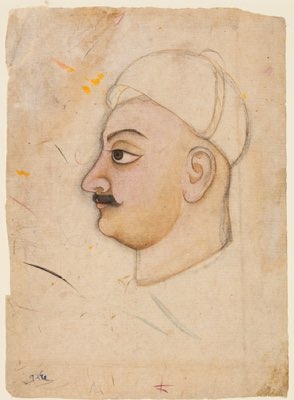
Falcon on a Perch
Falcon on a Perch
c. 1610
Krishna Abhisarika Nayika, from a Rasikapriya manuscript
c. 1615–25
Portrait of Gadadhar Prasad
1881
Drawing of a Man’s Head with an Unusual Turban
c. 1780
Prince Mathu Singh of Jatoli on a Blue Horse Riding to Udaipur
c. 1720
Krishna watches the milkmaids circumambulating a sacred tree: The month of Jyestha (May–June), from a Barahmasa (The Twelve Months)
c. 1760
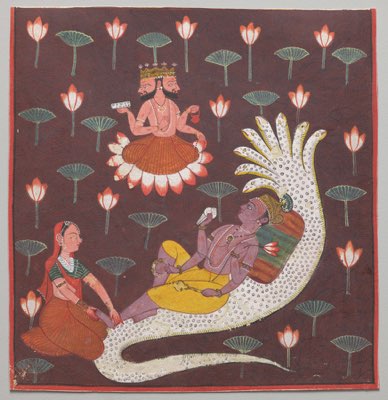
Vishnu on Ananta, the Endless Serpent
c. 1700
Krishna and Radha Quarreling: Shatha Nayaka, from a Rasikapriya
c. 1680
Sultan Ibrahim ibn Adham of Balkh Visited by Angels
c. 1740
Woman Addressing a Peacock: Gujari Ragini of Megh, from a Ragamala
c. 1680
Still Life: Bouquet of Flowers Emerging from the Grass
c. 1750
Feast where Vishnu decides he will incarnate as King Dasharatha’s sons, from Chapters 14–15 of the "Bala Kanda" (Book of Childhood) of a Ramayana (Rama’s Journey)
c. 1810
The Goddess Annihilates the Demon Raktabija, from a Devi-Mahatmya
c. 1640
Three Musicians Perform Before a King: Shri Raga, from a Ragamala
c. 1650
Women Play Music for Radha and Krishna: Chitrini Nayika, from a Rasikapriya
c. 1650
Two Women Pluck Flowers on a Terrace: Gunakali Ragini, from a Ragamala
c. 1650
A Brahmin gives Krishna the Message or Invitation for the Competition to Rukmini’s Svayamvara, from a Bhagavata Purana
c. 1650–60
Krishna Lifts Mount Govardhan, from a Bhagavata Purana
1686
Krishna and the Cowherds Dive into the River, from a Rasikapriya
c. 1640
Krishna and Radha Avoid Embarrassment: Mottaita Bhava, from a Rasikapriya
c. 1640
Portrait of Prince Sur Singh Rathor of Bikaner (1594–1631)
1611–13
Krishna Under a Canopy
c. 1680
A Disconsolate Lady on a Terrace with Attendants
c. 1730
Krishna Exacts a Toll from the Milkmaids: Dana-Lila, from a Bhagavata Purana
c. 1600
Five Poses of Krishna Making Love, from a Bikaner Bhagavata Purana
c. 1600
Krishna and Consort on a Palace Balcony with Musicians: Vukharo Ragaputra of Bhairav, from the “Boston Ragamala”
1770–75
Woman Longing for Her Lover: Verati Ragini of Dipak, from a Ragamala
1650–60
A Prince Performs Austerities (recto); Shiva and His Followers Return to Mount Kailash (verso), from a Romance of Chandrabhanu and Lavanyavati of Upendra Bhanja (1670–1740)
1700s
Noblewoman at a Jharokha Window Holding a Rose, from a Portraits of Women series
c. 1730
St Vincent de Paul at the Deathbed of Louis XIII
Jean Francois de Troy · 1731
Lepel
Lepel
B. Dellemijn · 1842 - 1898
Vork
Vork
B. Dellemijn · 1842 - 1898
As punishment, the jester’s wife and the Zangi are thrown into fire and the emir’s wife and the mahout are trampled by an elephant, from a Tuti-nama (Tales of a Parrot), Twenty-second Night
c. 1560
The sentinel in the employ of the Shah of Tabaristan prepares to sacrifice his son to the ghost of the Shah’s soul, from a Tuti-nama (Tales of a Parrot): Second Night
c. 1560
The forty wives and their secret paramours being punished by stoning to death, from a Tuti-nama (Tales of a Parrot): Twenty-third Night
c. 1560
The Parrot Addresses Khujasta at the Beginning of the Twenty-third Night, from a Tuti-nama (Tales of a Parrot)
c. 1560
The merchant’s daughter gives birth to a son as a result of eating out of the box. The clever child recognizes the false gems from true, from a Tuti-nama (Tales of a Parrot): Twenty-third Night
c. 1560
The merchant has the hateful skull ground and put into a box, from a Tuti-nama (Tales of a Parrot): Twenty-third Night
c. 1560
Kamjuy, the wife of the Raja, averts her face from the fishes, from a Tuti-nama (Tales of a Parrot): Twenty-third Night
c. 1560
The prince meets a carefree dancing dervish whose good fortune he purchases for his ring, from a Tuti-nama (Tales of a Parrot): Eighteenth Night
c. 1560
The young man, who has magically taken on the appearance of Mansur the merchant, arrives at his home, from a Tuti-nama (Tales of a Parrot): Seventeenth Night
c. 1560
The young man changes himself to look like Mansur, and thus inveigles himself into the bed of Mansur’s wife, but is put off by her, from a Tuti-nama (Tales of a Parrot): Seventeenth Night
c. 1560
The false Mansur punished before the judge and expelled from the city, from a Tuti-nama (Tales of a Parrot): Seventeenth Night
c. 1560
The Parrot Addresses Khujasta at the Beginning of the Eighteenth Night, from a Tuti-nama (Tales of a Parrot)
c. 1560
Khalis repays the prince for his kindness by changing into a snake and sucking the poison from the king’s daughter, from a Tuti-nama (Tales of a Parrot): Eighteenth Night
c. 1560
The prince, having deprived the snake of its natural food, a frog, feeds it with a piece of his own flesh, from a Tuti-nama (Tales of a Parrot): Eighteenth Night
c. 1560
Nikfal, the fortune of the prince in the form of a woman, offers to accompany him, from a Tuti-nama (Tales of a Parrot): Eighteenth Night
c. 1560
The prince, with the help of Mukhlis who changes into a frog, recovers the ring lost in the sea, and returns it to the king, from a Tuti-nama (Tales of a Parrot): Eighteenth Night
c. 1560