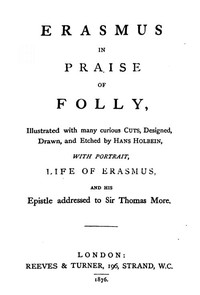
In Praise of Folly
Illustrated with Many Curious Cuts
Illustrated by Hans Holbein
"In Praise of Folly" by Desiderius Erasmus is an oration written in Latin in 1509. In this spiraling satirical work, the personified goddess Folly praises herself while attacking every aspect of human life—from lovers and princes to superstitious religious practices and church corruption. What begins as playful mockery grows darker as Erasmus examines self-deception, madness, and the contrast between human wisdom and divine folly. The work ultimately pivots toward an orthodox Christian purpose, revealing deeper meaning beneath its satirical surface.
Summary written by Project Gutenberg, by machine.
- Language
- English
- On Project Gutenberg since
- 6 October 2009
- Read in the last 30 days
- 4,110 times at Project Gutenberg
More by Desiderius Erasmus
See all: More by Desiderius Erasmus
A dialoge or communication of two persons

The Colloquies of Erasmus, Volume I.
Erasmus Against War

A Modest Meane to Mariage

Selections from Erasmus: Principally from his Epistles

One dialogue, or Colloquye of Erasmus (entituled Diuersoria)

Een twaalftal samenspraken

De Lof der Zotheid

The Praise of Folly

Das Lob der Narrheit

The Education of Children

A Merry Dialogue Declaringe the Properties of Shrowde Shrews and Honest Wives

Two Dyaloges (c. 1549)

A Very Pleasaunt & Fruitful Diologe Called the Epicure

Encomium Artis Medicae: De Lof Der Geneeskunde
Encomium artis medicae
More from the shelf “Banned Books from Anne Haight's list”
See all: More from the shelf “Banned Books from Anne Haight's list”
The Adventures of Sherlock Holmes

The Prince

History of Tom Jones, a Foundling

The Adventures of Tom Sawyer, Complete

The Scarlet Letter
Adventures of Huckleberry Finn
Ulysses
The Kama Sutra of Vatsyayana

On the Origin of Species By Means of Natural Selection

The History of the Decline and Fall of the Roman Empire

The call of the wild

Les Misérables

Gulliver's Travels into Several Remote Nations of the World

The Sorrows of Young Werther

Dubliners

The Awakening, and Selected Short Stories

Candide

Uncle Tom's Cabin

Essays of Michel de Montaigne — Complete