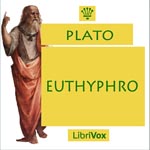
Euthyphro
by Plato
Translated by Benjamin Jowett
"Euthyphro" by Plato is a philosophical dialogue written around 399 BC. Set outside an Athenian court, it follows Socrates as he awaits trial for impiety. He encounters Euthyphro, a confident prophet prosecuting his own father for murder. Socrates asks Euthyphro to define piety, sparking a rigorous examination that produces increasingly refined definitions—yet none prove satisfactory. Their discussion culminates in a famous dilemma about the gods' relationship to goodness, launching a debate that continues millennia later.
Summary written by Project Gutenberg, by machine.
- Language
- English
- On Project Gutenberg since
- 1 February 1999
- Read in the last 30 days
- 6,482 times at Project Gutenberg
Listen to it
More by Plato
See all: More by Plato
The Republic of Plato
The works of Plato (Vol. 2 of 6)
The dialogues of Plato in five volumes, Vol. 2 (of 5)
The Project Gutenberg Works of Plato: An Index
De republiek van Plato
The works of Plato (Vol. 1 of 6)
Crito: Een dialoog van Plato
The Republic

Apology

Symposium
Phaedrus

Phaedo

Gorgias

Meno

Theaetetus

Laws

Timaeus

Apology, Crito, and Phaedo of Socrates

Ion

Protagoras
More from the shelf “Philosophy”
See all: More from the shelf “Philosophy”
The Prince

Second Treatise of Government
Thus Spake Zarathustra: A Book for All and None
Beyond Good and Evil
The Republic
On Liberty
Apology
The Nicomachean ethics of Aristotle

The Problems of Philosophy

The Critique of Pure Reason

The Communist Manifesto

The Poetics of Aristotle

Ethics

Discourse on the Method of Rightly Conducting One's Reason and of Seeking Truth in the Sciences

Democracy and Education: An Introduction to the Philosophy of Education

Utilitarianism

An Enquiry Concerning Human Understanding

Tractatus Logico-Philosophicus

A System of Logic, Ratiocinative and Inductive