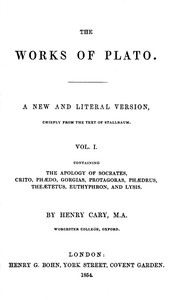
The works of Plato (Vol. 1 of 6)
by Plato
Translated by Henry Cary · Translated by Gottfried Stallbaum
The Republic (Ancient Greek: Πολιτεία, romanized: Politeia; Latin: De Republica) is a Socratic dialogue authored by Plato around 375 BC, concerning justice (dikaiosúnē), the order and character of the just city-state, and the just man. It is Plato's best-known work, and one of the world's most influential works of philosophy and political theory, both intellectually and historically. In the dialogue, Socrates discusses with various Athenians and foreigners the meaning of justice and whether the just man is happier than the unjust man. He considers the natures of existing regimes and then proposes a series of hypothetical cities in comparison, culminating in Kallipolis (Καλλίπολις), a utopian city-state ruled by a class of philosopher-kings. They also discuss ageing, love, theory of forms, the immortality of the soul, and the role of the philosopher and of poetry in society. The dialogue's setting seems to be the time of the Peloponnesian War. (This summary is from Wikipedia.)
Summary written by Project Gutenberg, by machine.
- Language
- English
- On Project Gutenberg since
- 6 May 2026
- Read in the last 30 days
- 613 times at Project Gutenberg
More by Plato
See all: More by Plato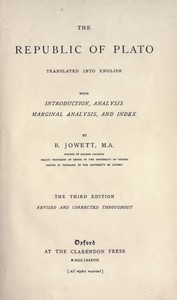
The Republic of Plato
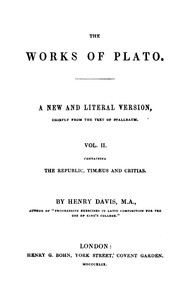
The works of Plato (Vol. 2 of 6)
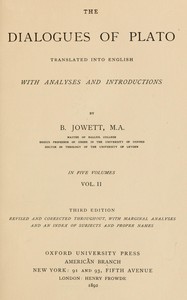
The dialogues of Plato in five volumes, Vol. 2 (of 5)
The Project Gutenberg Works of Plato: An Index
De republiek van Plato
Crito: Een dialoog van Plato
The Republic

Apology

Symposium
Phaedrus

Phaedo

Gorgias

Euthyphro

Meno

Theaetetus

Laws

Timaeus

Apology, Crito, and Phaedo of Socrates

Ion