Window mode follows your eyes with your camera, in this browser only: no picture or position leaves your device.
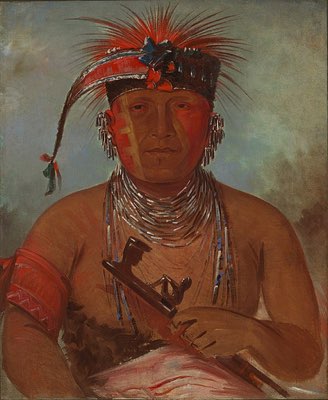
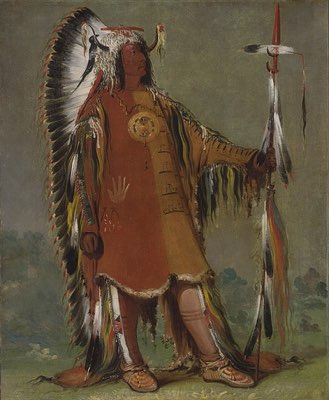
Toh-kí-e-to, Stone With Horns, a Chief
George Catlin (born Wilkes-Barre, PA 1796-died Jersey City, NJ 1872)
1832
- Medium
- oil on canvas
- Classification
- Paintings
- Dimensions
- 29 x 24 in. (73.7 x 60.9 cm)
- Culture
- Indians of North America
- Museum
- Smithsonian Institution, Smithsonian American Art Museum, Painting and Sculpture
- Credit line
- Smithsonian American Art Museum, Gift of Mrs. Joseph Harrison, Jr.
- Rights
- CC0 (Smithsonian Open Access), as the museum states it.
- Who can see it
- Tweens profiles and older: its subjects are known and suit older children. How works are placed
View at the Smithsonian Institution
About this work
George Catlin painted Stone with Horns at Fort Pierre, on his Missouri River trip in 1832. Stone with Horns was a chief of the Yankton Nakota, and Catlin described him in his travel account, Letters and Notes: “Toh-ki-e-to . . . [is] reputed the principal and most eloquent orator of the nation. The neck, and breast, and shoulders of this man, were curiously tattooed, by pricking in gunpowder and vermilion, which in this extraordinary instance, was put on in such elaborate profusion as to appear at a little distance like a beautifully embroidered dress. In his hand he held a handsome pipe, the stem of which was several feet long, and all the way wound with ornamented braids of the porcupine quills. Around his body was wrapped a valued robe, made of the skin of the grizzly bear, and on his neck several strings of wampum . . . I was much amused with the excessive vanity and egotism of this notorious man, who, whilst sitting for his picture, took occasion to have the interpreter constantly explaining to me the wonderful effects which his oratory had at different times produced on the minds of the chiefs and people of his tribe.” (Catlin, Letters and Notes, vol. 1, no. 27, 1841;…