Window mode follows your eyes with your camera, in this browser only: no picture or position leaves your device.
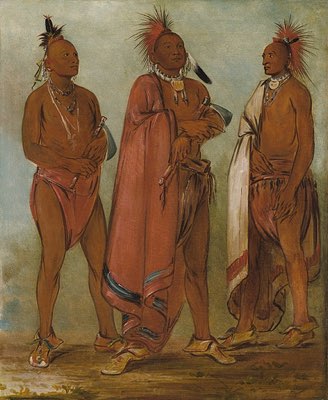
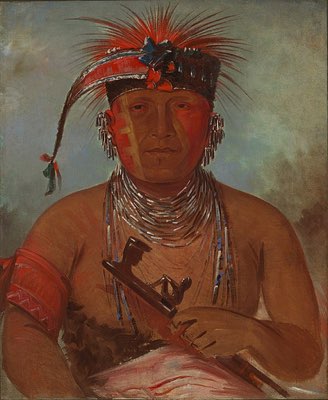
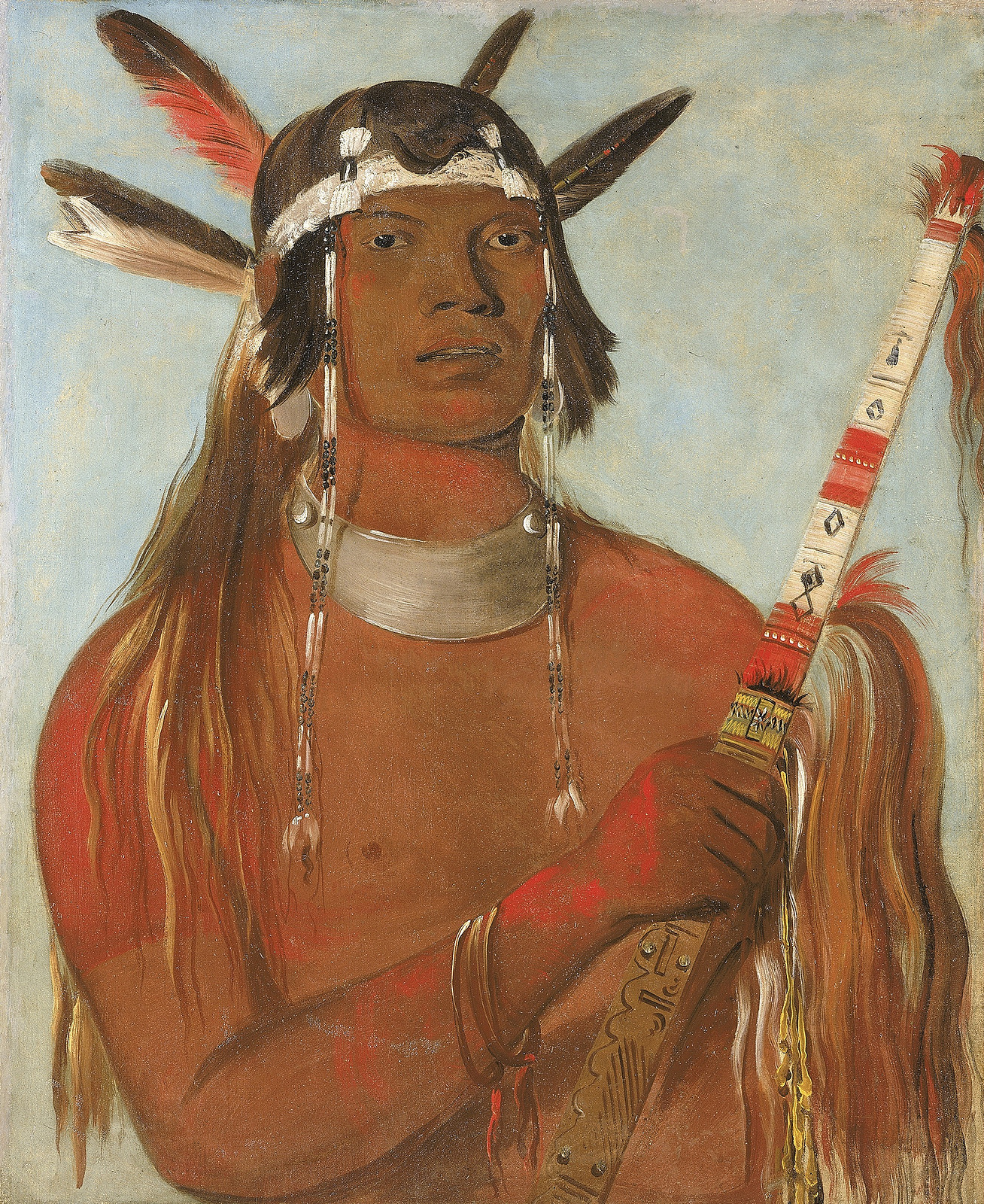
Seehk-hée-da, Mouse-colored Feather, a Noted Brave
George Catlin (born Wilkes-Barre, PA 1796-died Jersey City, NJ 1872)
1832
- Medium
- oil on canvas
- Classification
- Paintings
- Dimensions
- 29 x 24 in. (73.7 x 60.9 cm)
- Culture
- Indians of North America
- Museum
- Smithsonian Institution, Smithsonian American Art Museum, Painting and Sculpture
- Credit line
- Smithsonian American Art Museum, Gift of Mrs. Joseph Harrison, Jr.
- Rights
- CC0 (Smithsonian Open Access), as the museum states it.
- Who can see it
- Tweens profiles and older: its subjects are known and suit older children. How works are placed
View at the Smithsonian Institution
About this work
George Catlin took great care in describing the Mandan tribe. About their hair he wrote: “The diversity in the colour of hair is also equally as great as that in the complexion; for in a numerous group of these people (and more particularly amongst the females, who never take pains to change its natural colour, as the men often do), there may be seen every shade and colour of hair that can be seen in our own country, with the exception of red or auburn, which is not to be found.” Mouse-colored Feather posed “with a beautiful pipe in his hand,” and his hair was “quite yellow.” The artist painted this work at a Mandan village in 1832. (Catlin, Letters and Notes, vol. 1, no. 13, 1841, reprint 1973, and 1848 Catalogue, Catlin’s Indian Gallery, SAAM online exhibition)