Window mode follows your eyes with your camera, in this browser only: no picture or position leaves your device.
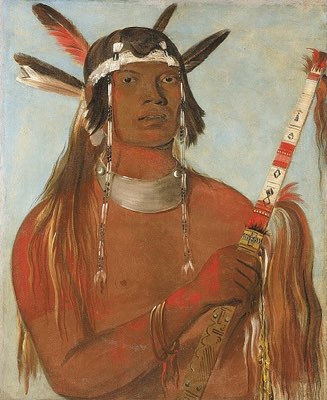
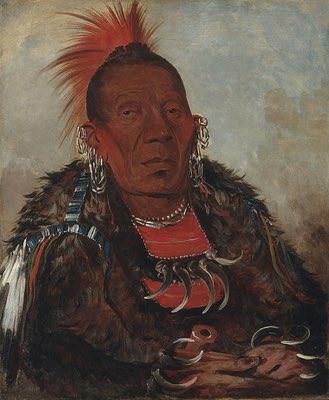
Wée-ke-rú-law, He Who Exchanges
George Catlin (born Wilkes-Barre, PA 1796-died Jersey City, NJ 1872)
1832
- Medium
- oil on canvas
- Classification
- Paintings
- Dimensions
- 29 x 24 in. (73.7 x 60.9 cm)
- Culture
- Indians of North America
- Museum
- Smithsonian Institution, Smithsonian American Art Museum, Painting and Sculpture
- Credit line
- Smithsonian American Art Museum, Gift of Mrs. Joseph Harrison, Jr.
- Rights
- CC0 (Smithsonian Open Access), as the museum states it.
- Who can see it
- Teens profiles and older: its subject is for older viewers (war, death, the Passion, drink or the like). How works are placed
View at the Smithsonian Institution
About this work
This portrait reflects George Catlin’s respect for the Native Americans who posed for him. He Who Exchanges looked directly at Catlin while the painter worked to capture his likeness. The figure’s pose reflects the symbolic importance of the effigy pipe he holds in his hand. Catlin had been given a similar pipe by a Pawnee, who explained that the seated figure on the pipe was his own portrait and that it would enable him to look a white man in the face. (Gurney and Heyman, eds., George Catlin and His Indian Gallery, 2002)