Window mode follows your eyes with your camera, in this browser only: no picture or position leaves your device.
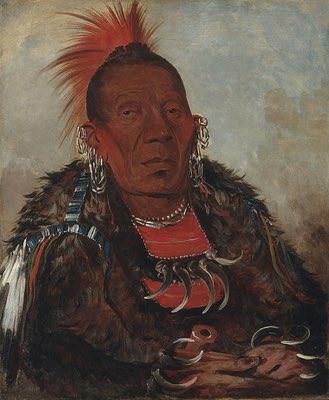
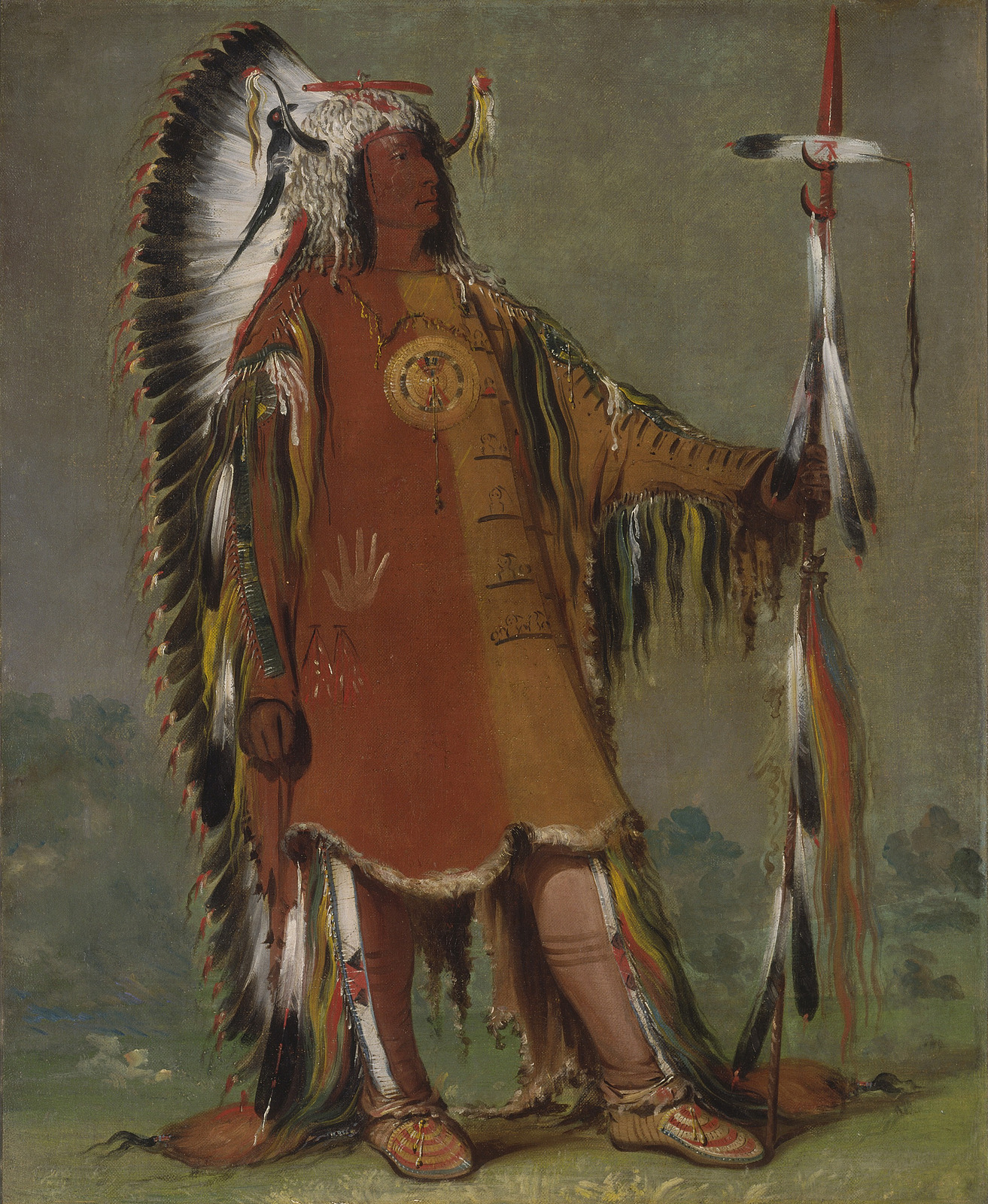
Máh-to-tóh-pa, Four Bears, Second Chief, in Full Dress
George Catlin (born Wilkes-Barre, PA 1796-died Jersey City, NJ 1872)
1832
- Medium
- oil on canvas
- Classification
- Paintings
- Dimensions
- 29 x 24 in. (73.7 x 60.9 cm)
- Culture
- Indians of North America
- Museum
- Smithsonian Institution, Smithsonian American Art Museum, Painting and Sculpture
- Credit line
- Smithsonian American Art Museum, Gift of Mrs. Joseph Harrison, Jr.
- Rights
- CC0 (Smithsonian Open Access), as the museum states it.
- Who can see it
- Tweens profiles and older: its subjects are known and suit older children. How works are placed
View at the Smithsonian Institution
About this work
George Catlin described Four Bears, a chief of the Mandan tribe, as an "extraordinary man, though second in office, [he] is undoubtedly the first and most popular man in the nation. Free, generous, elegant and gentlemanly in his deportment---handsome, brave and valiant; wearing a robe on his back, with the history of his battles emblazoned on it; which would fill a book of themselves, if properly translated . . . Máh-to-tóh-pa had agreed to stand before me for his portrait at an early hour of the next morning . . . I looked out of the door of the wigwam, and saw him approaching with a firm and elastic step, accompanied by a great crowd of women and children, who were gazing on him with admiration, and escorting him to my room. No tragedian ever trod the stage, nor gladiator ever entered the Roman Forum, with more grace and manly dignity than did Máh-to-tóh-pa enter the wigwam, where I was in readiness to receive him." The artist painted this portrait at a Mandan village in 1832. (Catlin, Letters and Notes, vol. 1, nos. 13, 21, 1841; reprint 1973)