Window mode follows your eyes with your camera, in this browser only: no picture or position leaves your device.
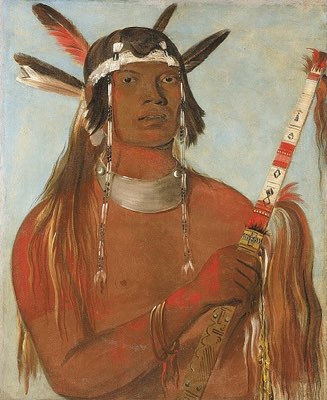
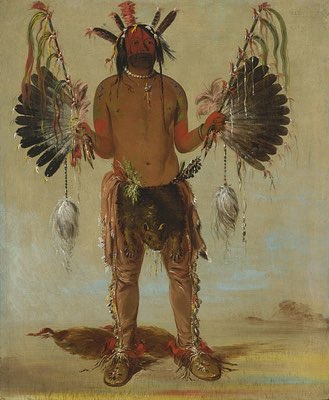
Wúk-mi-ser, Corn, a Miniconjou Warrior
George Catlin (born Wilkes-Barre, PA 1796-died Jersey City, NJ 1872)
1832
- Medium
- oil on canvas
- Classification
- Paintings
- Dimensions
- 29 x 24 in. (73.7 x 60.9 cm)
- Culture
- Indians of North America
- Museum
- Smithsonian Institution, Smithsonian American Art Museum, Painting and Sculpture
- Credit line
- Smithsonian American Art Museum, Gift of Mrs. Joseph Harrison, Jr.
- Rights
- CC0 (Smithsonian Open Access), as the museum states it.
- Who can see it
- Teens profiles and older: its subject is for older viewers (war, death, the Passion, drink or the like). How works are placed
View at the Smithsonian Institution
About this work
“I am now in the heart of the country belonging to the numerous tribe of Sioux or Dahcotas, and have Indian faces and Indian customs in abundance around me. This tribe is one of the most numerous in North America, and also one of the most vigorous and warlike tribes to be found, numbering some forty or fifty thousand, and able undoubtedly to muster, if the tribe could be moved simultaneously, at least eight or ten thousand warriors, well mounted and well armed. This tribe take vast numbers of the wild horses on the plains towards the Rocky Mountains, and many of them have been supplied with guns; but the greater part of them hunt with their bows and arrows and long lances, killing their game from their horses' backs while at full speed.” George Catlin painted Wúk-mi-ser at Fort Pierre in 1832. (Catlin, Letters and Notes, vol. 1, no. 26, 1841; reprint 1973)