Window mode follows your eyes with your camera, in this browser only: no picture or position leaves your device.
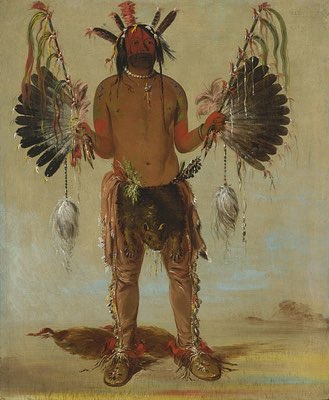
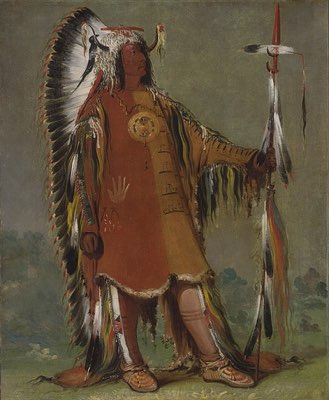
Tóh-to-wah-kón-da-pee, Blue Medicine, a Medicine Man of the Ting-ta-to-ah Band
George Catlin (born Wilkes-Barre, PA 1796-died Jersey City, NJ 1872)
1835
- Medium
- oil on canvas
- Classification
- Paintings
- Dimensions
- 29 x 24 in. (73.7 x 60.9 cm)
- Culture
- Indians of North America
- Museum
- Smithsonian Institution, Smithsonian American Art Museum, Painting and Sculpture
- Credit line
- Smithsonian American Art Museum, Gift of Mrs. Joseph Harrison, Jr.
- Rights
- CC0 (Smithsonian Open Access), as the museum states it.
- Who can see it
- Tweens profiles and older: its subjects are known and suit older children. How works are placed
View at the Smithsonian Institution
About this work
George Catlin described Blue Medicine, a member of the Eastern Sioux/Dakota tribe, as a noted doctor or medicine man, “with his medicine or mystery drum and rattle in his hands, his looking-glass on his breast, his rattle of antelope's hoofs, and drum of deer-skins.” The artist painted this portrait in 1835 at Fort Snelling, a military post in today’s Minnesota. (Catlin, 1848 Catalogue, Catlin’s Indian Gallery, SAAM online exhibition)