Window mode follows your eyes with your camera, in this browser only: no picture or position leaves your device.
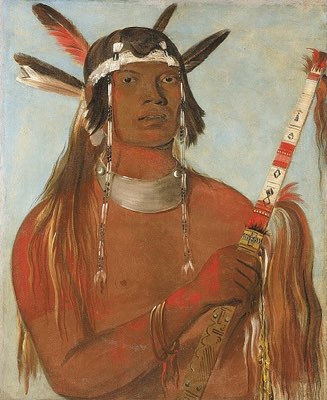
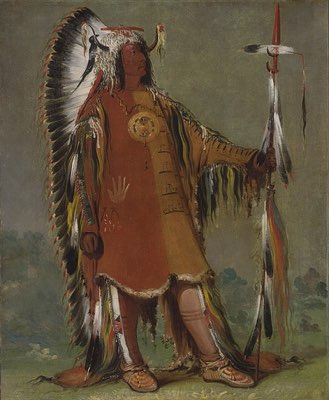
Wán-ee-ton, Chief of the Tribe
George Catlin (born Wilkes-Barre, PA 1796-died Jersey City, NJ 1872)
1832
- Medium
- oil on canvas
- Classification
- Paintings
- Dimensions
- 29 x 24 in. (73.7 x 60.9 cm)
- Culture
- Indians of North America
- Museum
- Smithsonian Institution, Smithsonian American Art Museum, Painting and Sculpture
- Credit line
- Smithsonian American Art Museum, Gift of Mrs. Joseph Harrison, Jr.
- Rights
- CC0 (Smithsonian Open Access), as the museum states it.
- Who can see it
- Tweens profiles and older: its subjects are known and suit older children. How works are placed
View at the Smithsonian Institution
About this work
In 1830, Catlin accompanied William Clark, of the celebrated Lewis and Clark expedition, up the Mississippi River from St. Louis to Fort Crawford. Two years later, he began the first of several journeys deep into the frontier, traveling up the Missouri River. At Fort Pierre, a fur-trading post situated in what is now South Dakota, he met Wán-ee-ton, chief of the Yanktonai Nakota tribe. Catlin considered him “one of the most noted and dignified, as well graceful chiefs of the Sioux tribe,” and went on to describe his portrait of the chief as “full-length, in a splendid dress; head-dress of war-eagle’s quills and ermine, and painted robe.” (Catlin, 1848 Catalogue, Catlin’s Indian Gallery, SAAM online exhibition)