Window mode follows your eyes with your camera, in this browser only: no picture or position leaves your device.
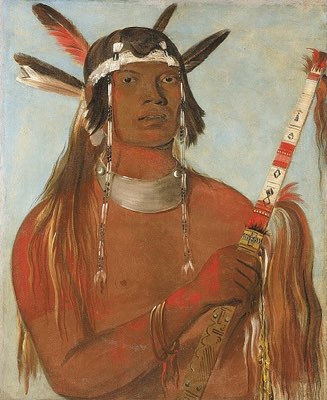
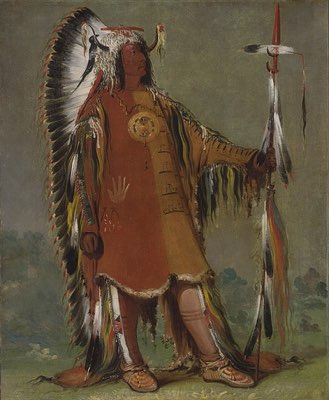
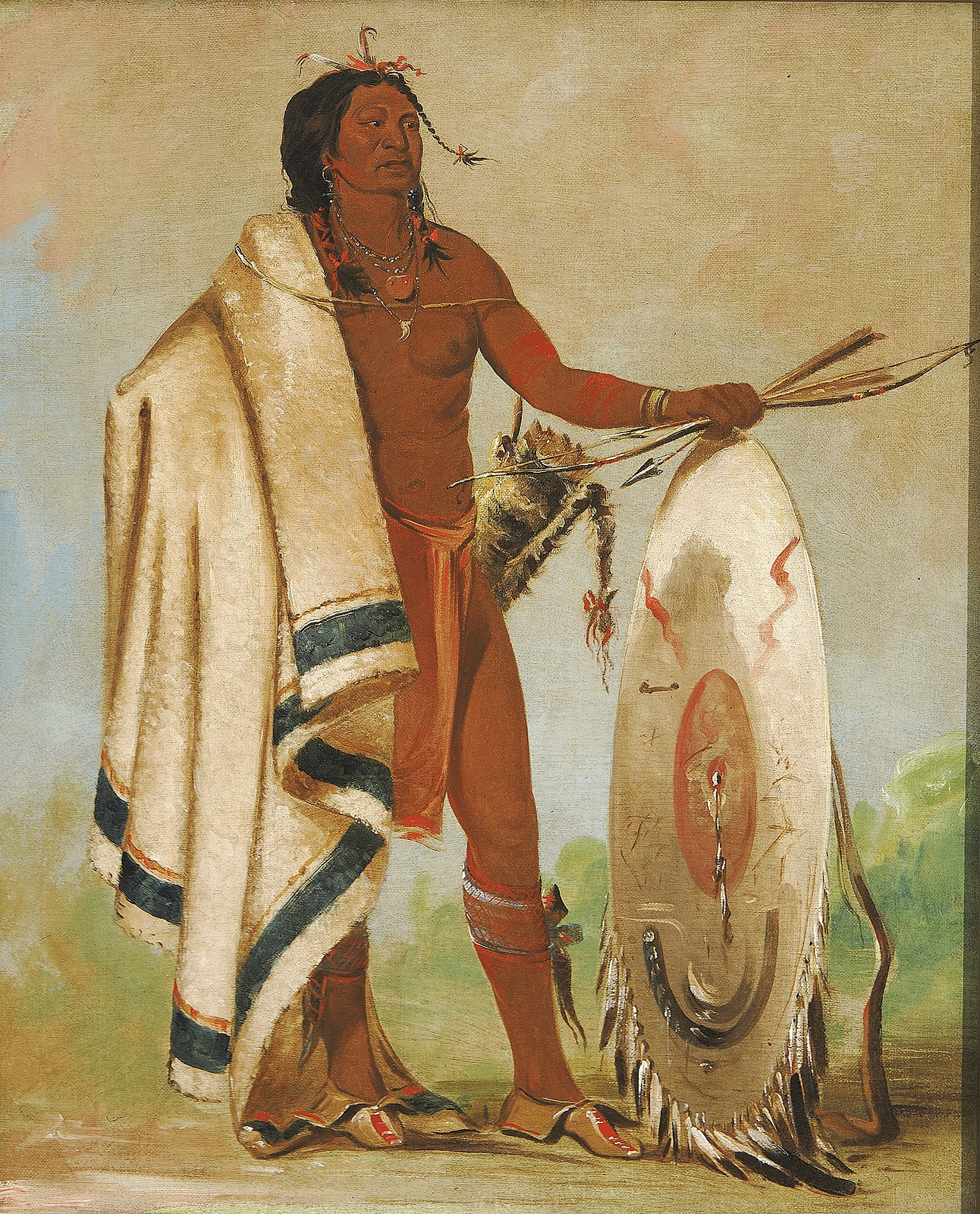
Kotz-a-tó-ah, Smoked Shield, a Distinguished Warrior
George Catlin (born Wilkes-Barre, PA 1796-died Jersey City, NJ 1872)
1834
- Medium
- oil on canvas
- Classification
- Paintings
- Dimensions
- 29 x 24 in. (73.7 x 60.9 cm)
- Culture
- Indians of North America
- Museum
- Smithsonian Institution, Smithsonian American Art Museum, Painting and Sculpture
- Credit line
- Smithsonian American Art Museum, Gift of Mrs. Joseph Harrison, Jr.
- Rights
- CC0 (Smithsonian Open Access), as the museum states it.
- Who can see it
- Teens profiles and older: its subject is for older viewers (war, death, the Passion, drink or the like). How works are placed
View at the Smithsonian Institution
About this work
George Catlin described Smoked Shield as “another of the extraordinary men of this tribe [Kiowa], near seven feet in stature, and distinguished, not only as one of the greatest warriors, but the swiftest on foot, in the nation. This man, it is said, runs down a buffalo on foot, and slays it with his knife or his lance, as he runs by its side!” Smoked Shield’s most notable accessory is his shield, made of the heaviest part of a buffalo hide and smoked over a campfire to make it even tougher. Smoked Shield is draped with what appears to be a trade blanket, perhaps due to a shortage of buffalo robes caused by depletion of the southern herds through over-hunting. (Catlin, Letters and Notes, vol. 2, no. 43, 1841, reprint 1973; Gurney and Heyman, eds., George Catlin and His Indian Gallery, 2002)