Window mode follows your eyes with your camera, in this browser only: no picture or position leaves your device.
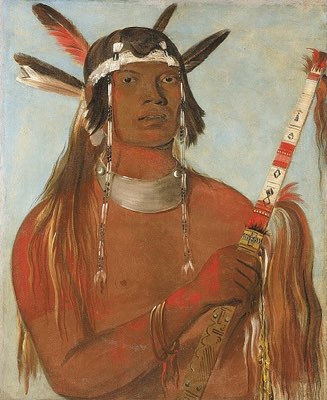
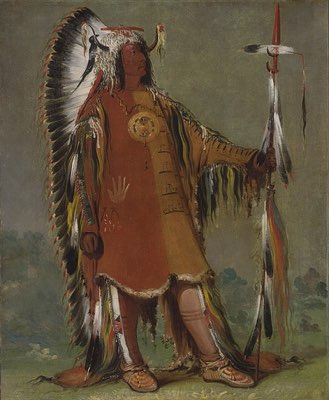
Téh-tóot-sah (better known as Tohausen, Little Bluff), First Chief
George Catlin (born Wilkes-Barre, PA 1796-died Jersey City, NJ 1872)
1834
- Medium
- oil on canvas
- Classification
- Paintings
- Dimensions
- 29 x 24 in. (73.7 x 60.9 cm)
- Culture
- Indians of North America
- Museum
- Smithsonian Institution, Smithsonian American Art Museum, Painting and Sculpture
- Credit line
- Smithsonian American Art Museum, Gift of Mrs. Joseph Harrison, Jr.
- Rights
- CC0 (Smithsonian Open Access), as the museum states it.
- Who can see it
- Tweens profiles and older: its subjects are known and suit older children. How works are placed
View at the Smithsonian Institution
About this work
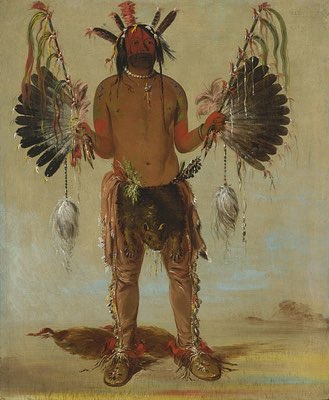
Téh-tóot-sah, the head chief of the Kiowa, was described by George Catlin as “a very gentlemanly and high minded man, who treated the dragoons and officers with great kindness while in his country. His long hair, which was put up in several large clubs and ornamented with a great many silver broaches, extended quite down to his knees.” Catlin’s ability to see Indians as “gentlemanly and high minded,” when so many other white Americans saw them only as uncivilized, may reflect the strong influence of Enlightenment ideas in Philadelphia during Catlin’s youth. Catlin painted Téh-tóot-sah at a Comanche village in 1834. (Catlin, Letters and Notes, vol. 2, no. 43, 1841; reprint 1973)