Window mode follows your eyes with your camera, in this browser only: no picture or position leaves your device.
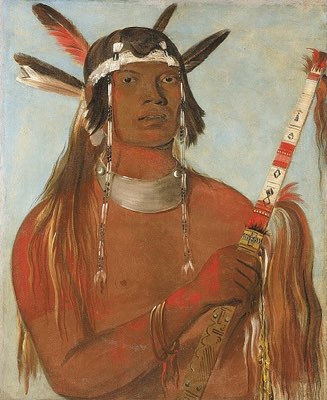
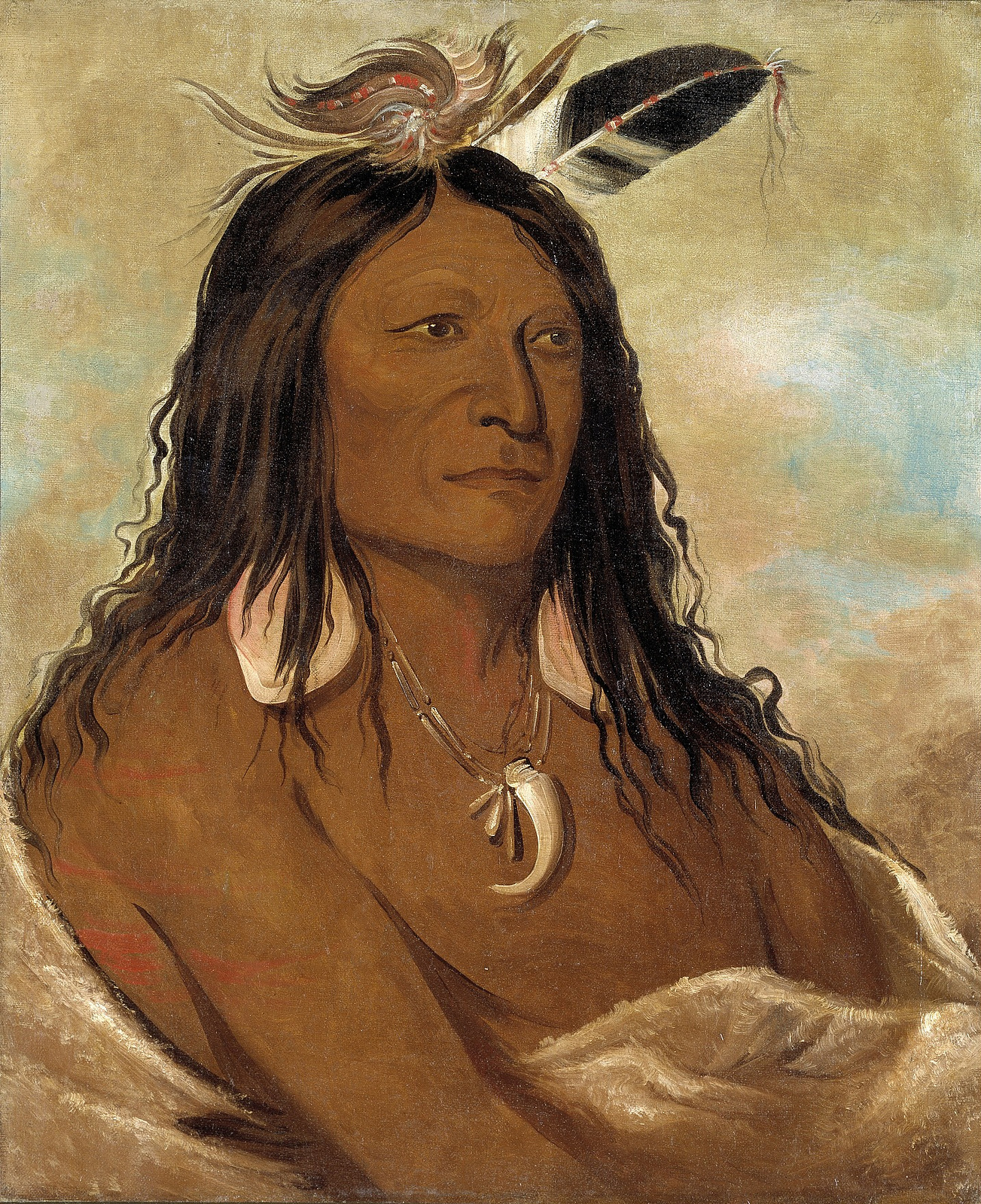
Eé-shah-kó-nee, Bow and Quiver, First Chief of the Tribe
George Catlin (born Wilkes-Barre, PA 1796-died Jersey City, NJ 1872)
1834
- Medium
- oil on canvas
- Classification
- Paintings
- Dimensions
- 29 x 24 in. (73.7 x 60.9 cm)
- Culture
- Indians of North America
- Museum
- Smithsonian Institution, Smithsonian American Art Museum, Painting and Sculpture
- Credit line
- Smithsonian American Art Museum, Gift of Mrs. Joseph Harrison, Jr.
- Rights
- CC0 (Smithsonian Open Access), as the museum states it.
- Who can see it
- Tweens profiles and older: its subjects are known and suit older children. How works are placed
View at the Smithsonian Institution
About this work
George Catlin described this Comanche chief as “pleasant looking . . . without anything striking or peculiar in his looks; dressed in a very humble manner . . . his hair carelessly falling about his face, and over his shoulders.” He noted that “the only ornaments to be seen about him were a couple of beautiful shells worn in his ears, and a boar’s tusk attached to his neck, and worn on his breast.” The chief’s mild demeanor masks the ferocious struggle against white settlers that his people would sustain for decades. Catlin painted this portrait when the United States military had not yet gained control of the southern Plains. The confrontation between Bow and Quiver’s people and white settlers would come to a head in the Comanche and Kiowa wars of the 1870s. (Catlin, Letters and Notes, vol. 2, no. 42, 1841, reprint 1973; Gurney and Heyman, eds., George Catlin and His Indian Gallery, 2002)