Window mode follows your eyes with your camera, in this browser only: no picture or position leaves your device.
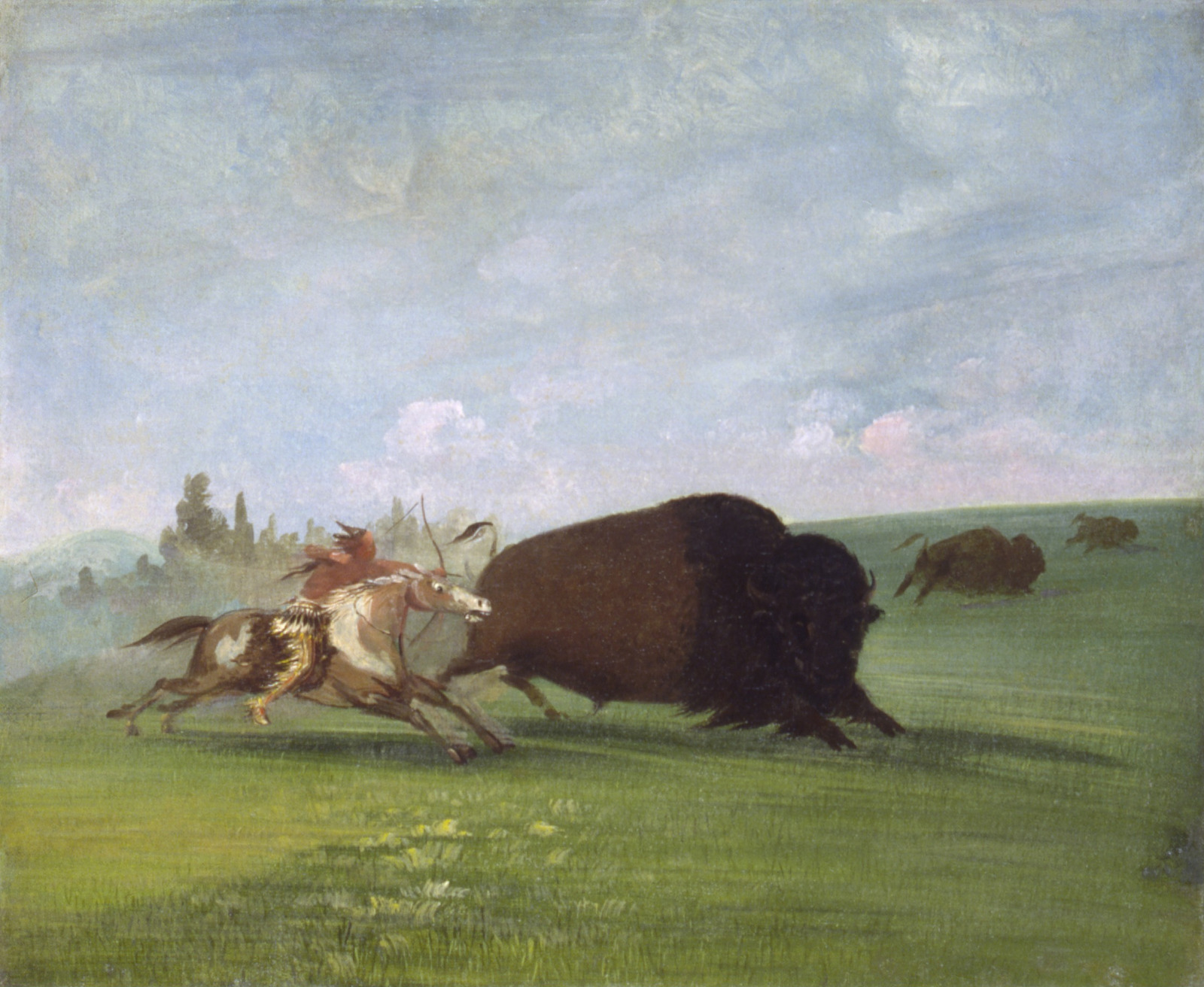
Buffalo Chase, a Single Death
George Catlin (born Wilkes-Barre, PA 1796-died Jersey City, NJ 1872)
1832-1833
- Medium
- oil on canvas
- Classification
- Paintings
- Dimensions
- 24 x 29 in. (60.9 x 73.7 cm)
- Culture
- Indians of North America
- Museum
- Smithsonian Institution, Smithsonian American Art Museum, Painting and Sculpture
- Credit line
- Smithsonian American Art Museum, Gift of Mrs. Joseph Harrison, Jr.
- Rights
- CC0 (Smithsonian Open Access), as the museum states it.
- Who can see it
- Teens profiles and older: its subject is for older viewers (war, death, the Passion, drink or the like). How works are placed
View at the Smithsonian Institution
About this work
“In the chase of the buffalo, or other animal, the Indian generally ‘strips’ himself and his horse, by throwing off his shield and quiver, and every part of his dress, which might be an encumbrance to him in running; grasping his bow in his left hand, with five or six arrows drawn from his quiver, and ready for instant use . . . These horses are so trained, that the Indian has little use for the rein, which hangs on the neck, whilst the horse approaches the animal on the right side, giving his rider the chance to throw his arrow to the left; which he does at the instant when the horse is passing---bringing him opposite to the heart, which receives the deadly weapon ‘to the feather’ . . . I have fairly represented the mode of approaching, at the instant the arrow is to be thrown; and the striking disparity between the size of a huge bull of 2000 pounds weight, and the Indian horse, which, it will be borne in mind, is but a pony.” George Catlin made this sketch on the Upper Missouri in 1832. (Catlin, Letters and Notes, vol. 1, no. 31, 1841; reprint 1973)