Window mode follows your eyes with your camera, in this browser only: no picture or position leaves your device.
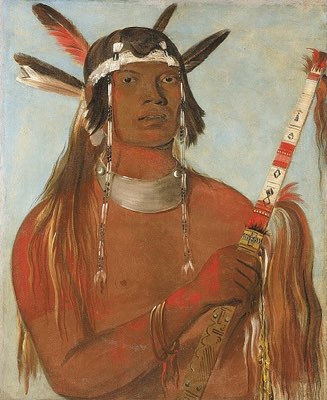
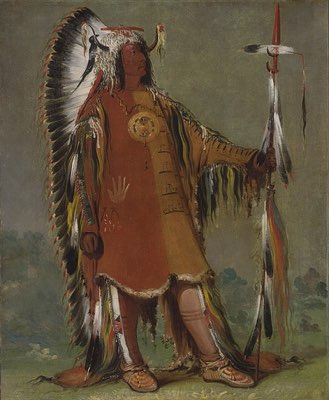
Wi-jún-jon, Pigeon's Egg Head (The Light), a Distinguished Young Warrior
George Catlin (born Wilkes-Barre, PA 1796-died Jersey City, NJ 1872)
1831
- Medium
- oil on canvas
- Classification
- Paintings
- Dimensions
- 29 x 24 in. (73.7 x 60.9 cm)
- Culture
- Assiniboine Indians
- Museum
- Smithsonian Institution, Smithsonian American Art Museum, Painting and Sculpture
- Credit line
- Smithsonian American Art Museum, Gift of Mrs. Joseph Harrison, Jr.
- Rights
- CC0 (Smithsonian Open Access), as the museum states it.
- Who can see it
- Teens profiles and older: its subject is for older viewers (war, death, the Passion, drink or the like). How works are placed
View at the Smithsonian Institution
About this work
George Catlin first met Wi-jún-jon (also called the Light) in St. Louis in December 1831, when the Assiniboine warrior was en route to Washington to meet President Andrew Jackson and tour the city. Catlin recalled that the warrior appeared for his portrait sitting “plumed and tinted . . . [and] dressed in his native costume, which was classic and exceedingly beautiful”---attributes nicely captured in this finished portrait. Wi-jún-jon returned home to the northern Plains eighteen months later a decidedly different man---dressed apparently in a “general’s” uniform and sharing what to his fellow tribesmen were astonishing accounts of the white man’s cities. They eventually rejected his stories as “ingenious fabrication of novelty and wonder,” and his persistence in telling such “lies” eventually led to his murder. (Catlin, Letters and Notes, vol. 2, no. 55, 1841; reprint 1973)