Window mode follows your eyes with your camera, in this browser only: no picture or position leaves your device.
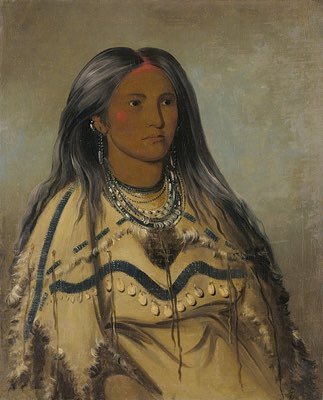
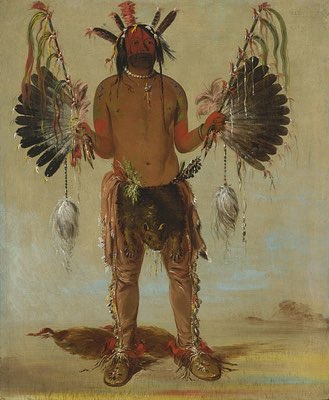
Oó-je-en-á-he-a, Woman Who Lives in a Bear's Den
George Catlin (born Wilkes-Barre, PA 1796-died Jersey City, NJ 1872)
1832
- Medium
- oil on canvas
- Classification
- Paintings
- Dimensions
- 29 x 24 in. (73.7 x 60.9 cm)
- Culture
- Indians of North America
- Museum
- Smithsonian Institution, Smithsonian American Art Museum, Painting and Sculpture
- Credit line
- Smithsonian American Art Museum, Gift of Mrs. Joseph Harrison, Jr.
- Rights
- CC0 (Smithsonian Open Access), as the museum states it.
- Who can see it
- Tweens profiles and older: its subjects are known and suit older children. How works are placed
View at the Smithsonian Institution
About this work
“This extraordinary length of hair amongst the Crows is confined to the men alone; for the women, though all of them with glossy and beautiful hair, and a great profusion of it, are unable to cultivate it to so great length; or else they are not allowed to compete with their lords in a fashion so ornamental (and on which the men so highly pride themselves), and are obliged in many cases to cut it short off.” George Catlin further explained that the “Crow women (and Blackfeet also) are not handsome, and I shall at present say but little of them. They are, like all other Indian women, the slaves of their husbands: being obliged to perform all the domestic duties and drudgeries of the tribe, and not allowed to join in their religious rites or ceremonies, nor in the dance or other amusements . . . The Crow and Blackfeet women, like all others I ever saw in any Indian tribe, divide the hair on the forehead, and paint the separation or crease with vermilion or red earth. For what purpose this little, but universal, custom is observed, I never have been able to learn.” (Catlin, Letters and Notes, vol. 1, no. 8, 1841; reprint 1973)