Window mode follows your eyes with your camera, in this browser only: no picture or position leaves your device.
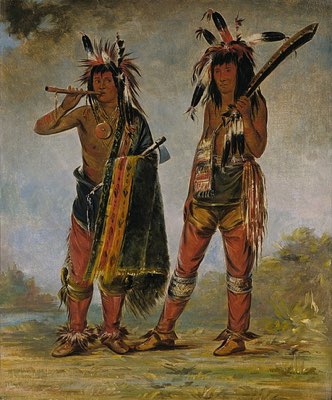
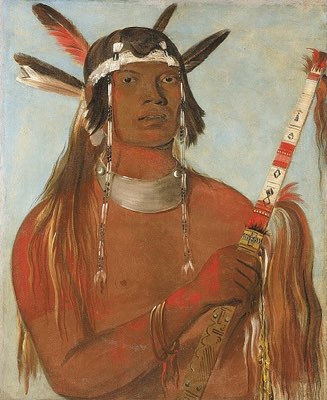
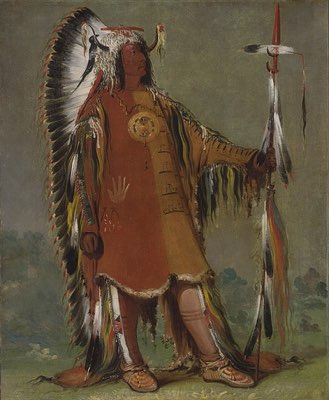
Loo-rá-wée-re-coo, Bird that Goes to War, a Tapage Pawnee
George Catlin (born Wilkes-Barre, PA 1796-died Jersey City, NJ 1872)
1832
- Medium
- oil on canvas
- Classification
- Paintings
- Dimensions
- 29 x 24 in. (73.7 x 60.9 cm)
- Culture
- Indians of North America
- Museum
- Smithsonian Institution, Smithsonian American Art Museum, Painting and Sculpture
- Credit line
- Smithsonian American Art Museum, Gift of Mrs. Joseph Harrison, Jr.
- Rights
- CC0 (Smithsonian Open Access), as the museum states it.
- Who can see it
- Teens profiles and older: its subject is for older viewers (war, death, the Passion, drink or the like). How works are placed
View at the Smithsonian Institution
About this work
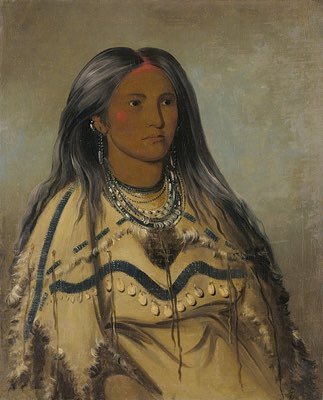
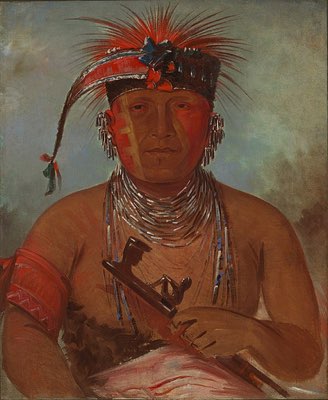
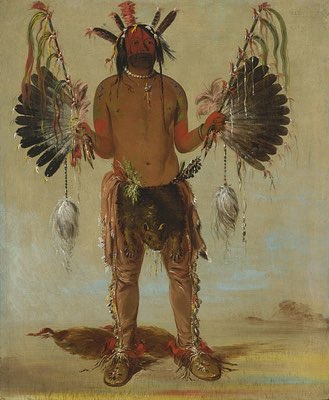
George Catlin probably painted these images of Pawnee chiefs and warriors at Fort Leavenworth (in today’s Kansas) in 1832. He later described the tribe as: “A very powerful and warlike nation, living on the river Platte, about one hundred miles from its junction with the Missouri; laying claim to, and exercising sway over, the whole country, from its mouth to the base of the Rocky Mountains. The present number of this tribe is ten or twelve thousand; about one half the number they had in 1832, when that most appalling disease, the small-pox, was accidentally introduced amongst them by the Fur Traders, and whiskey sellers; when ten thousand (or more) of them perished in the course of a few months . . . The Pawnees have ever been looked upon, as a very warlike and hostile tribe; and unusually so, since the calamity which I have mentioned.” (Catlin, Letters and Notes, vol. 2, no. 34, 1841; reprint 1973)