Opening the book…
2.4.1 Speeding Up
Model
Observe the simulation at https://tinyurl.com/mysolarsystemPHET to see how changing the speed of an orbiting object changes the orbit itself. An object makes a circular orbit around a star. At point A, the speed of the object increases from that circular orbit speed.

- Draw out the new orbit as a dashed line.
- Put a dot at the point on the orbit that is directly on the other side of the star as Point A. Label it B.
- Is Point B a periapsis or apoapsis? Is the object moving faster or slower at Point B than at Point A?
- Does increasing the speed of an object in circular orbit push the other side of the orbit further from the star or does it pull the other side of the orbit closer in to the star?
2.4.2 Slowing Down
Model
Observe the simulation at https://tinyurl.com/mysolarsystemPHET to see how changing the speed of an orbiting object changes the orbit itself. An object makes a circular orbit around a star. At point A, the speed of the object decreases from that circular orbit speed.
- Draw out the new orbit as a dashed line.
- Put a dot at the point on the orbit that is directly on the other side of the star as Point A. Label it C.
- Is Point C a periapsis or apoapsis? Is the object moving faster or slower at Point C than at Point A?
- Does increasing the speed of an object in circular orbit push the other side of the orbit further from the star or does it pull the other side of the orbit closer in to the star?
2.4.3 Adjusting to Circular Orbits from Elliptical Orbits
Model
The model below shows an elliptical orbit of a satellite around a star. Points A and B are the periapsis and apoapsis of the orbit.
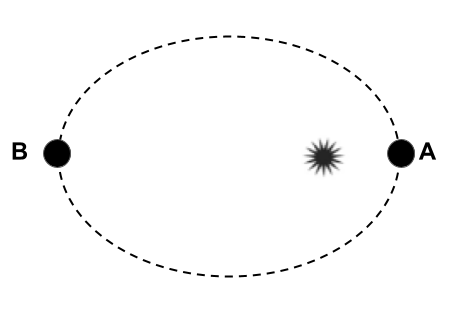
- Is the planet moving faster at point A or B? Explain how you know.
- In order to turn the orbit into a circular orbit that includes point A, should the satellite speed up or slow down at point A? Explain your reasoning.
- In order to turn the orbit into a circular orbit that includes point B, should the satellite speed up or slow down at point A? Explain your reasoning.
- What should be at the center of both circular orbits?
- Draw both circular orbits.
2.4.4 Many Orbits
Model

Multiple circular orbits A–E around a star used to compare orbital speeds.
Image Credit: Astronomy Interactives from the Astronomy Education Department at the University of Nebraska-Lincoln (https://astro.unl.edu/interactives/)
- Which orbit (A–E) is the fastest? How do you know?
- Which orbit (A–E) is the slowest? How do you know?
- Describe the process (speeding up / slowing down) to get from circular orbit A to circular orbit B.
- Describe the process (speeding up / slowing down) to get from circular orbit C to circular orbit B.
- In general, what is the process to change the size of a circular orbit?
This page titled 2.4: Transfer Orbits was last modified on Tue, 06 Oct 2026 22:47:32 GMT and is shared under a CC BY 4.0 license and was authored, remixed, and/or curated by .
The book could not be loaded just now.