Opening the book…
2.3.1 Exploring Orbits
Model
Go to the simulation: https://tinyurl.com/mysolarsystemPHET
Make adjustments and click the options to show the velocity and force. Before running the simulation, always click the button to "Follow Center of Mass".
Pay attention to:
- Orbital Shape
- Orbital Velocity (Green Arrow)
- Gravitational Force (Purple Arrow)
- Orbital Period
Complete the table to record what you observe:
| We Will Change... | We Predict... | We Observed... |
|---|---|---|
- Summarize: Construct one or more CERs to identify patterns or summarize what determines the orbits of a two-body system.
2.3.2 Kepler Orbits
Model
The model below shows a planet at different positions in it's orbit around a star. The same amount of time elapses between successive letters (A to B, B to C, etc.).

Planet orbit with labeled positions showing changing orbital speed around a star.
- Does the planet appear to travel the same distance each month?
- At which positions is the planet moving the fastest? The slowest? Explain.
- At position D, is the speed of the planet increasing or decreasing? Explain.
- Draw a line between each lettered position of the planet and the center of the star. Describe how the wedges that form between planet positions compare.
- Create a concise statement that describes the relationship between a planet’s orbital speed and its distance from its companion star.
Summary

Kepler's First Law states that the orbital path of planets trace out an ellipse which has two foci. The start (or other parent body) is at one focus and the other focus is empty. The eccentricity of the ellipse is the distance between each focus divided by twice the semimajor axis. A circle has an eccentricity of zero.
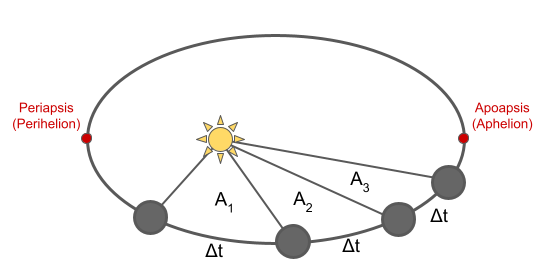
As objects travel in their orbit, they trace out Equal Area wedges in Equal Amounts of Time. This relationship is known as Kepler's Second Law.
2.3.3 Arcs and Areas in an Orbit
Model

Elliptical orbit divided into wedges showing orbital arcs and equal-area sectors.
Image Credit: Astronomy Interactives from the Astronomy Education Department at the University of Nebraska-Lincoln (https://astro.unl.edu/interactives/)
Information Processing
- Identify some evidence (No CER needed)
- Which wedge is the widest (biggest angle)? Is the planet close or far from the star in that portion?
- Which wedge is the narrowest (smallest angle)? Is the planet close or far from the star in that portion?
- How do the areas of each wedge (approximately) compare?
Critical Thinking: Write a CER response:
- How do you think the length of time it takes for the planet to traverse the arc of each wedge compares?
2.3.4 Orbital Period
Model
In a Planetarium or using planetarium software (eg, World Wide Telescope), view the orbits of planets in our solar system. All planets orbit the same object (the Sun) but their orbits are different.
- What planet is traveling the fastest? Is it close or far from the Sun?
- What planet is traveling the slowest? Is it close or far from the Sun?
- What planet takes the most time to complete an orbit (Period)? Is it close or far from the Sun?
- What planet takes the least time to complete an orbit (Period)? Is it close or far from the Sun?
2.3.5 Kepler Law 3
Model
This graph shows how the orbital period (time to complete one orbit) of an object in our solar system varies with distance. An AU is an Astronomical Unit and is equal to the average distance between the Earth and the Sun. This graph was created using Desmos.

- When satellites are closer to the object they orbit, is the orbital period longer or shorter?
- If I double the size of the orbit (orbital distance), does the orbital period double? If not, is it more than double or less than double? Cite examples from the graph.
Summary
The relationship between the orbital distance and orbital period is given by the equation:
\(P^{2} \propto a^{3}\)
This equation is known as Kepler’s 3rd Law. The symbol \( \propto \) means “proportional to” and shows a general trend relationship. The exact equation was determined later by Isaac Newton.
Kepler’s third law becomes an equality when used for objects in our solar system if the period is measured in years and the semimajor axis is measured in Earth–Sun distances, which are called Astronomical Units (AU).
Apply
The table below provides a partial list of the orbital periods (in years) and orbital distances (in AU) for six planets orbiting a one solar-mass star. The mass of each planet is also provided (in Earth masses). Rank the orbital periods of the planets. It might help to determine some of the unknown values.
Activity Credit: Astronomy Interactives from the Astronomy Education Department at the University of Nebraska-Lincoln (https://astro.unl.edu/interactives/)
| Planet | Orbital Distance (AU) | Orbital Period (Years) | Mass (Earth Masses) |
|---|---|---|---|
| A | 20 | 500 | |
| B | 0.8 | 375 | |
| C | 3.0 | 100 | |
| D | 2.0 | 50 | |
| E | 5.0 | 3 | |
| F | 3.5 | 0.5 |
2.3.6 Orbital Speed
Model
The equations below identify an approximate average speed by using Kepler’s Third Law (\(P^{2}=a^{3}\)) and assuming a circular orbit. They originate by taking the circumference of that orbit (\(2\pi a\)) and dividing by the time (period, \(P\)).
These equations are only valid for objects orbiting a solar-mass star and the units are in Astronomical Units per Year (AU/year).
\(v_{avg}=\frac{2\pi a}{P}\)
\(v_{avg}=\frac{2\pi}{P^{1/3}}\)
\(v_{avg}=\frac{2\pi}{a^{1/2}}\)
- Use the equations, along with Kepler’s 3rd Law, to complete this table for the planets in our solar system.
| Planet | Orbital Distance | Orbital Period | Orbital Speed |
|---|---|---|---|
| Mercury | 0.4 AU | ||
| Venus | 0.1 AU | ||
| Earth | 1.0 AU | ||
| Mars | 1.5 AU | ||
| Jupiter | 5.2 AU | ||
| Saturn | 9.6 AU | ||
| Uranus | 19.2 AU | ||
| Neptune | 30 AU |
This page titled 2.3: Kepler Orbits was last modified on Tue, 06 Oct 2026 22:47:29 GMT and is shared under a CC BY 4.0 license and was authored, remixed, and/or curated by Andrew Totah-McCarty.
The book could not be loaded just now.