Opening the book…
2.5.1 Circular Orbital Speed
Model
This model shows two gravitational orbits of an object around a star. The stars have different masses, as shown. Assume the orbiting object is the same object in both systems.

Two different star–planet orbit systems with different star masses for comparing orbital speed.
- Which orbiting system (left or right) will have a stronger force of gravity? Explain your reasoning.
- Which orbiting system (left or right) do you think will have a faster moving planet? Explain your reasoning.
- Based on your response above, draw additional dots for the system on the right around the orbit. Assume the same amount of time between dots as the model on the left, so decide if they should be further apart or closer together. Explain your reasoning.
Summary
The speed of a circular orbit does not depend on the mass of the orbiting object (for example, a planet). It depends on the mass of the object being orbited (for example, a star) and the distance between the planet and the star.
It is based on the strength of gravity and follows the relationship:
\(v_{\text{circular orbit}} \propto \sqrt{\frac{M}{r}}\)
2.5.2 Weighing a Star
Model
The model below shows two orbits of planets around different stars. Assume the same amount of time elapses between each dot in the orbit.

Two planetary orbits with equal time markers used to compare star masses.
- Which orbit has a faster moving planet? Explain how “speed” can be determined on these dot models of an orbit.
- Which orbit must have a more massive star? Explain your reasoning.
- Explain how we can use measurements of a satellite orbit to determine (or at least compare) the mass of the central body that satellite orbits.
Summary
We can rearrange the same equation from earlier to show that the mass of the central body can be determined by the relationship:
\(M_{\text{central body}} \propto v^{2}r\)
2.5.3 Speed on an Orbit
Model
In the model below, the speed of the satellite is the same for both objects.

Two satellite orbits of different sizes with equal orbital speed for comparison.
- Which orbit (A or B) is a bigger path?
- If the satellites travel at the same speed, how will the length of time needed for each satellite to complete one orbit compare?
- If we put dots at equal intervals of time, which orbit will have more dots? Explain your reasoning.
- Draw the dots to show the orbit for the satellite on the right. Make sure they represent the same amount of time between dots as the orbit on the left.
Summary
The speed of the orbiting satellite is represented in this model by the spacing between the dots.
Apply
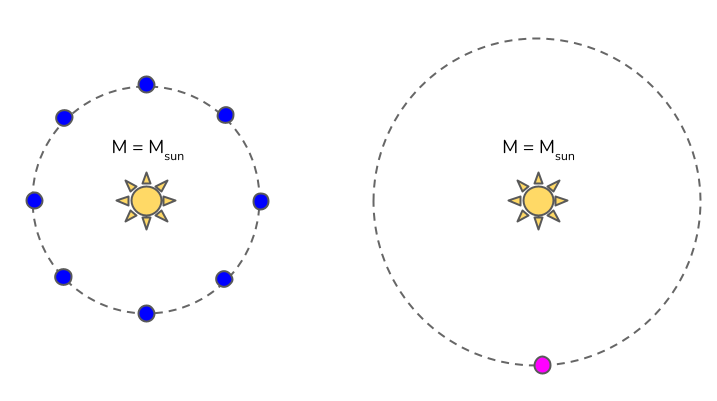
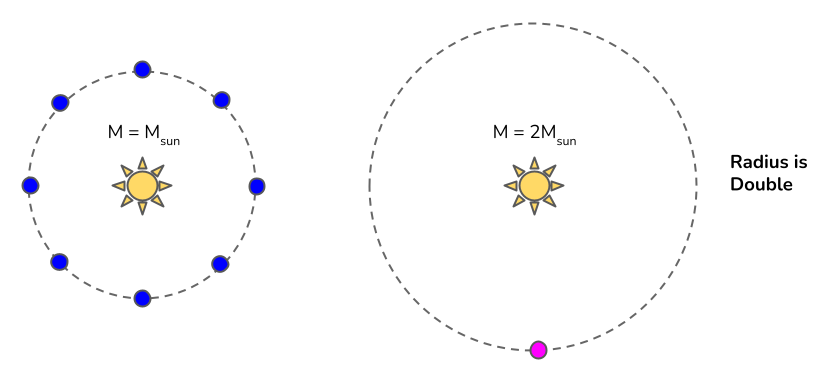
Use the orbit on the left to complete the model for the orbit on the right, based on the values given for \(M\) and \(r\).
Explain your reasoning for each model based on how the speed of each satellite should compare. Then identify which orbit takes longer to complete.
Summary
The time it takes for a satellite to complete one orbit is called the orbital period.
It depends on the radius of the orbit and the mass of the central body and is related by the equation:
\(P_{\text{satellite}} \propto \sqrt{\frac{r^{3}}{M_{\text{central body}} + m_{\text{satellite}}}}\)
We will not use this equation much, but the powers in the equation show that the period increases with radius and decreases with mass.
The radius plays a bigger role than mass because it is raised to the third power.
This equation can be thought of as:
\(P_{\text{satellite}} \propto \sqrt{\frac{\text{radius} \times \text{radius} \times \text{radius}} {M_{\text{central body}} + m_{\text{satellite}}}}\)
This page titled 2.5: Newtonian Orbits was last modified on Tue, 06 Oct 2026 22:47:34 GMT and is shared under a CC BY 4.0 license and was authored, remixed, and/or curated by Andrew Totah-McCarty.
The book could not be loaded just now.