Opening the book…
Dynamics of Systems
Connected Objects
 Model
Two objects are connected by a string and pulled by a person. The forces of gravity and the normal forces are shown on the force diagrams but not on the picture.

 Explore
Draw a system boundary around Block A and a separate system boundary around Block B
Circle external interactions as they cross the system boundary.
How many forces act on block A? Label them on the Force Diagram.
How many forces act on block B? Label them on the Force Diagram.
Do any forces (on an individual object) cancel? If so, cross them out on the diagram.
Which direction are the blocks accelerating? Answer space
 Critical Thinking & Concept Invention
If the two blocks are connected, will they have the same acceleration or different acceleration?
What direction should the net force be on each block? Explain your reasoning.
-
Construct an acceleration equation using column vectors, then fill in the column vectors with relevant variables (eg, or ) and zeros when applicable. You can exclude the forces you crossed out earlier.
Box A
Answer space Box B
Circle unknowns that are not , , or . Which equation is easier to solve for ? Use that equation to identify what is in terms of other variables in the problem. Answer space
Plug that equation for into the other equation. Solve for the force between the blocks (eg, ) in terms of the other variables in the problem (eg, in terms of , , and ) Answer space
Combined Systems
Model

Explore
What objects are in the system? What objects are in the surroundings?
Circle external interactions as they cross the system boundary.
How many forces external to the system boundary interact with the system?
What is the mass of the system (in terms of , )? Answer space
Critical Thinking & Concept Invention
What should the net force on the system equal? How does it relate to the acceleration of the system?
-
Fill in the column vectors with relevant variables and zeros when applicable. Then solve for the acceleration.
Box A + Box B
Answer space
Many Objects
A person pushes on Block B with a force to the right as shown. There is friction between the blocks and between the blocks and the table, such that everything moves at a constant speed to the right.
Model


Explore
On each Object Interaction Diagram, circle external interactions as they cross the system boundary.
How many interaction lines are drawn between the table and Block B and between the table and Block C? Why does this make sense?
How many interaction lines cross the boundary of System 1?
How many interaction lines cross the boundary of System 2?
How many interaction lines cross the boundary of System 3? Answer space
Critical Thinking & Concept Invention
What should the net force be on each system? Look back at the description of motion.
The force of gravity is typically easy to calculate. Identify how many non-gravitational interactions cross the boundary of each system.
Which system will be easiest to make a force diagram for? Why?
Make a force diagram for each system. Start with whichever one you think is easiest. You only need to include external forces.
Rank the magnitudes of the horizontal forces in your force diagrams.
Did you use Newton’s 1st/2nd Law when comparing force magnitudes? If so, explain how.
Did you use Newton’s 3rd Law when comparing force magnitudes? If so, explain how.
Are there any forces that appeared on the force diagrams for System 1 or System 2 but not on System 3? Which ones? Why did you not need to include them? Answer space
 Apply
The mass of each block is 2.5kg and the coefficient of friction between the blocks and the table is 0.2. Determine the magnitude of each force. Recall and ; Answer space
Pulleys and Coordinates
Model

Explore
Without performing any calculation, predict and describe what each object will do as soon as Object B is released. Explain your thinking.
-
Identify whether each object moves towards or away from the labeled points.
Object Point I Point II Point III A B
Critical Thinking & Concept Invention
Was there a directional response (towards or away from ) that had the same answer for both blocks? Which one?
Could it be accurate to say that both blocks moved along the same direction? Explain your thinking.
What would we need to do to identify the same direction for motion when we use column vectors to represent acceleration? Answer space
Changing Coordinates
Model
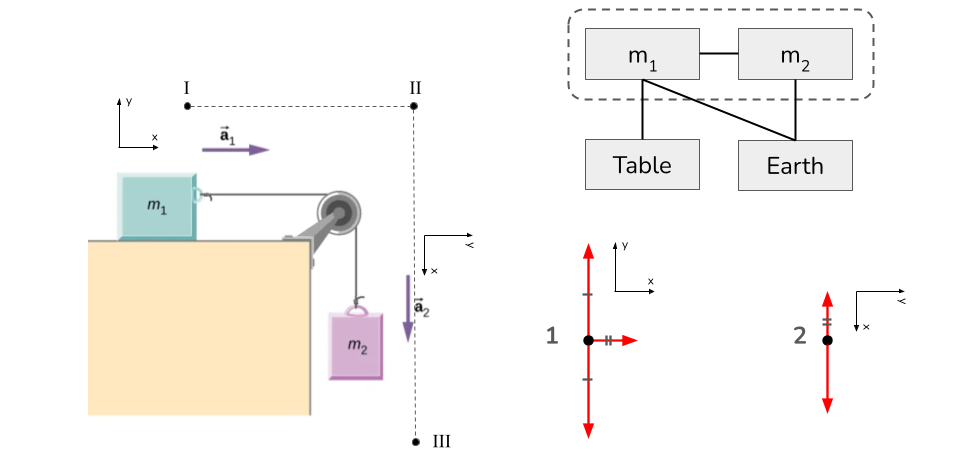
Explore
Use the diagram to label the forces (eg, ). Draw a dashed line connecting any Third Law Pairs.
What direction (up, down, left, right) is the positive x-axis next to Block A?
What direction (+/- or ) does Block A accelerate?
What direction (up, down, left, right) is the positive x-axis next to Block B?
What direction (+/- or ) does Block B accelerate? Answer space
Critical Thinking & Concept Invention
Could it be accurate to say that both blocks moved along the same direction? Explain your thinking.
How did the coordinate system shift to make the acceleration vectors in the same direction?
When do you think it makes sense to make this shift in coordinate system? Answer space
This page titled 5.2: Dynamics of Systems was last modified on Fri, 06 Nov 2026 21:34:41 GMT and is shared under a CC BY 4.0 license and was authored, remixed, and/or curated by Andrew Totah-McCarty.
The book could not be loaded just now.