Opening the book…
Circular Motion
Cylindrical Coordinates
 Model

 Explore
Identify the direction of each coordinate unit vector:
Which coordinate unit vectors change direction and which are fixed?
The vector points from to . Is the direction of in the direction of or ? Write your answer at the end of the equation for on the model and change it to . Answer space
 Critical Thinking & Concept Invention
-
Manipulate the equations:
Rewrite both equations from the model and divide by
If we take the limit as these quantities go to zero, the ’s become differentials (’s). Rewrite the equations with this limit.
Replace the derivative quantities (ie, ) with the quantities they represent.
The quantities and are the same thing. Use this to identify a equation for velocity in terms of cylindrical coordinates. Answer space
Uniform Circular Motion
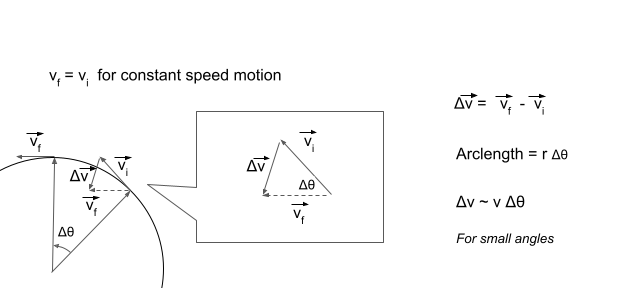
Model
Explore
Use the model to fill in the blanks in the statements.
|
Describe the velocity as the object goes around the circle. |
All velocity vectors have the same but different . |
|
Interpret the angles and how they relate to the direction of the velocity vector |
The change in direction of the velocity vectors can be identified as , which is also the angle between and |
|
Describe the magnitude and direction of the ’s. |
The vector points and has magnitude . |
Critical Thinking & Concept Invention
Construct and manipulate the equation below to identify acceleration for uniform circular motion.
Identify the relationship between and the other quantities in the model |
|
|
Divide by on both sides |
|
|
Eliminate using the relationship or |
|
|
Eliminate v using the relationship or |
Identify the direction (+/- or ) of these vector quantities and add it to the end of all of the equations.
 Summary
When an object moves in a circle without changing the radius of that circle at a constant speed (v) it has a constant angular velocity (). The velocity () of the object changes because the direction of the velocity vector changes. The rate of this change is called the centripetal acceleration () and can be represented by the equations:
Using the relationships between speed, angular speed, and radius (), we can represent this in terms of linear speed () or angular speed ():
You can use any of the equations for the magnitude of the centripetal acceleration, based on the information you have for the problem and the question you are trying to answer. In all cases, the direction of the centripetal acceleration is towards the center of the circle ( ).
 Apply
A 1200kg car drives around a turn at a speed of 15 m/s. The turn can be approximated as a circle with radius 8 meters.
What must the centripetal acceleration be to change the direction of the car’s velocity but not its speed?
If that force is only from friction, what must the frictional force be?
If the coefficients of friction between the car tires and the road are and , will the car make the turn successfully? Explain your thinking.
Centripetal Acceleration and Net Force Equations
Model
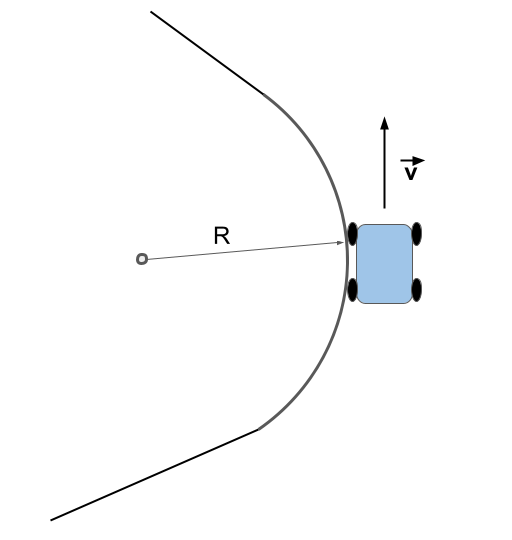
The model below shows a curve in the road that can be modeled as a portion of a circle. The car travels at a constant speed around the turn.
Top View
Rear View

Explore
What direction (+/- or ) points towards the center of the circle of the car’s motion? In the column vector, put “” in that component (x or y) with a or sign in front.
Which force(s) have components that point towards the center of the circle of the car’s motion?
What other forces might act on the car? Identify the forces and their directions. Answer space
Critical Thinking & Concept Invention
What component should be zero for the net force? Fill it in.
-
Finish the net force equation by including variables for friction and the equation (with variables) for gravity. You can replace the variable “” with its equation. Does the mass of the car matter?
Answer space
Apply
Determine which direction the centripetal acceleration should be based on the “circle” the car travels along. Then draw force vectors for the normal force and gravitational force that shows a net force in the necessary direction for the motion of the car. Assume the car drives at a constant speed.

Centripetal Acceleration on Ramps
Model

Explore
What forces act on the car?
What direction (+/- or ) points towards the center of the circle of the car’s motion? In the column vector, put “” in that component (x or y) with a or sign in front.
Which force(s) have components that point towards the center of the circle of the car’s motion?
Is that component opposite or adjacent to the angle ?
Critical Thinking & Concept Invention
Finish the net force equation by including the equation (with variables) for gravity and fill in the column vector for the normal force. Does the mass of the car matter?
Which force applied the centripetal force in this case?
Replace the variable “” with its equation. What must the magnitude of the force with a centripetal component be equal to?
As the angle increases, does more or less of that force point in the direction of the centripetal force?
Explain as a group: How do banked turns (turns that are ramped at an angle) make it easier for the car to turn? Answer space
-
If a roadway is banked at the proper angle, a car can round a corner without any assistance from friction between the tires and the road. Construct a net force equation for the motion of this car. Then, find the appropriate banking angle () for a 900-kg car traveling at 20.5 m/s in a turn of radius 85.0 m.
This page titled 5.3: Circular Motion was last modified on Fri, 06 Nov 2026 18:01:55 GMT and is shared under a CC BY 4.0 license and was authored, remixed, and/or curated by Andrew Totah-McCarty.
The book could not be loaded just now.