Opening the book…
General Circular Motion
 Model
An object can undergo circular motion (constant r) and experience a change in speed (v and are not constant). The model below identifies the acceleration components of changes to direction and changes to linear and angular speed.
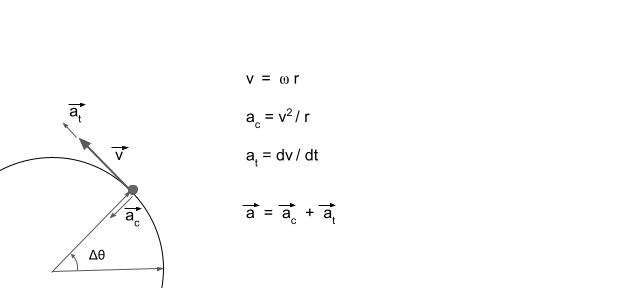
 Explore
Use the model to fill in the blanks in the statements.
|
Describe the centripetal acceleration () |
The magnitude of is based on and . The direction is . |
|
Describe the tangential acceleration () |
The magnitude of is based on and . The direction is . |
|
Which acceleration changes the speed and which changes the direction of motion? |
changes the speed and changes the direction of motion. |
 Critical Thinking & Concept Invention
Construct and manipulate the equation below to identify acceleration for general circular motion.
|
Use the relationship to replace the ’s in both equations. |
|
|
Assume is constant. Show how that affects the derivative in the equation for . |
|
|
Put it all together: What is the vector equation for ? Be sure to include directions on each acceleration vector. |
Answer space
 Summary
The rate that the angular velocity changes is called angular acceleration and uses the variable :
For rigid objects, the centripetal acceleration portion is supplied by the internal forces between the different pieces of that rigid object. The angular acceleration is caused by tangential forces, which cause torque.
| Center Pointing | Tangential |
|---|---|
| is internal | is external |
| comes from a center-pointing force so that force does not apply torque. | so |
| so |
Euler’s Second Law
Model
| Newton’s 2nd Law | Euler’s 2nd Law |
|---|---|
Explore
Explore and markup the model by:
Identifying and highlight equivalent pairs of quantities that are represented as a derivative or a single variable (eg, and ). Use different colors for different pairs.
Underline the constants that were pulled out of a derivative.
Critical Thinking & Concept Invention
-
Compare the different types of acceleration:
Question Linear Acceleration Angular Acceleration How does each acceleration vary with an inertial quantity (m or I) determined?
Answer space
Answer space
Describe the relationship between inertia and acceleration
If the mass of an object is greater, the acceleration will be for the same .
If the moment of inertia of an object is greater, the angular acceleration will be for the same .
How does each acceleration vary with the net external interaction (Force or Torque)?
Answer space
Answer space
Describe the relationship between inertia and external interactions
If the mass of an object is greater, I need a Force for the same .
If the moment of inertia of an object is greater, I need a Torque for the same .
Statics
Model
A rod of mass M and length R is connected to a pivot point. The rod can rotate freely around the pivot point. A cable is connected to the rod with an angle . The rod remains at rest.

Explore
Create an Object Interaction Diagram for this scenario with the rod as the system.
How many external forces act on the rod?
What should the acceleration of the rod be equal to? Why? Fill in the column vector based on your response.
Where is the Force of Gravity () drawn on the rod? What moment arm would this be in a torque calculation?
What should the moment arm be for the other two forces?
How many forces apply a nonzero torque to the rod? In which direction(s) are those torques? Explain your thinking.
What should the angular acceleration of the rod be equal to? Why? Fill in the column vector based on your response. Answer space
Critical Thinking & Concept Invention
Fill in the forces (with variables when needed) into the Acceleration Equation.
Calculate the torques (with variables when needed) and fill in the Angular Acceleration Equation.
Solve the set of equations (Acceleration and Angular Acceleration) to identify the magnitude of the force of tension () in the cable and the full vector force exerted from the pivot point
Angular Kinematics Relationships
Model
| Angular Kinematics | Linear Kinematics |
|---|---|
Explore
Explore and markup the model by:
Identifying what mathematical operation takes you from one quantity to the next as you go downward.
Identifying what mathematical operation takes you from one quantity to the next as you go upward.
-
Identify each row as one of the following:
Description of Motion
Description of Change in Motion
Description of Position/Orientation, not Motion.
Critical Thinking & Concept Invention
-
Discuss with your group what each quantity represents and identify a clear definition:
Angular Linear Answer space Answer space Answer space Answer space Answer space
Circular Motion with Angular Acceleration
Model
A bug (mass m) is on the rim of a record of radius . The record is initially not moving and then begins to spin. Just when the record is turned on, the angular acceleration is constant at . The coefficient of static friction between the bug and the record is .

Explore
Explore and markup the model by:
Draw the Normal Force Vector next to its label on the side view. If it should be the same length as another vector, put hash marks to illustrate equal magnitudes.
Examine the Top View Diagram and label the dashed force components as “” for the tangential force and “” for the centripetal force.
Based on these center pointing and tangential direction, fill in the components of the vector with either “” or “”
Identify which direction should be the positive y-axis on the Top View diagram and add that to the coordinates for that diagram.
Critical Thinking & Concept Invention
Fill in the force vectors for the gravitational force and the normal force.
Replace and with their equations using angular coordinate (eg, ’s and ’s.
Identify the friction force column vector based on the other vectors in your equation.
Identify the magnitude of this vector (How do you find a magnitude from components)?
Remind each other which calculus operation takes you from to . Use this to replace the ’s with ’s and another variable that might show up.
Identify the maximum force of static friction. At what time (did this variable show up in the last step?) will the necessary frictional force (to maintain the acceleration) exceed this value? Answer space
This page titled 5.4: Angular Acceleration was last modified on Fri, 06 Nov 2026 21:28:40 GMT and is shared under a CC BY 4.0 license and was authored, remixed, and/or curated by .
The book could not be loaded just now.