Opening the book…
Rotational Dynamics
Accelerated Rolling
 Model

 Explore
| Question | Translation | Rotation |
|---|---|---|
What is the speed/velocity variable that describes each motion? |
||
|
What is the acceleration that changes those speeds/velocities? |
||
|
Is the change in that motion based on the net Force or net Torque? |
 Critical Thinking & Concept Invention
-
Compare and contrast linear and angular acceleration in the context of this wheel.
Question Linear Acceleration Angular Acceleration Describe what each quantity represents about the wheel
represents ...
represents ...
-
Construct equations using and :
Question Linear Acceleration Angular Acceleration Answer space
Copy / rewrite each equation in terms of not
Answer space
Copy / rewrite each equation in terms of not
Why is it useful to rewrite the equations for both accelerations in terms of a single variable ( or )? Answer space
Net Force and Net Torque
Model
To speed up, a car applies force from the axle (not the very center, but close to the center) to the wheel to make it turn. The road applies force to the wheel (opposing the rotation direction), which propels the car forward. Ideally (so make this assumption) the wheel turns without slipping. To simplify this problem, we will focus just on the wheel and ignore the rest of the car. The rest of the car just adds mass without adding to the moment of inertia of the wheel.
A wheel experiences forces ( and ) near the axle a distance from the center with equal magnitudes () in opposing directions. A pair of equal but opposing forces that apply torque in this manner is called a couple. Let’s assume the forces from this couple are constant. The friction applies force at the rim of the wheel, R, and might not be constant (so don’t make that assumption).

Explore
Next to the wheel, create a Force Diagram by carefully copying all of the force vectors onto a dot.
Add those force vectors together to graphically identify the net force. Which direction (if any) will the wheel accelerate? Does this make sense?
Which forces apply torques? In which direction(s)?
Which forces do not apply torques? Why not?
Critical Thinking & Concept Invention
-
As a group, identify how many forces act on the wheel. Then, construct a Net Force Equation. List the vector variables after the sign and put empty (for now) column vectors underneath each variable.
-
As a group, identify how many torques act on the wheel. Then, construct a Net Torque Equation. List the vector variables after the sign and put empty (for now) column vectors underneath each variable.
-
Solve the system of equations to identify the magnitude of the frictional force based on the force from the couple and the two radii ( and ). Assume the wheel is a solid disk.
Answer space
Summarize this process: How can you determine unknown forces using the force and torque concepts? Answer space
 Apply
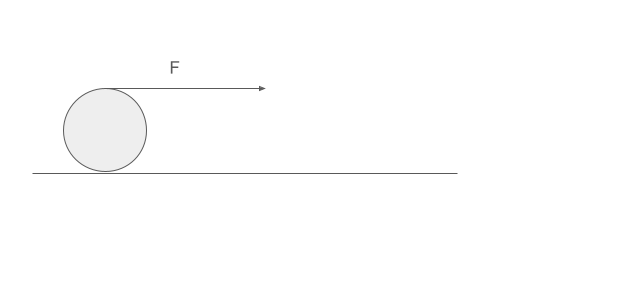
A 3kg disk with a radius of 0.7m is pulled to the right with a Force of 8N. Assume there is sufficient friction between the disk and the ground that it rolls without slipping.
Identify all of the forces and torques acting on the disk.
Identify the linear and angular acceleration of the disk.
Angular Work
Model
Explore
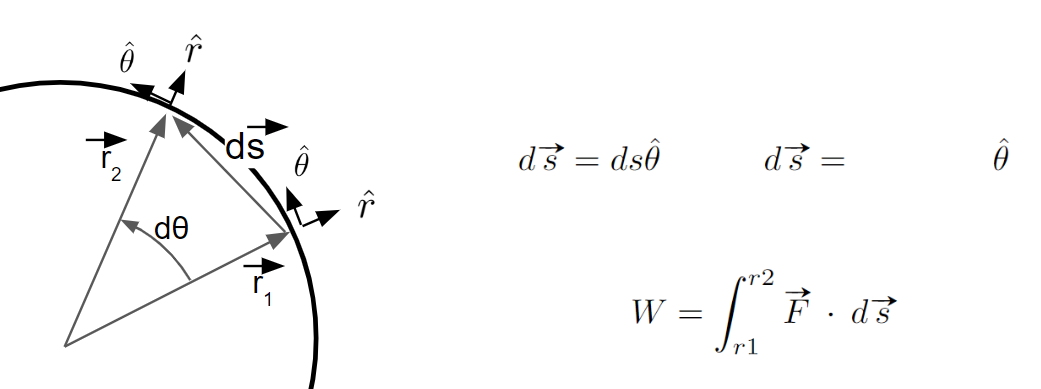
What direction, using cylindrical coordinate unit vectors, is the differential displacement ?
Is that displacement vector radial or tangential?
What angle does the displacement vector () make with a radial vector?
Critical Thinking & Concept Invention
|
What do the differential measurements represent? |
represents ... represents ... |
|
What is in cylindrical coordinates? |
|
|
Construct a new Work integral using your new version of . Be sure to identify what the new limits of integration should be. |
|
|
Examine the integrand (what is in the integral, not including the differential quantity). What other quantity does this resemble? |
|
|
Rewrite the Work integral with your response for the previous question written in as the integrand. |
This page titled 5.5: Rotational Dynamics was last modified on Fri, 06 Nov 2026 21:45:03 GMT and is shared under a CC BY 4.0 license and was authored, remixed, and/or curated by Andrew Totah-McCarty.
The book could not be loaded just now.