Opening the book…
Energy and Power Equations
 Model
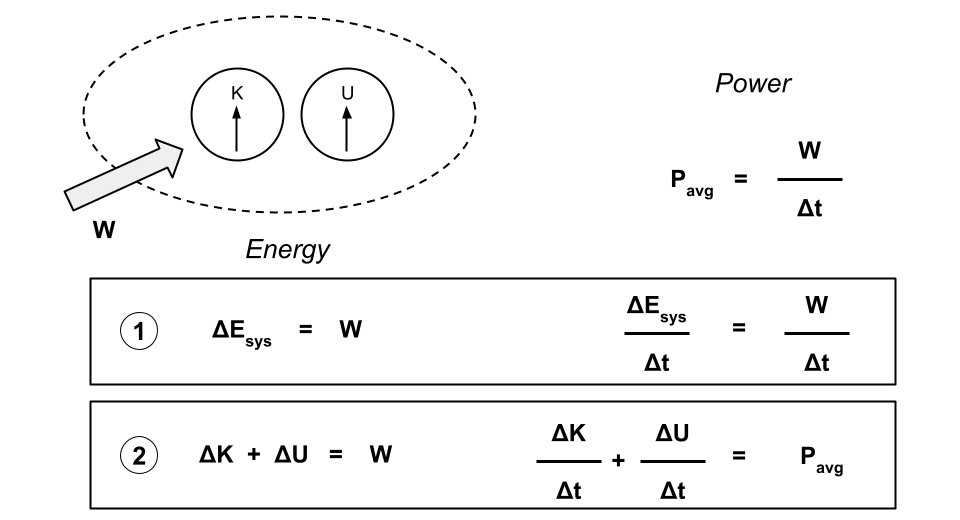
 Explore
What operation is performed on the energy equation to turn it into a power equation?
If the typical units for energy are Joules (J), what do you think the units are for power?
Do you think the equation in Box 1 is true for all scenarios or just this specific scenario shown by the Energy Interaction Diagram? Explain your thinking.
Do you think the equation in Box 2 is true for all scenarios or just this specific scenario shown by the Energy Interaction Diagram? Explain your thinking. Answer space
 Critical Thinking & Concept Invention
Is energy / Work normally associated with changes in position or changes in time?
Which new measurement (spatial or temporal) is incorporated into the power equation?
Why do you think the power equation is average power? What might we need to do to find instantaneous power? Answer space
 Summary
The rate that work is done, , is called Power. Power is represented by the variable P, and is typically measured in units of Watts (W) which are Joules per second ().
If power is constant, . Over any time-interval, which means that . This is a way you can use average (or constant) power in an energy equation.
 Apply
Find the average power applied to an elevator that lifts a 2500-kg load a height of 35.0 m in 12.0 s and also increases the speed from rest to 4.00 m/s in that time. Construct an energy equation, then turn it into a power equation.
Answer space
Linear Power
Model
| Integral Form | Differential Form | Rate of Change |
|---|---|---|
Explore
What quantities are the same and what quantities are different in the integral and differential forms of this equation?
What operation happens to the left side of the differential form of the equation to turn the equation into a rate? Perform that same operation to the right side and record your answer on the model after the equals sign.
Critical Thinking & Concept Invention
|
What is the differential ratio (fraction) that you just wrote above? What does the quantity represent? |
|
|
Rewrite the equation by substituting your response above in place of the differential ratio. |
|
|
Underneath the equation, write what the quantity on each side of the equation represents |
|
|
Interpret the sign. Under what conditions is this rate positive or negative? |
Summary
Work relates to Force through a spatial integral. Taking the derivative of that integral, we can relate force and Power.
The result of this vector dot product is a signed scalar quantity. It represents ...
Answer space
Apply
-
A girl pulls her 15-kg wagon along a flat sidewalk by applying a 10-N force at to the horizontal. Assume that friction is negligible and that the wagon starts from rest.
How much work does the girl do on the wagon after pulling it 3 meters?
What is the speed of the wagon when it has moved 3 meters from its initial position?
What is the instantaneous power the girl applies at the 3 meter mark?
-
A 750kg car is towed by a cable that is powered by an engine. The engine maintains a constant power of 1 horse-power (746 Watts). Assume the car starts at rest (). Identify the following:
What is the speed of the car after it is towed for 3 seconds? What is the instantaneous force on the car at the 3 second mark?
What is the speed of the car after it is towed 8 seconds? What is the instantaneous force on the car at the 8 second mark?
Identify the speed of the car as a function of time by following the same steps as before with .
Power as a Differential Equation
Model

Explore
What is the length of time for this timeline? How is that different than what we typically do for energy processes?
What energy is changing in the system?
What is different about how these energies are identified?
Is there work going into the system? What is different about how this work is labeled?
Critical Thinking & Concept Invention
|
Take the time derivatives (don’t forget the chain rule). Assume mass is constant with time. |
Answer space |
|
Separate the Variables: Move the ’s to the side of the equation with an explicit time-dependence |
|
|
Integrate both sides but only evaluate the integral on the left hand side. Use variables to make it a definite integral (eg, to ) |
|
|
Summarize the Separation of Variables process. Identify why it made sense which term has the or . |
Summary
When power is not constant, we need to use calculus to solve the energy-rate equation. When dealing with different variables, we use the separation of variables technique to connect variables with their differential quantities. This lets us take separate integrals for each term.
Apply
Let’s assume the power is a function of time given by the equation with A as a constant. Copy your equation from the critical thinking section, integrate power. Then determine the speed as a function of time (with some constants in the equation).
Angular Power
Model
Explore
How is this similar to the equation for differential work () for linear power? How is each variable shifted to represent angular motion?
What operation happens to the left side of the differential form of the equation to turn the equation into a rate? Perform that same operation to the right side and record your answer on the model after the equals sign.
Critical Thinking & Concept Invention
|
What is the differential ratio (fraction) that you just wrote on the right side of the equals sign in the model above? What does the quantity represent? |
|
|
Rewrite the equation by substituting your response above in place of the differential ratio. |
|
|
Underneath the equation, write what the quantity on each side of the equation represents |
|
|
Interpret the sign. Under what conditions is this rate positive or negative? |
Summary
Work relates to torque through an angular, spatial integral. Taking the derivative of that integral, we can relate torque and power.
Answer space
Apply
-
A playground merry-go-round has a radius of 2.2m and mass of 180kg. A child applies a force of 22N at the edge of the merry-go-round in a direction perpendicular to the radius.
Draw a picture of the scenario from above and label the Force and radius vectors. Choose and label a coordinate system.
Identify the torque on the merry-go-round
If the merry-go-round starts at rest, identify the angular velocity of the merry-go-round after pushing for 8 seconds.
Identify the power the child must exert at the 8-second mark.
A wind turbine rotates at 20 revolutions/min. If its power output is 2.0 MW, what is the torque produced on the turbine from the wind? Note: You will need to convert to radians per second and watts. The power output of the turbine must equal the power input from the wind.
This page titled 5.6: Power was last modified on Sun, 08 Nov 2026 22:46:39 GMT and is shared under a CC BY 4.0 license and was authored, remixed, and/or curated by Andrew Totah-McCarty.
The book could not be loaded just now.