Opening the book…
Acceleration Dynamics
Recall we learned about Newton’s Three Laws of Motion in our exploration of Momentum:
(1) In a closed system the momentum of a system does not change:
If then We can also say If then
(2) In a open system the rate that the momentum of a system changes is equal to the net external force:
(3) Impulse can be traded between objects. The impulse on one object is equal and opposite to the impulse on the other. Similarly, Forces are an interaction between two objects and each object experiences the same magnitude of force but in an opposite direction
In this section, we will explore these same laws in terms of accelerations, rather than momenta.
Acceleration
 Model
If we assume that the mass of the system is constant, then this can be written as...
Which can be rewritten as...
 Explore
What is different about the first two lines? What did the instructor do to each side of the equation?
What happened to mass from line 2 to line 3? Why is that allowed? Answer space
 Critical Thinking & Concept Invention
Annotate each step by describe the action taken and explain why that action is allowed.
Examine Newton’s 2nd Law at the top of the page. What can you write in place of . Right your answer on the left side of the equals sign for line 4.
What quantity have we learned about previously that is equatl to ? Right your answer on the right side of the equals sign for line 4.
Copy the final equation here. If this equation always true? If not, identify under what circumstances the equation is true. Hint: Look back over the derivation and search for any assumptions. Answer space
 Apply
-
A force with components and is applied to a box. Determine the acceleration () of the box if:
The mass of the box is 2kg
The mass of the box is 6kg
-
A car has an acceleration of and . Determine the net force () of the box if:
The mass of the box is 2kg
The mass of the box is 6kg
Answer space
Multiple Forces and Force Diagrams
Model
Explore
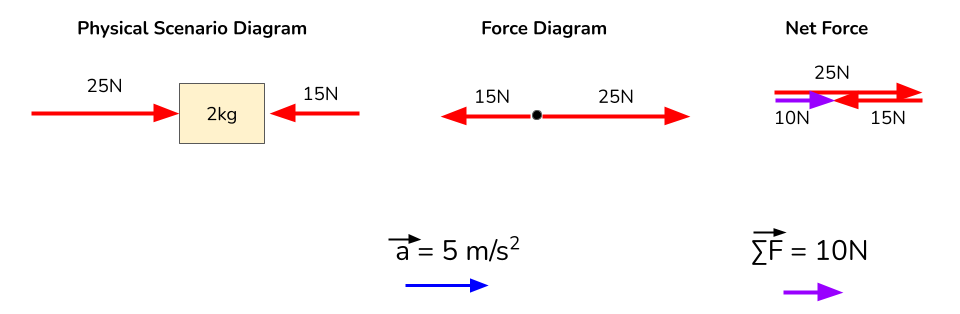
How are force vectors (arrows) arranged on a Force Diagram?
How are force vectors (arrows) arranged to determine the net Force()?
Is the net Force vector (arrow)( drawn on the force diagram?
How many forces are applied to the box? List their magnitudes and directions.
What is the acceleration () of the box? List the magnitude and direction. = to the
What is the net force () on the box? List the magnitude and direction = to the Answer space
Critical Thinking & Concept Invention
How is the net force determined from the other forces?
Which force vector is the acceleration based on? Answer space
Apply
Make a Force Diagram and determine the Net Force for this Physical Scenario Diagram by adding the vectors together graphically.

Answer space
 Summary
When there are multiple forces acting on an object, the acceleration is proportional to the net force. This gives the equation:
If we know the acceleration and instead want to determine the force, we can rearrange the equation to give us:
Interactions and Third Law Pairs
Model


Explore
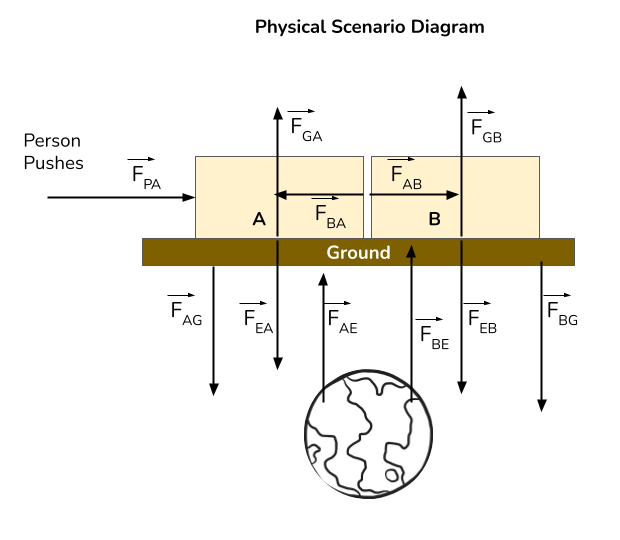
Identify groups of forces that all have the same magnitude. List them here.
Identify forces that have the same letters in the subscripts, but in different order. Draw a dashed line between those forces on the force diagrams and label those lines Third Law Pair
Compare the third law pairs: Do they have the same magnitude? Do they point in the same direction? Answer space
Circle external interaction lines as they cross the system boundary. Answer space
How many objects are in the system? List the objects.
Examine the force diagrams and make a big dashed box around the force diagrams for the objects that are a part of the system.
Critical Thinking & Concept Invention
Come up with a definition of a third law pair.
Are all pairs of forces with equal and opposite magnitude third law pairs? Explain why or why not and cite examples from the model.
Examine the OID. Do the lines between objects on the OID represent third law pairs? Explain your thinking.
Examine the force diagrams that are a part of the system. If you added all of them up, what would the net force () be? Draw just that vector and label it . Explain your reasoning how you determined this vector. Answer space
Stacked Books at Rest
Model

Explore
How many interactions does each object have? Book A: Book B: Book C: Table:
Are the objects accelerating or is the velocity not changing (ie, )?
Based on your answer, what should the net force be on each object?
Critical Thinking & Concept Invention
Which interaction (Force) do you have an equation to calculate the force magnitude for?
Which object will be easiest to model/calculate the forces for first? Why will that be an easier object to start with?
Construct a force diagram for each object. Be sure to identify third law pairs. Do not make a diagram for the Earth. Answer space
Construct a net force equation for each object. Calculate all forces.
Top Book
Middle Book
Bottom Book
Table
Stacked Books in an Elevator
Model

Explore
Are the objects accelerating or is the velocity not changing (ie, )?
Based on your answer, what should the net force be on each object? Book A: Book B: Book C: Table:
Critical Thinking & Concept Invention
Which interaction (Force) do you have an equation to calculate the force magnitude for?
Which object will be easiest to model/calculate the forces for first? Why will that be an easier object to start with?
Construct a force diagram for each object. Be sure to identify third law pairs. Do not make a diagram for the Earth. Answer space
Construct a net force equation for each object. Calculate all forces.
Top Book
Middle Book
Bottom Book
Table
Summary
Every object follows the Newton’s Second Law equation:
When we have multiple objects that interact, we can write a system of equations using this law:
Newton’s Third Law shows up across these equations and connects them:
By using what we know about the forces involved and/or the accelerations we can solve for unknown forces or accelerations across these equations.
This page titled 5.1: Acceleration Dynamics was last modified on Fri, 06 Nov 2026 00:14:43 GMT and is shared under a CC BY 4.0 license and was authored, remixed, and/or curated by Andrew Totah-McCarty.
The book could not be loaded just now.