Opening the book…
Please review the 3 tabs of information below, to help you distinguish among PREVENTION, INTERVENTION, and CONTROL.
 Roll over the tabs to view more information.
| Prevention | Intervention | Eradication |
|---|---|---|

The planning for and taking of action to prevent or forestall the occurrence of an undesireable event (like an outbreak of a communicable disease, or an increase in the prevalence of a chronic condition). Examples include promoting healthy eating through farmer's markets, school lunches and access to supermarkets. |

Efforts to control a disease in progress. Examples include working to reduce the spread of sexually-transmitted infections, screening for high blood pressure so cases can be referred for medical help, or assisting diabetics to make long-term changes to their diets. |
Efforts to control a disease in progress. Examples include working to reduce the spread of sexually-transmitted infections, screening for high blood pressure so cases can be referred for medical help, or assisting diabetics to make long-term changes to their diets. |
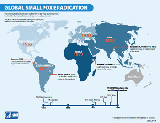
Eradication of diseases does not happen often. Eradication means that we have stamped out the disease completely. Small pox is the most famous case of eradication of a disease, and polio has been close to eradication several times. If a disease lives only in humans, as small pox does, there is a chance of eradicating it for good. When a disease has an animal reservoir -- for example, the Ebola virus that can live in bats and some other animals -- even when an epidemic is successfully overcome and no humans in that area have the disease, we can't say it is eradicated, since it's possible for it to jump from the animal species to the human species again. For this reason, I doubt that Covid-19 will ever be eradicted, although I do expect that the pandemic will end and the disease will be more easily controlled.
This page titled 5.16: Prevention, Intervention, Control, and Eradication of Diseases was last modified on Tue, 19 Aug 2025 21:43:34 GMT and is shared under a CC BY-NC-SA 4.0 license and was authored, remixed, and/or curated by Janey Skinner.
The book could not be loaded just now.