Opening the book…
1. Your instructor will have an apparatus set up by attaching rubber vacuum tubing from the side arm of a filtration flask to the vacuum pump. The vacuum tubing has thick walls to prevent its collapse.
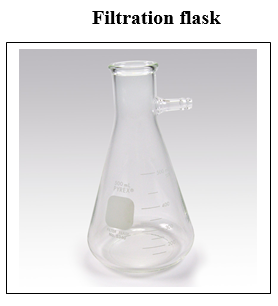
2. When you turn on the vacuum pump and place the palm of your hand on top of the flask, you should feel a strong suction due to the low pressure inside the suction flask if the vacuum pump is working properly.
3. Remove your hand and turn off the vacuum pump.
4. A small balloon is inflated to a size so that it can be placed inside the 250-ml suction flask. Place the stopper on the flask. Observe the behavior of the balloon in the flask while the vacuum pump is turned on.
5. Turn off the vacuum line. Detach the vacuum tubing from the vacuum line and allow air to enter the flask. Observe the behavior of the balloon.
6. Remove the balloon from the flask and place it in the beaker provided, Save the suction flask for the next set of students.
7. Answer questions a through c based on your observations in full sentences.
a. What happened to the balloon in the suction flask when you turned on the vacuum pump?
b. What happened to the balloon when you turned off the vacuum, detached the tubing, and increased the pressure in the flask?
c. Explain your observations in questions a and b using the appropriate gas law.
This page titled 12.4.1: Boyle’s Law- Volume-Pressure Relationship was last modified on Tue, 05 May 2026 19:31:39 GMT and is shared under a CC BY-NC 4.0 license and was authored, remixed, and/or curated by Deboleena Roy.
The book could not be loaded just now.