Theaetetus
by Plato
Translated by D. Burger
"Theaetetus" by Plato is a philosophical dialogue written in the early-middle 4th century BCE. In this foundational work of epistemology, Socrates questions the young mathematician Theaetetus about the nature of knowledge itself. They examine three definitions—knowledge as perception, as true judgment, and as true judgment with an account—but each proves unsatisfactory. The dialogue ends without resolution as Socrates departs to face trial for impiety, leaving the essential question unanswered.
Summary written by Project Gutenberg, by machine.
- Language
- Dutch (Nederlands)
- On Project Gutenberg since
- 12 November 2023
- Read in the last 30 days
- 323 times at Project Gutenberg
More by Plato
See all: More by Plato
The Republic of Plato
The works of Plato (Vol. 2 of 6)
The dialogues of Plato in five volumes, Vol. 2 (of 5)
The Project Gutenberg Works of Plato: An Index
De republiek van Plato
The works of Plato (Vol. 1 of 6)
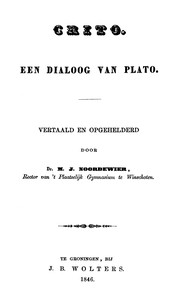
Crito: Een dialoog van Plato
The Republic
Apology
Symposium
Phaedrus
Phaedo

Gorgias
Euthyphro
Meno
Theaetetus
Laws
Timaeus
Apology, Crito, and Phaedo of Socrates