Window mode follows your eyes with your camera, in this browser only: no picture or position leaves your device.
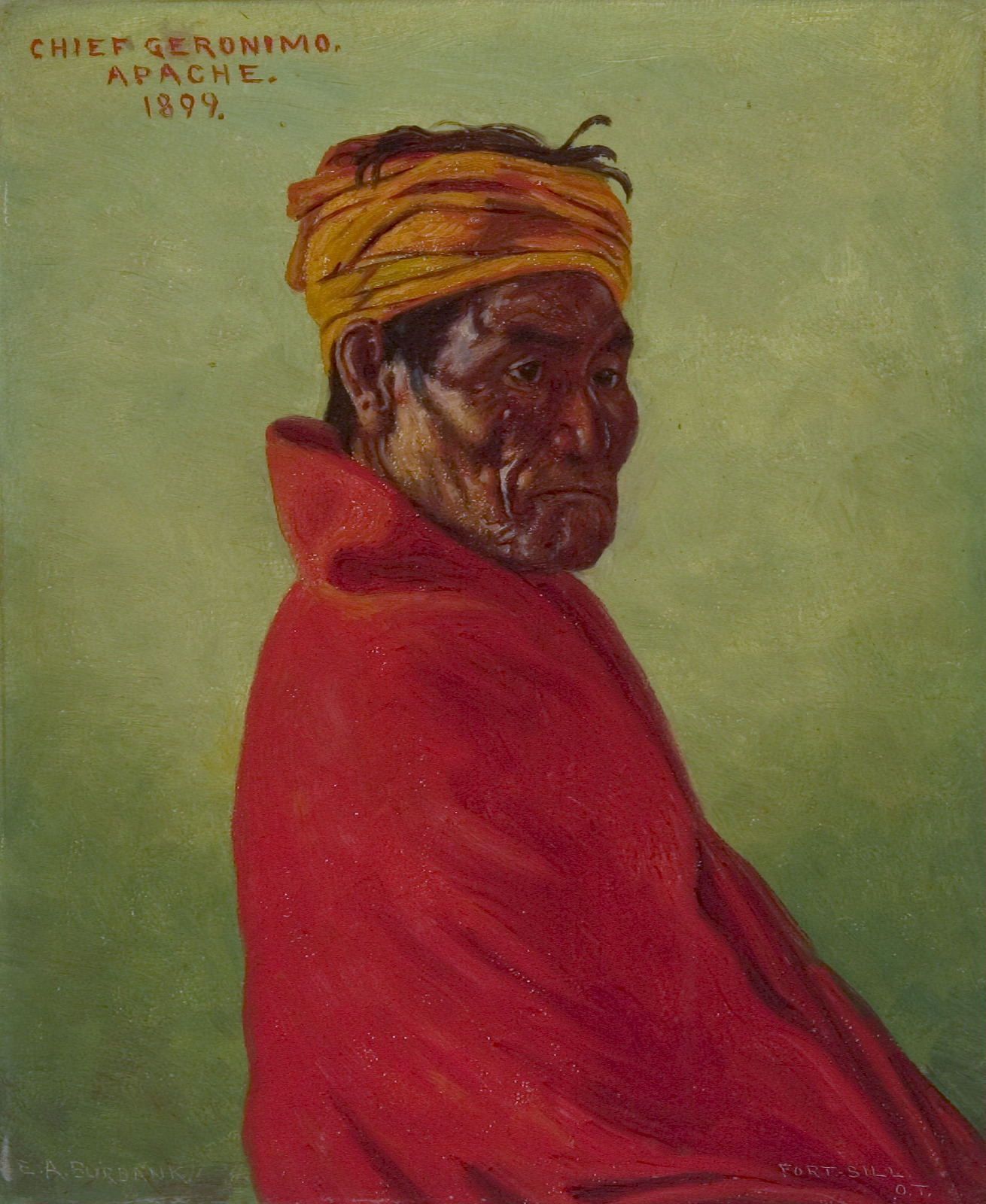
Geronimo
Elbridge Ayer Burbank (born Harvard, IL 1858-died San Francisco, CA 1949)
1899
- Medium
- oil on board
- Classification
- Paintings
- Dimensions
- 12 x 10 in. (30.4 x 25.4 cm)
- Culture
- Indians of North America
- Museum
- Smithsonian Institution, Smithsonian American Art Museum, Painting and Sculpture
- Credit line
- Smithsonian American Art Museum, Given in memory of Doris and James Snell, friends of the artist
- Rights
- CC0 (Smithsonian Open Access), as the museum states it.
- Who can see it
- Tweens profiles and older: its subjects are known and suit older children. How works are placed
View at the Smithsonian Institution
About this work
Geronimo was a medicine man and highly respected Apache leader who fought to protect his tribe from the government’s Indian policies. He avoided capture several times, but in 1886 he surrendered and was sent with other Apaches to a reservation at Fort Sill, Oklahoma. Thereafter, he served as a government scout, worked as a farmer, and joined the Dutch Reformed Church. He was a public figure who participated in Buffalo Bill’s Wild West touring show, Theodore Roosevelt’s inauguration, and the St. Louis World’s Fair. Elbridge Ayer Burbank’s uncle Edward Everett Ayer commissioned the artist to paint portraits of Native Americans, and Geronimo was his first subject. In this half-length painting, Burbank showed Geronimo in profile. The great Apache seems still to be on guard, turning warily to confront an approaching visitor. (Truettner, ed., The West As America: Reinterpreting Images of the Frontier, 1820-1920, 1991)