Window mode follows your eyes with your camera, in this browser only: no picture or position leaves your device.
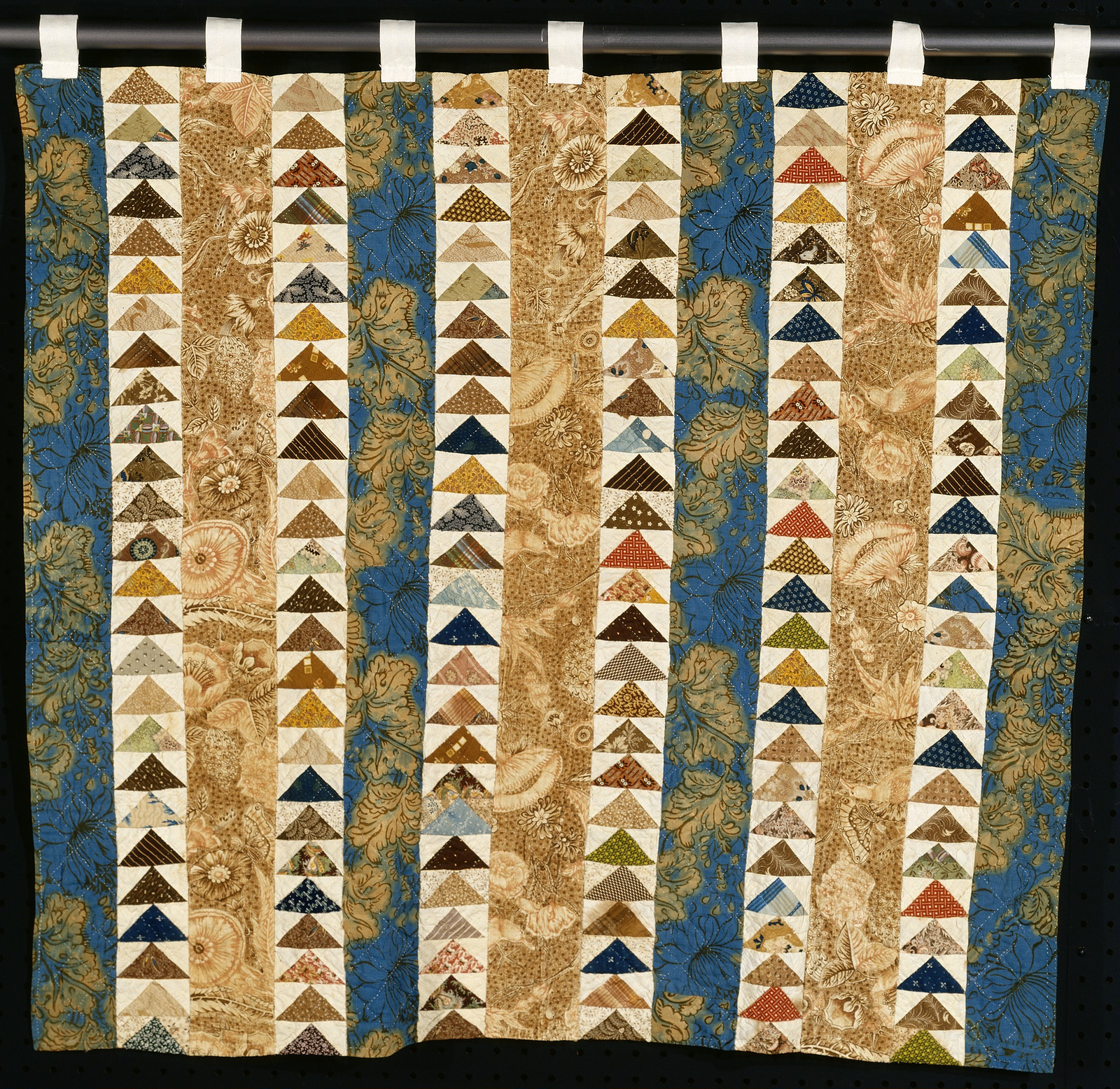
Flying Geese
ca. 1840
- Medium
- calicoes and furnishing fabrics
- Classification
- Quilts
- Dimensions
- 35 5/8 x 38 3/4 in. (90.5 x 98.3 cm)
- Museum
- Smithsonian Institution, Smithsonian American Art Museum, Renwick Gallery
- Credit line
- Smithsonian American Art Museum, Gift of Patricia S. Smith
- Rights
- CC0 (Smithsonian Open Access), as the museum states it.
- Who can see it
- Little Ones profiles and older: it shows gentle subjects for the very young. How works are placed
View at the Smithsonian Institution
About this work
Both Flying Geese and Honeycomb are examples of patterned American quilts made from luxurious samples of calicoes and chintzes imported from France and England. Calico cotton fabrics, used primarily for dressmaking, were printed with small, repeated patterns of floral or abstract designs; chintz was a glazed cotton cloth printed with large, single-colored designs of flowers and birds. These elaborately painted fabrics originally came from India, but by the mid-1700s printing methods had been developed in England and France to replicate the Indian technique of hand painting. Flying Geese is a reversible quilt, created for a child’s bed. The triangle “geese” on the front are composed of English calicoes, and the back is an arrangement of pieced blocks and stripes. In Honeycomb, hexagonal floral calicoes have been combined with solid colors and a chintz border to create a dramatic geometric design.