Window mode follows your eyes with your camera, in this browser only: no picture or position leaves your device.
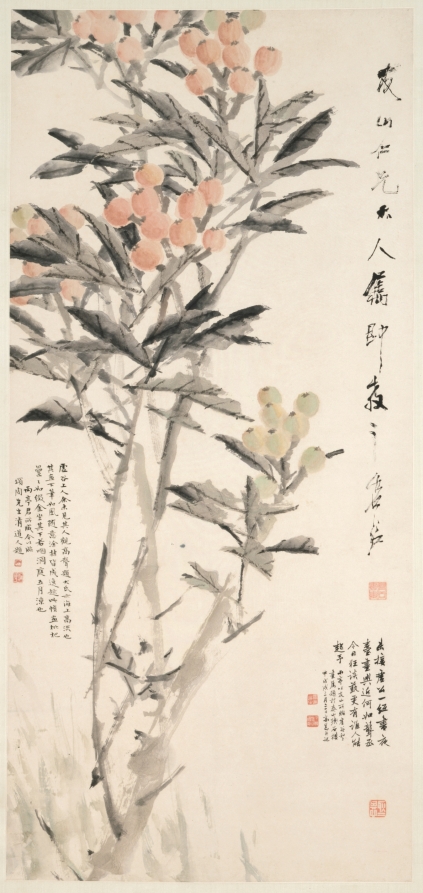
Pipa (Loquats)
Xugu (Chinese, 1823–1896)
c. 1888–89
- Medium
- Hanging scroll; ink and color on paper
- Classification
- Painting
- Dimensions
- Painting: 112.6 x 52.2 cm (44 5/16 x 20 9/16 in.); Overall (no knobs): 231 x 70.5 cm (90 15/16 x 27 3/4 in.)
- Culture
- China, Yangzhou, Qing dynasty (1644–1911)
- Museum
- Cleveland Museum of Art, Chinese Art
- Credit line
- John L. Severance Fund
- Rights
- Public domain (CC0), as the museum states it.
- Who can see it
- Teens profiles and older: its museum says too little about what it shows to place it for younger viewers. How works are placed
View at the Cleveland Museum of Art
About this work
The loquat is a plant native to China that produces a juicy, yellow fruit in early summer. The artist may have intentionally extended the branches beyond the paper to emphasize the abundance of fruit. Xugu’s subjects of flowers, goldfish, and loquats express wishes for abundance and wealth, and must have appealed to his patrons.
Xugu gave up his career as a military official during the Taiping rebellion (1850–64) and became an itinerant monk who painted for a living. He spent the later years of his life in Shanghai and his fame as an artist is associated with that city.