Window mode follows your eyes with your camera, in this browser only: no picture or position leaves your device.
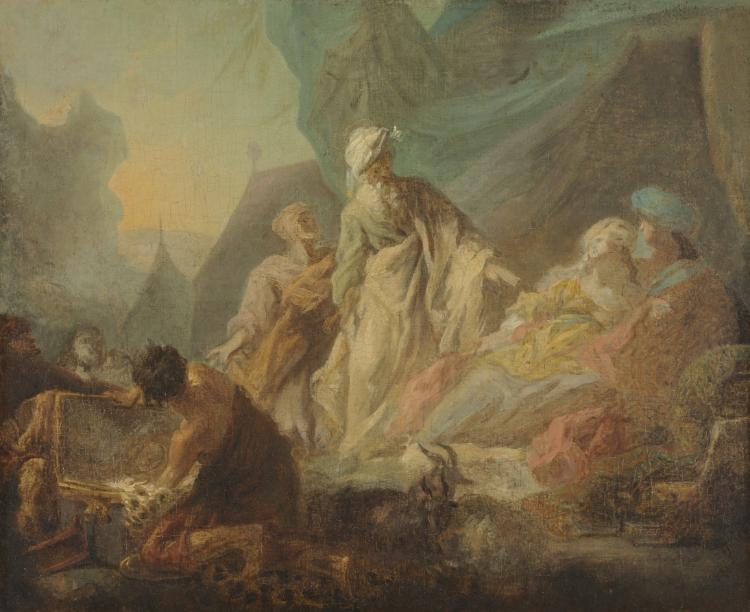
Laban Searching for His Stolen Gods
Augustin de Saint-Aubin (French, 1736–1807)
1753
- Medium
- oil on canvas
- Classification
- Painting
- Dimensions
- Framed: 62 x 72 x 7.5 cm (24 7/16 x 28 3/8 x 2 15/16 in.); Unframed: 45.6 x 57.3 cm (17 15/16 x 22 9/16 in.)
- Culture
- France
- Museum
- Cleveland Museum of Art, European Painting and Sculpture
- Credit line
- Gift of Ruth and Sherman E. Lee in memory of their parents, George B. and Inez W. Ward, and Emery and Adelia Lee
- Rights
- Public domain (CC0), as the museum states it.
- Who can see it
- Teens profiles and older: its subject is for older viewers (war, death, the Passion, drink or the like). How works are placed
View at the Cleveland Museum of Art
About this work
This painting is a sketch for a special competition in 1753 held by the Royal Academy in Paris. After the Grand Prix de Rome, the academy's top student prize, an unexpected vacancy in the school's branch in Rome required the academy to hold another contest. Saint-Aubin's oil sketch was well received and he won first place among three finalists. However, his final canvas, now in the Louvre, failed to garner him this distinguished award. Saint-Aubin eventually abandoned his goal of becoming a member of the Royal Academy and joined the less-prestigious Academy of St. Luke. The subject of Saint-Aubin's sketch, selected by the academy, comes from the Old Testament book of Genesis (31:33–35). After toiling for Laban for 14 years, Jacob fled with his wife, Rachel, who was also Laban's daughter. Unbeknownst to Jacob, Rachel had stolen her father's idols before their departure to secure her right to her first born. Laban tracks down Jacob and Rachel and accuses them of carrying off his idols. Jacob is still unaware of Rachel's previous actions, and she has hidden the gods under a camel saddle on which she sits.